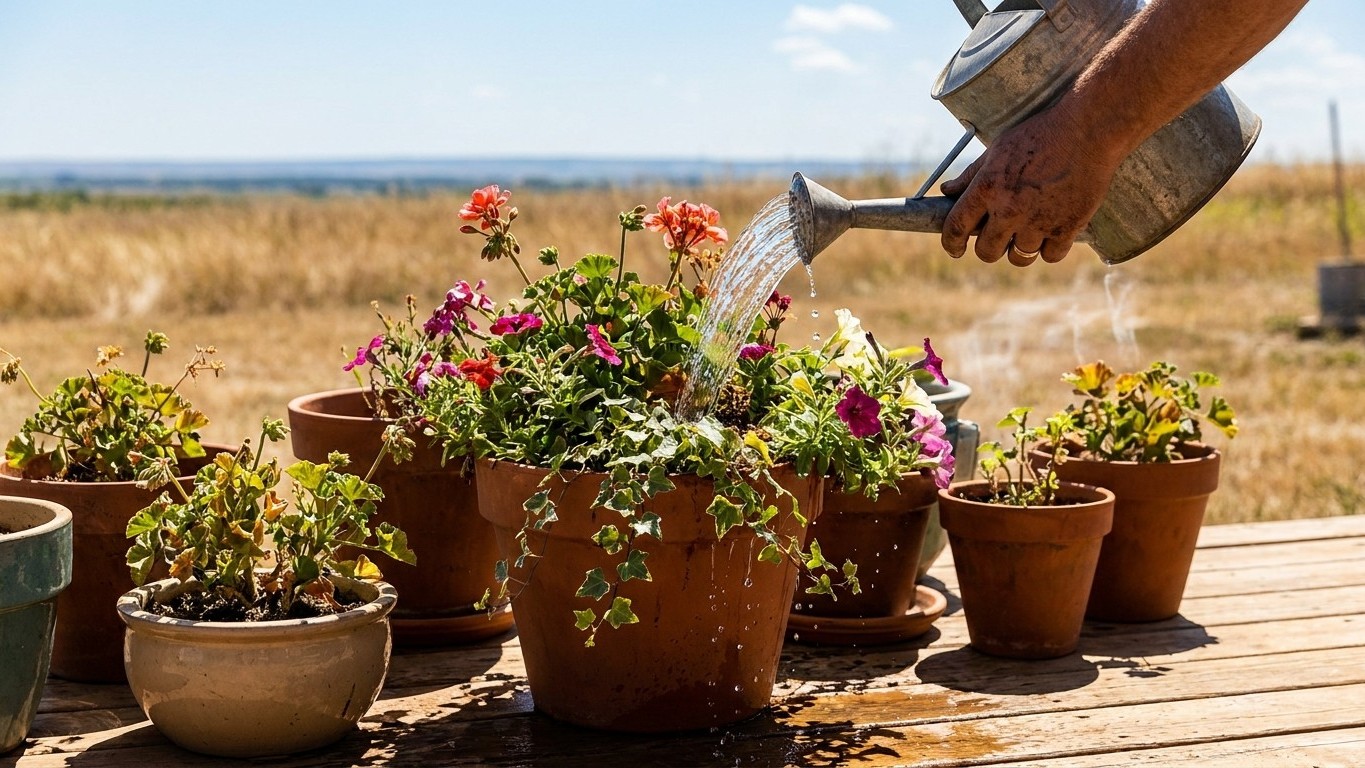

Containers dry out faster than garden beds no matter where you live, but North Dakota’s dry Augusts and double-digit stretches of 90-degree days push that timeline hard. The short answer: check pots daily during summer, water until it drains from the bottom, and don’t count on rain to do the job for you.
What changes here

Two numbers set the terms for anyone watering pots in this state. August, the driest summer month, averages 2.6 inches of rain. The state’s reference station also logs 11.7 days a year at or above 90 degrees. Put together, that’s a summer where the sky delivers little water right when heat is pulling the most moisture out of a container.
Do the arithmetic and it gets concrete. A garden bed wants roughly an inch of water a week. August’s 2.6 inches, spread across the month’s roughly 4.4 weeks, works out to about 0.59 inch of rain a week from the sky. That leaves a gap of around 0.4 inch a week that has to come from a hose or watering can, and that’s for ground soil with some capacity to hold moisture between rains.
Containers don’t get that benefit. Potting mix in a pot has no surrounding soil mass to draw from, and it’s exposed to sun and wind on every side, not just the top. A terracotta or unglazed pot loses even more through its walls. So the 0.4-inch weekly shortfall calculated for a garden bed understates what a container actually needs; pots routinely need watering several times a week in August, and small pots (under a gallon) may need it daily once the mercury climbs toward that 90-degree mark.
None of this is a forecast for any single yard. These are 1991-2020 normals from one reference station, and a patio that bakes in full afternoon sun will run drier than these averages suggest, while a shaded porch will run wetter. A finger in the pot, not the almanac, is what tells you when to water on any given day.
How to water when it matters
The method that works in this climate isn’t complicated, but the reasoning behind it matters as much as the steps. Deep watering pushes moisture down through the entire root ball instead of just wetting the surface, which trains roots to grow down and out rather than staying shallow where heat and evaporation reach them first. Morning watering gives the plant several hours to absorb what it needs before the day’s heat and any afternoon wind pull moisture back out. Watering at the base, rather than overhead, keeps water where roots can use it instead of losing a share to evaporation off leaves before it ever reaches the soil.
Checking moisture at root depth, not just the surface, is the part most people skip. A container’s top inch can look bone dry while the middle is still damp, or the reverse, especially in a compacted mix. A finger pushed two inches into the pot, or a wooden chopstick or moisture meter for taller containers, tells you what’s actually happening at the roots rather than what the surface color suggests.
- Push a finger two inches into the potting mix; if it comes out dry, water that day, if it’s still damp, wait.
- Water slowly at the base until liquid runs from the drainage holes, which signals the whole root ball has been reached, not just the top layer.
- Water in the early morning, before the day’s heat and any wind start pulling moisture back out of the mix.
- On days forecast above 90 degrees, recheck by early afternoon; small pots under a gallon can dry out again within hours.
- Empty saucers after watering so roots aren’t sitting in standing water for more than an hour or two.
Treat that as a starting sequence, not a fixed rule. A glazed ceramic pot in shade holds water far longer than an unglazed terracotta pot in full sun, and mix that’s gone hydrophobic (water beading and running off instead of soaking in) needs a slower pour or a brief soak in a basin to rewet properly.
What goes wrong
“I water a little every day, just to be safe.”
Frequent shallow watering wets only the top inch or two of mix, which is exactly where surface roots form. Those roots then sit in the hottest, most exposed part of the container and are the first to scorch during one of this state’s 90-degree stretches. Deep, less frequent watering is what actually protects the plant.
“It rained yesterday, so I skipped watering.”
A summer thunderstorm can drop a heavy burst of rain that mostly runs off a container’s mix or off nearby foliage rather than soaking in, especially if the mix has dried and pulled away from the pot’s edges. Checking with a finger after a storm, rather than assuming the pot is covered, catches this before the plant wilts.
“I water in the evening so it’s not so hot on the plant.”
Evening watering leaves leaves and the mix surface wet overnight, and that prolonged dampness is exactly the condition fungal diseases need to take hold. Morning watering lets everything dry by nightfall.
“I skipped mulch, it’s just a pot.”
A bare mix surface loses moisture straight to sun and wind with nothing slowing it down. A thin layer of bark mulch or even gravel on top of container mix cuts evaporation and stretches the time between waterings, which matters most during the 11.7 days a year this state sees 90-degree heat.
Local help
For guidance suited to specific plants and soils in this state, North Dakota State University Extension is the primary resource. Watering restrictions during dry stretches vary by city and water district and change from year to year, so check current rules with your local water provider before setting an outdoor watering schedule.
Common questions
How often should I water container plants during a North Dakota summer?
Check daily once temperatures approach 90 degrees; small pots often need water every day or two during August, while larger containers may stretch to every third day depending on sun exposure and pot material.
Does rain mean I can skip watering my pots?
Not automatically. August’s average of 2.6 inches often falls in a few heavy bursts that run off a dry mix rather than soaking in, so check moisture at root depth with a finger before deciding to skip.
What container material holds moisture best in this climate?
Glazed ceramic and plastic pots retain moisture longer than unglazed terracotta, which loses water through its porous walls in addition to the surface, a real difference during the state’s dry, hot summer stretches.
Is morning or evening better for watering pots here?
Morning. It lets plants take up water before peak afternoon heat and lets any wet leaves or surface mix dry out before nightfall, lowering the risk of fungal problems overnight.