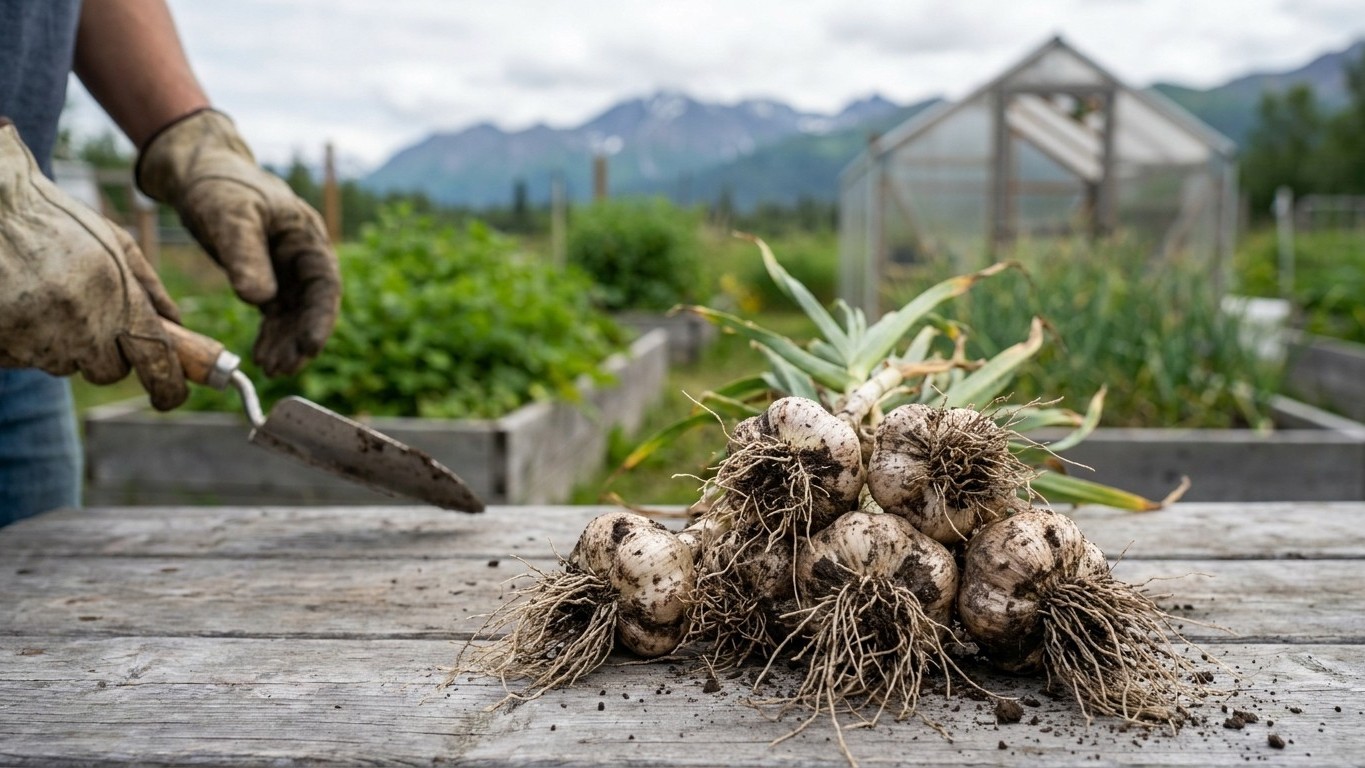

Six to eight weeks of soil under 40°F is all a garlic clove needs to split into a proper head instead of coming up as one solid, undivided bulb — and that’s the one number this state stops arguing about. Anchorage’s frost-free stretch runs about 143 days a year, which leaves roughly seven months of cold on the other side, deep into subzero across most of Alaska. So the vernalization question, the one that has warm-state growers refrigerating cloves before planting, is already answered here by the ground itself.
Will garlic get the cold it needs in Alaska

Garlic is an annual trick played on a perennial mechanism. A clove needs a stretch of real cold after it goes in the ground, or it never splits into separate cloves the following summer. Skip that cold and you don’t lift a head of garlic. You lift one round, undivided bulb, the same shape as the clove you planted, and it happens more often than beginners expect.
University of Georgia Extension publication C854 sets the requirement at six to eight weeks with soil temperatures under 40°F. That figure comes out of a warm state trying to fake a winter it doesn’t reliably get. Alaska has the opposite problem. With NOAA’s 1991-2020 normals putting the Anchorage growing season at around 143 frost-free days, the cold season on the other side of that line runs close to seven months, deep into subzero territory across much of the state. Alaska clears the six to eight week chilling requirement by a wide margin, everywhere from the coast to the Interior, which is the one part of this crop the climate here does not complicate.
That doesn’t mean the chilling clock stops mattering once you’re past the “is there enough cold” question. It explains why gardeners in mild-winter states have to fake vernalization by refrigerating cloves for six to eight weeks before planting, and it explains why hardneck types, which want a harder winter, sulk in those climates while softnecks shrug it off. Keep that logic in mind if you ever start cloves indoors, store seed stock in a heated garage over winter, or plant late into ground that’s already frozen solid: a clove that never gets its cold, wherever it sits, still won’t divide. The fix if you ever find yourself short on natural cold is one of two things: refrigerate the cloves before planting, or plant a softneck, which needs less chilling to begin with. In most of Alaska you won’t need either option, but it’s worth knowing they exist rather than concluding the crop is off the table.
Gardeners working through the same question in other cold-winter growing regions, including Alberta, land on the same answer for the same reason: enough winter is rarely the problem in these climates. Once vernalization is settled, what actually matters is choosing Garlic Varieties That Suit Alaska Winters and knowing When to Plant Garlic in Alaska.
When to put the cloves in
Garlic planted in fall needs enough time in unfrozen soil to grow roots before the ground locks up, but not so much time that it pushes a lot of top growth that then gets hammered by the first hard freeze. That balance is what sets the planting window, and in Alaska it has to be read off the fall freeze date rather than off a calendar month.
NOAA’s 1991-2020 Climate Normals put the first fall freeze at the Anchorage station somewhere between September 22 and October 1, a nine-day spread rather than a single date. Split that range and the midpoint lands around September 26 or 27. Treat that midpoint as a planning anchor, not a promise: the actual freeze in any given year can arrive more than a week to either side of it, and a station reading from Anchorage doesn’t describe the Interior, the North Slope, or the coast, all of which run on their own schedules.
Counting back from that midpoint, most Anchorage-area gardeners are setting cloves in the ground roughly three to four weeks ahead of it, which puts actual planting in early to mid September for that specific location. Don’t wait for visible ground frost to decide you’re behind, because roots need those three to four weeks in soil that’s still workable, not soil that’s already stiffening. Elevation moves this earlier: a garden a few hundred feet higher than the valley floor cools sooner than the reference station does. A large lake or the open coast moves it the other way, holding warmth into the soil longer than an inland site at the same latitude. If you garden well outside the Anchorage area, particularly in the Interior, expect the whole window to shift earlier and to compress, since the frost-free season there runs shorter than the 143 days NOAA records at Anchorage.
Which types suit Alaska
Hardneck or softneck isn’t a matter of taste in this state, it’s a matter of winter, and Alaska’s winter answers the question for you. Hardneck garlic wants the hard chilling this climate delivers in abundance, and it rewards you with a stiff central scape, big and easy-to-peel cloves, and the more complex flavor most cooks reach for first. Softneck garlic tolerates milder winters and, in exchange for asking less of the cold, stores for months longer in a pantry.
Hardneck: the default choice
Given how comfortably this territory clears the chilling requirement covered above, hardneck is the type to plant first here. From the cultivars grown and sold as hardneck types, German White and German Red are classic porcelain-type garlics, with big, easy cloves and reliable vigor. Chesnok Red and Duganski are purple stripe types, often picked for cooking quality and a milder bake. Georgian Crystal, Georgian Fire, Music-type Blue Music, Fall Festival and Ivan round out the porcelain and purple stripe types worth trying in a first planting, and Bavarian Purple is a rocambole, the subtype most associated with intense, sharp raw flavor.
Softneck: worth it for storage
Softneck cultivars in this list, Early Red Italian, Inchelium Red, Italian Late and Lorz Italian, are artichoke types. They ask less of winter cold and, because they don’t put energy into a scape, tend to store considerably longer than hardnecks once cured. Softneck earns a spot in an Alaska garden mainly if long storage matters more to you than the strongest flavor, or if you want a backup type in case a hard early freeze catches a late planting before it’s fully rooted.
All of the varieties above are planted the same way here: cloves set out in early autumn, ahead of the ground freezing, the same window covered in the section above.
Soil and bed preparation
Drainage first
Garlic sits in that bed through the entire winter and into next summer, and it rots from standing water long before any disease organism gets involved. Never plant garlic into a bed that still holds water an hour after a hard rain. Alaska’s mineral soils, especially anywhere near glacial silt, drain slowly and hold cold, wet pockets right where a clove needs to be growing roots in early fall. Raised beds solve two problems at once here: they drain faster than a flat bed, and the soil in them warms and cools sooner, which matters for both rooting in fall and for early growth once the snow is gone.
Feeding the bed before planting
Work compost or well-rotted manure into the bed weeks before you plant, not the same week, so it has time to settle rather than sitting fresh against the cloves. Fresh, undecomposed manure right at planting time invites rot in exactly the season the clove can least afford it. Break up any compacted layer to a full spade’s depth, since garlic roots run deep for a bulb crop and a hardpan a few inches down will stunt the whole plant even if the surface looks fine. If you’re planting into a bed that grew onions, garlic, leeks or shallots in recent years, move this year’s garlic to different ground if you have the space, since those crops share pests and pathogens and repeated planting in the same soil builds up whatever is already there.
What the climate here favours, and what it does not
UC IPM’s Pest Management Guidelines for onion and garlic, UC ANR Publication 3453, publish the temperature ranges several major garlic diseases need to become active. Running Anchorage’s monthly mean air temperatures against those published ranges gives a rough read on which diseases this climate tends to favor and which it doesn’t, not a forecast of what will or won’t show up in a given garden.
White rot, caused by the fungus Sclerotium cepivorum, has a published range of 50 to 75°F, and Anchorage’s mean air temperatures fall inside that range in two months of the growing season, June and July. That makes white rot the one disease this climate actually leans toward, and it’s also the most serious of the four, since its resting structures can persist in soil for years once established. Fusarium basal rot needs 59 to 90°F and no month at Anchorage reaches into that range on average. Southern blight has a published optimum of 86 to 95°F and pink root an optimum of 75 to 85°F; no Anchorage month averages anywhere near either one.
Three qualifications matter more than the numbers themselves. The published thresholds are soil temperatures, while the figures compared here are air temperatures, and soil lags air by weeks and swings far less, so a warm June doesn’t mean garlic-bed soil is sitting at that same reading. A monthly average is not a month spent inside that range either: a June averaging 55°F still has days well above and below it. And Anchorage is one station in a very large state, milder than most of the Interior and colder than parts of the Southeast coast, so treat this as a general tendency for the region around that station, not a rule for wherever you actually garden. None of this means the diseases outside their listed range can’t occur. Infected planting stock carries all four of these pathogens into a garden regardless of what the thermometer says, which is the real argument for starting with certified, disease-free seed garlic rather than grocery-store cloves of unknown origin.
Getting it through the winter
A cold-climate garlic bed and a mild-climate one are managed almost opposite from each other once the cloves are in the ground, and Alaska sits firmly on the cold-climate side of that line. Once the soil starts to chill down toward freezing, lay on a thick mulch of straw or chopped leaves, deep enough that you can’t see soil through it anywhere in the bed. That layer isn’t there to keep the clove warm exactly. It’s there to keep the soil temperature steady rather than swinging through repeated freeze-thaw cycles.
Frost heave, not the cold itself, is what kills the most cloves over an Alaska winter. A freeze-thaw cycle lifts the soil and can push a shallow-planted clove partway or all the way out of the ground, where it desiccates or freezes outright with no soil around it. Planting a bit deeper than you would in a milder state, and mulching heavily before the ground locks up, are the two real defenses against it. Snow cover, once it arrives and stays, does more insulating work than any mulch layer, so a mulch applied before the first reliable snowfall is doing the job the snow will later take over.
Leave the mulch alone through the shoulder season and don’t pull it back at the first mild day in spring. An early thaw followed by another freeze is exactly the freeze-thaw cycle that causes heaving, and a bed you’ve already uncovered has lost its buffer against it. Wait until you see new green growth pushing up through the mulch with real vigor before you start easing it back. Growers working a maritime, snow-insulated climate like Newfoundland and Labrador handle this differently again, since their winters buffer soil temperature in a way an Interior Alaska winter doesn’t, which is a useful reminder that winter garlic protection is a local decision, not a fixed recipe.
Harvest and curing here
Pull garlic by what the plant is telling you, not by a date on the calendar. When the lower leaves have browned and dried back while a good number of upper leaves are still green, the bulb has stopped adding size and it’s time to lift. Pull a test bulb or two and check that the cloves have separated and the wrapper skins are intact before you dig the whole row. Waiting too long past that point risks the wrappers splitting underground, which ruins the bulb for storage even though it’s still perfectly edible.
Don’t wash the bulbs before curing. Brush off loose soil by hand and leave the roots and tops attached. Curing is where a lot of Alaska-grown garlic gets lost after a perfectly good harvest, because a cool, often damp summer climate doesn’t dry bulbs the way a hot, arid one does. Bulbs left to cure outside under a tarp in humid conditions are prone to mold before they’ve finished drying down. Cure indoors instead, somewhere shaded with air actively moving over the bulbs, a box fan on low pointed across a drying rack works well, and give it real time, generally several weeks, rather than judging by how the outside of the bulb looks after a few days. Once the outer wrappers are papery and the neck is tight and dry, trim the roots and tops and move the bulbs to storage.
Local help
County-level planting dates, frost data for your specific area, and soil testing all fall outside what a single Anchorage-based figure can tell you. Contact the University of Alaska Fairbanks Cooperative Extension Service before you finalize a planting date or amend a bed, since they can give guidance tied to your actual location. Find your local office through the UAF Cooperative Extension Service directory.
Common questions
Can I Plant Garlic in spring instead of fall in Alaska?
You can, but expect smaller bulbs, since spring-planted garlic misses most of the natural chilling period this article covers and skips the fall root-establishment window entirely. If you have to plant in spring, pre-chilling cloves in a refrigerator for several weeks beforehand gets you closer to the vernalization a fall planting gets for free.
Can I just replant garlic I bought at the grocery store?
You can try it, but it’s a gamble on two fronts. Grocery garlic is often a variety chosen for shipping and shelf life rather than for a short, cold-anchored season, and it isn’t certified disease-free, so you risk introducing white rot or another soil-borne pathogen into a bed you’ll be using for garlic for years to come.
Should I cut off the garlic scape?
Yes, on hardneck plants. The scape is the curling flower stalk hardnecks send up in early summer, and cutting it while it’s still tender redirects the plant’s energy into bulb size rather than into that stalk. Softneck varieties don’t produce a scape at all, which is one more reason they’re a simpler crop for a first attempt.
Can I grow garlic in a raised bed or container above ground?
A raised bed works well and is often the better choice here for drainage, as covered above. A container is riskier over an Alaska winter specifically, because the soil in a pot above ground freezes harder and faster than soil in the ground, with far less insulating mass around the cloves. If you use a container, bury it to its rim in the garden bed or bank mulch heavily around its sides, not just on top.
Is Anchorage’s frost data close enough for the rest of the state?
Not necessarily. The NOAA figures come from a single station near Anchorage, one of the milder and longer-season parts of an enormous state. The Interior runs a shorter frost-free season with a harder winter, and the coast and Southeast run milder than Anchorage in places. Use the reasoning here, chilling requirement, freeze-relative planting window, drainage and mulch, but check your own area’s dates with the extension service before you commit to a date.