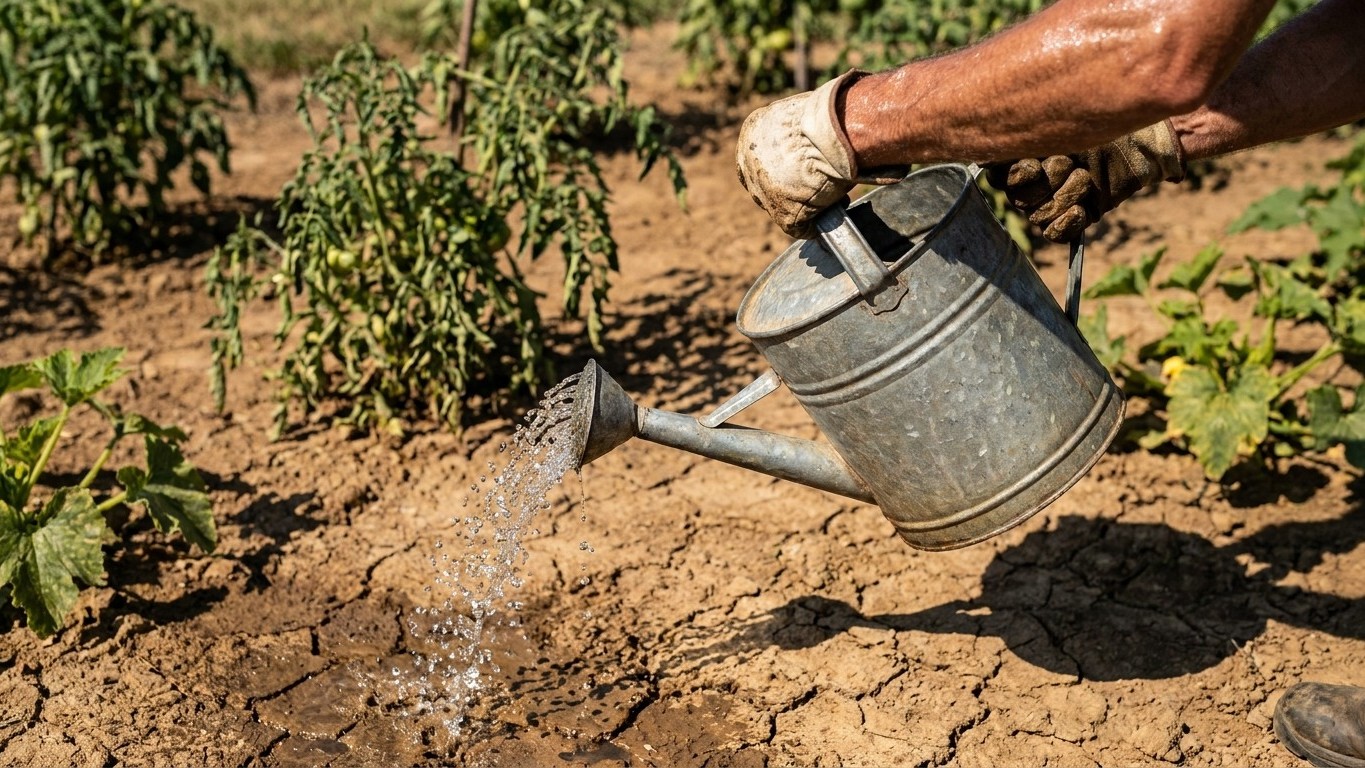

West Virginia gardens need about an inch of water a week through the growing season, but August rainfall alone covers only part of that, and with 16 days a year hitting 90F, the gap between what falls and what a bed actually needs is where most watering decisions in this state get made.
What changes here

Two numbers set the terms for watering in West Virginia: 3.75 inches of rain in August, the driest summer month, and 16.0 days a year that reach 90F or higher. Together they mean the driest stretch of the season is also the hottest, so the weeks when a garden gets the least help from the sky are the same weeks it’s losing the most moisture to heat and evaporation.
Do the arithmetic on that August figure and it gets concrete. Spread 3.75 inches evenly across August’s roughly 4.43 weeks (31 days divided by 7) and the sky delivers about 0.85 inch of water in an average week. A bed asking for the standard rule of thumb, roughly an inch a week, is short by about 0.15 inch that week, and that’s before accounting for the fact that August rain in this state rarely falls evenly. A single thunderstorm can dump most of a week’s allotment in twenty minutes, with the rest of the week bone dry, which changes how a gardener should read that 0.85-inch average.
June and July run wetter, 4.72 and 5.38 inches respectively, part of a summer total of about 13.8 inches against a yearly 46.2 inches. That’s a state where rain is not scarce overall, it’s just badly timed relative to the heat. The 16 days above 90F don’t cluster neatly in August either; they can show up in July and push demand higher in a month that already has the most rain to offer, which is why watching the calendar alone won’t tell a gardener when to turn on the hose.
Soil texture is what turns that same inch of water into either a resource or a runoff problem. Sandy soil lets water drain through within a day, so a garden on sandy ground in a low-rain month like August needs shorter, more frequent watering to make up the difference the sky isn’t providing. Heavy clay holds water for a week or more, which sounds like an advantage during a dry August until it rains on top of already-saturated clay and roots start to suffocate. Knowing which one is under a given bed matters more here than the rainfall total itself.
How to water when it matters
The method that works in West Virginia is deep and infrequent, delivered at the base of the plant, in the morning. Deep watering pushes moisture down to where roots actually live, six to eight inches for most vegetables and perennials, training the plant to grow roots downward instead of clustering near the surface where an August afternoon can bake them dry within hours. Watering at the base instead of overhead means the moisture goes where it’s used instead of evaporating off leaves before it reaches soil, which matters more on the 16 days a year the state hits 90F. Morning watering gives the plant hours to take up water before the heat of the day starts pulling it back out through the leaves, and it lets any moisture that lands on foliage dry off long before evening.
Checking soil at root depth, not just the surface, is what separates a garden that thrives in August from one that quietly stresses. The top inch of soil can look and feel dry within hours of watering even when the roots below are still well supplied, and the reverse happens too, a crusty dry surface over moist soil that doesn’t need water yet.
- Push a finger or a garden trowel two inches into the soil near the base of the plant; if it’s dry at that depth, it’s time to water, if it’s still cool and moist, wait another day.
- On sandy soil, water more often but in shorter sessions, roughly every three to four days during August, since sand won’t hold a full week’s supply.
- On heavy clay, water less often but let it soak in fully, aiming for about once a week and always checking that the previous watering has actually dried down before adding more.
- Apply water slowly at the base until it’s moved past the two-inch check point, then stop; a good starting point is roughly 1 inch of water delivered over the week, adjusted up or down based on what the finger test shows on that specific bed.
- Re-check two to three days after any watering session rather than assuming the job is done for the week, especially during the stretch of days that hit 90F.
That one-inch figure is a starting point, not a rule. The only way to know if it’s right for a particular yard is to check the soil itself, because a shaded clay bed and a sun-baked sandy strip along a driveway can need very different amounts even sitting ten feet apart.
What goes wrong
“I water a little every day, just to be safe.”
A daily sprinkle wets the top inch of soil and nothing more, which trains roots to stay shallow, right where an August afternoon at 90F can dry them out fastest. Deep, infrequent watering builds a root system that can reach moisture lower down; daily light watering builds one that can’t survive a hot week without help.
“I water in the evening so it doesn’t evaporate.”
Evening watering feels efficient because less is lost to daytime heat, but it leaves foliage wet all night. Combined with the humidity that often follows a summer rain in this state, that’s exactly the window fungal disease needs to take hold. Morning watering gives leaves the whole day to dry.
“It rained yesterday, so the garden’s fine.”
A passing shower can look like relief and still only wet the top half-inch of soil, especially during the kind of brief, heavy August thunderstorm this state tends to get instead of steady all-day rain. The only way to know is the same finger check used before watering: push down two inches and see if the moisture actually made it that far.
“I skip the mulch, the plants get more sun that way.”
Bare soil loses moisture to evaporation far faster than mulched soil, and on the days this state hits 90F, that difference shows up within hours. A two- to three-inch layer of mulch keeps the soil cooler and holds onto water longer, which matters most in August when the sky is already giving the least.
Local help
West Virginia University Extension Service tracks conditions and offers garden-specific guidance for the state’s growing regions, and it’s the best next stop for questions specific to a county’s soil and climate. Watering restrictions vary by water district and change with drought conditions, so check with the local water provider for current rules before setting a watering schedule.
Common questions
How often should I water my garden in West Virginia during August?
Check soil two inches down every two to three days; sandy soil often needs water every three to four days during August, while clay-heavy soil can go closer to a week between waterings if it hasn’t fully dried.
Is West Virginia’s summer rainfall enough for a vegetable garden without extra watering?
Not reliably in August. The average of 3.75 inches works out to about 0.85 inch a week, short of the roughly one inch most vegetable beds want, and that rain often arrives in one heavy storm rather than spread evenly across the week.
What time of day is best for watering in West Virginia?
Morning. It gives plants time to take up water before the heat of the day, and lets any wet foliage dry out fully before evening, when moisture left on leaves overnight invites disease.
Does clay soil mean I can water less often in West Virginia?
Yes, but with a catch. Clay holds water longer, so it needs less frequent watering, but it also drains slowly, so watering it again before it has dried at root depth can drown roots rather than help them.