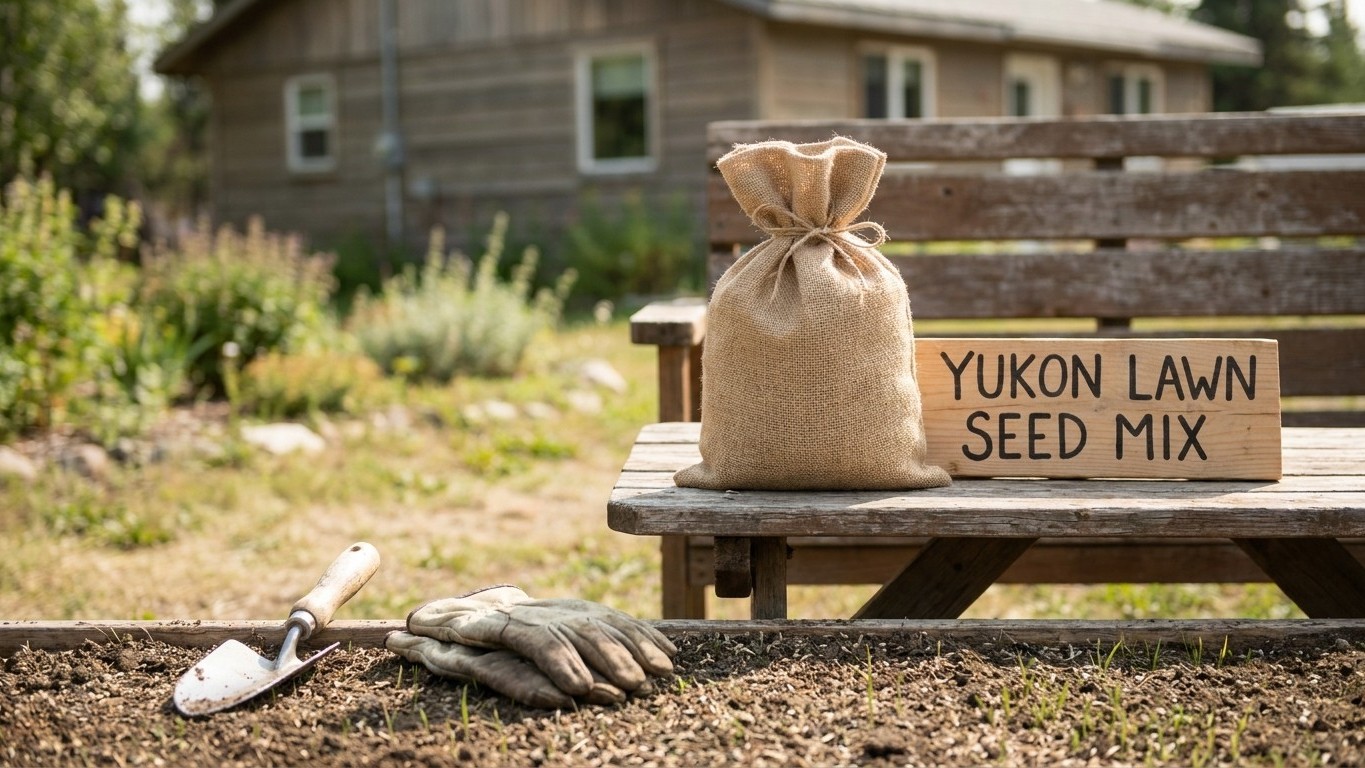

The best grass seed for a Yukon lawn is a cool-season type. Clemson Cooperative Extension (HGIC 1214) and Penn State Extension list five species suited to this climate: Kentucky bluegrass, perennial ryegrass, tall fescue, fine fescue, and rough bluegrass. Environment and Climate Change Canada’s 1981-2010 normals put the mean first fall frost at Whitehorse A at August 25, so any new seeding needs weeks of root growth before that date arrives. Check your own district against that figure before you order seed, since the far north and higher ground turn cold sooner.
The short answer for Yukon
Best seed for a Yukon lawn is a cool-season mix — Kentucky bluegrass, perennial ryegrass, tall fescue, fine fescue, or rough bluegrass — because nothing else survives a winter here. Whitehorse’s average first fall frost lands August 25, and that date is the whole game: whatever you plant needs enough weeks of root growth before it hits. Before you pick a species or a blend, walk your own yard and check sun, traffic, drainage, and how many weeks you’ve actually got left — that answer decides which of the five cool-season grasses is worth buying.
Within the cool-season group, the right seed depends on what the lawn has to do. A few questions decide it before you ever open a seed bag:
- How much direct sun does the site get through the day
- Will kids, dogs, or foot traffic wear a path across it
- Is the soil well drained or does water sit after rain
- How much time is left before the average first fall frost
If you have not yet worked through soil prep and grading, that groundwork is covered in Yukon Lawn Care, and it matters more than the seed label does. A perfect blend sown into compacted clay or standing water will fail regardless of species. Once the site is ready, the choice among the five cool-season grasses comes down to trade-offs in speed, density, and how much attention each one wants for the rest of the season, covered species by species below.
Working through the year

None of the five cool-season grasses is free of a downside here. Ranked roughly by how well each one fits a short Yukon growing season, here is what each buys you and what it costs.
Perennial Ryegrass

Perennial ryegrass germinates faster than any of the other four, often showing green within days rather than weeks, which matters when the growing window between last spring frost and the mean August 25 first fall frost at Whitehorse is already tight. The cost is durability. It grows in bunches with no spreading rhizomes or stolons, so it cannot fill in a bare patch on its own, and it tends to be shorter-lived through a hard winter than the others on this list. Most Yukon growers use it as the fast-establishing partner in a blend rather than as a lawn on its own.
Fine Fescues

Fine fescues ask for the least. They tolerate poor, thin soil, need less nitrogen than bluegrass, and hold color in shade better than any of the other four species. Their weakness is wear. The fine, wiry blades do not stand up to a well-worn path or a dog run, and a lawn that gets steady foot traffic will thin out in those spots faster than it would under Kentucky bluegrass.
Kentucky Bluegrass

Kentucky bluegrass spreads by underground rhizomes and knits itself into the densest, most self-repairing sod of the group, which is why it is the standard choice where a lawn takes real traffic. The trade-off is time. It is slower to establish than ryegrass, often taking noticeably longer to fill in from seed, and it wants more sun and more consistent moisture than fine fescue to look its best.
Tall Fescue

Tall fescue’s coarse, broad blade and deep root system make it the most drought-tolerant of the five, an advantage that matters less in a Yukon summer than it would further south. It grows in clumps rather than spreading, so a thin tall fescue lawn stays thin unless it is overseeded. Clemson Cooperative Extension’s tall fescue maintenance calendar, HGIC 1219, lays out the season structure for this species in detail, mowing higher through summer heat and concentrating nitrogen in fall rather than spring. That calendar’s actual months are built for South Carolina’s much longer season, so for the version matched to Yukon’s own frost window, use The Yukon Lawn Care Calendar, Month by Month instead.
Rough Bluegrass

Rough bluegrass, sometimes sold as Poa trivialis, is worth naming only for one job: a constantly damp, shaded corner where nothing else takes hold. It spreads by shallow surface stolons and thrives in wet shade, but that same shallow root system means it dries out and dies back fast under any drought stress, so it has no place in a sunny, well-drained yard.
| Species | Texture | Shade tolerance | Establishment speed | Wear tolerance |
|---|---|---|---|---|
| Perennial Ryegrass | Fine to medium | Low | Fast | Moderate |
| Fine Fescues | Very fine | High | Moderate | Low |
| Kentucky Bluegrass | Medium | Low to moderate | Slow | High |
| Tall Fescue | Coarse | Moderate | Moderate | Moderate to high |
| Rough Bluegrass | Fine | High | Fast | Low |
What changes across Yukon
Every figure in this article is tied to the Whitehorse A weather station, and Whitehorse sits in a river valley at a relatively low elevation for the territory. Communities and homesteads at higher elevation, and those farther north toward Dawson City and beyond, run on a shorter, colder season than the Whitehorse normals suggest. That gap is not cosmetic. A lawn at higher elevation can see its first fall frost arrive weeks ahead of the Whitehorse mean, which shrinks the already tight window for a new perennial ryegrass or fine fescue seeding to root before the ground turns.
Elevation is the main driver of that spread, but exposure matters too. A slope facing north or a valley bottom that pools cold air overnight will frost earlier and harder than a south-facing yard on the same street, let alone one in a different part of the territory entirely. Wind exposure changes the picture further: an open, unsheltered lawn dries out faster between waterings than one tucked behind a windbreak or a stand of spruce, even if both sites see the same air temperature on paper.
None of this means the five recommended species change across Yukon, since Clemson’s and Penn State’s cool-season classification is about climate type, not a single town. It means the calendar built around Whitehorse’s August 25 mean frost date needs to be pulled earlier for a colder site and can be pushed a little later for a warmer, sheltered one. Treat the Whitehorse figure as a starting point to adjust from, not a date to circle on the calendar and trust outright.
The mistakes this climate punishes
Seeding too late
The single most common failure in a Yukon lawn is sowing cool-season seed too close to the average first fall frost. Environment and Climate Change Canada’s normals put that mean date at August 25 for Whitehorse A, and because it is a mean, frost arrives earlier than that in roughly half of all years. Seed sown right up against that date, or after it, does not get the several weeks of root growth it needs before the ground freezes, and the result shows up the following spring as bare, dead patches where the seedlings never anchored.
Trying a warm-season grass
Some growers, chasing a lawn they remember from a warmer climate, try Bermuda grass or zoysia. Both are warm-season species built for long, hot summers, and Yukon’s cool-season classification means they cannot complete a full growth cycle here before winter. The damage does not show as browning that recovers in spring, the way a dormant cool-season lawn does after a dry summer. It shows as a lawn that simply does not come back at all.
Mowing too short
Cutting any of the five recommended cool-season grasses too short during the warmest, driest stretch of summer stresses the plant right when it can least afford it. The blades lose the leaf area they need to keep roots cool and shaded, and the lawn browns off faster than it would at a taller cut. That browning is not death. Cool-season turf that has been scalped in a dry spell greens back up once temperatures drop and moisture returns, but a lawn cut short and then hit by an early frost has far less reserve to draw on going into winter.
Feeding heavily right before freeze-up
A late, heavy nitrogen application pushed on right before the ground freezes forces soft new growth that has no time to harden off. That tender growth is what gets damaged first when the first hard frost arrives, undoing whatever benefit the feeding was meant to give.
Checking this against your county
Every figure on this page comes from a single reference point, the Whitehorse A weather station, and Yukon is too large and too varied in elevation for one town’s normals to stand in for the whole territory. Before you commit to a seeding date, check conditions for your own district through Agriculture and Agri-Food Canada, the federal agriculture department’s site. It is a useful starting point when a local provincial resource is not available online, and it can point you toward more specific advice for your area.
If you farm or garden seriously in the territory, it is also worth asking neighbors and local nurseries what has actually survived a winter in your specific spot. A frost date from a valley-floor weather station is a guide, not a guarantee, for a yard sitting higher up or further north.
Common questions
Can I just use a warm-season grass seed mix if it’s cheaper?
No. Warm-season species like Bermuda grass and zoysia need a long hot growing season to establish and cannot survive a Yukon winter regardless of price or how the seed bag is marketed. Stick to the cool-season species Clemson Cooperative Extension and Penn State Extension list for this climate type.
How late in the season can I still seed a Yukon lawn?
There is no single safe date, since Environment and Climate Change Canada’s August 25 figure for Whitehorse A is a mean, not a guaranteed cutoff, and frost arrives earlier than that in about half of all years. The safer approach is to seed as early in the season as soil conditions allow rather than waiting and hoping the frost holds off.
Why did my grass seed come up patchy instead of thick?
Patchy germination usually points to uneven soil contact, dry spots, or seed that sat too long before the site was ready rather than a bad seed lot. Bunch-forming species like perennial ryegrass and tall fescue will not fill in a bare patch on their own the way Kentucky bluegrass can through its spreading rhizomes.
Is a blend better than a single species for Yukon?
For most yards, yes, a blend spreads the risk that any one species has a bad year. A common approach pairs the fast germination of perennial ryegrass with the slower, self-repairing sod of Kentucky bluegrass or the shade tolerance of fine fescue, rather than betting the whole lawn on one species alone.