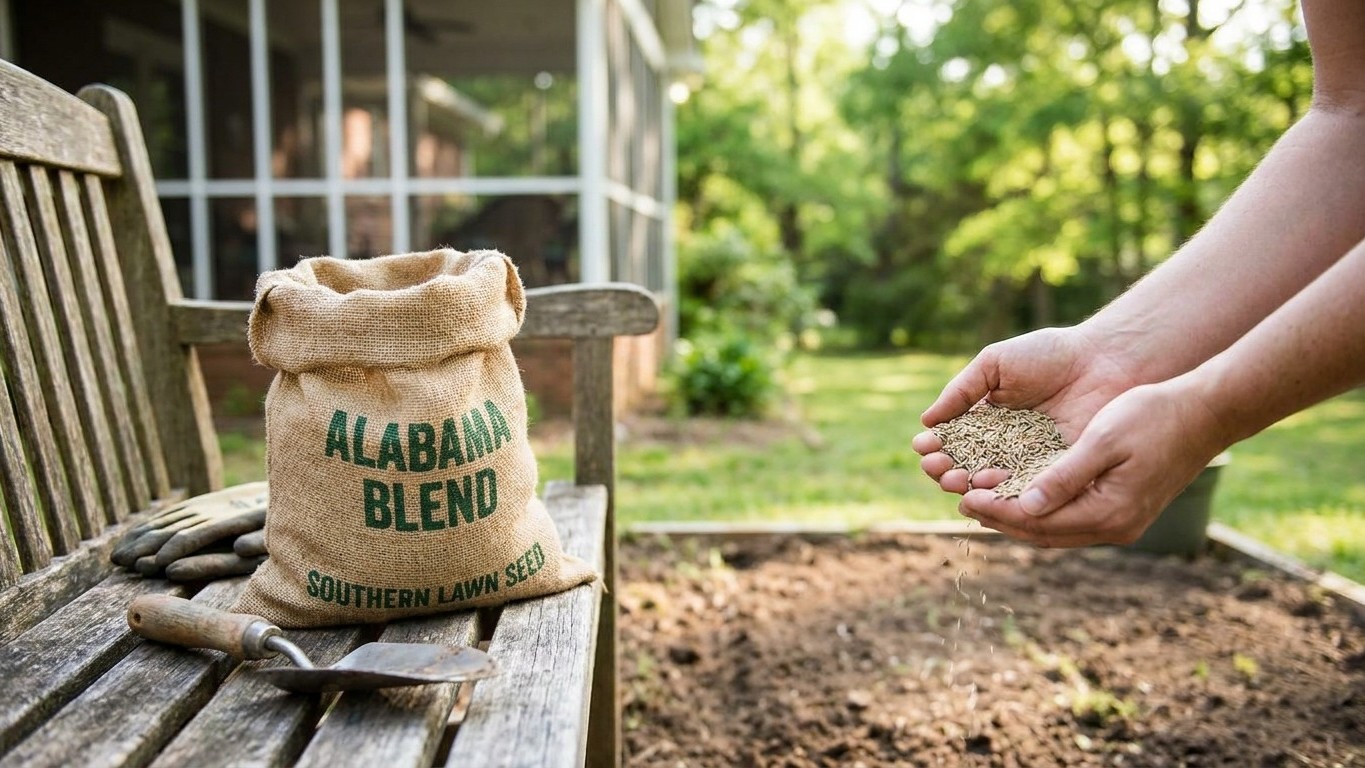

Seven warm-season species make Alabama’s shortlist: Bermudagrass, Zoysiagrass, St. Augustinegrass, Centipedegrass, Bahiagrass, Carpetgrass and Seashore Paspalum. Tall fescue and Kentucky bluegrass aren’t on it, because Alabama summers push past what cool-season grass tolerates — it thins in July and August instead of thickening toward fall. Picking among the seven comes down to shade, traffic, drainage, and how much mowing you’re willing to do. Centipedegrass demands the least upkeep but sulks in shade and traffic; Bermudagrass shrugs off both but wants more mowing and nitrogen; St. Augustinegrass sits comfortably between the two.
The short answer for Alabama
The short list is the same seven warm-season species Clemson Cooperative Extension names in HGIC 1214: Bermudagrass, Zoysiagrass, St. Augustinegrass, Centipedegrass, Bahiagrass, Carpetgrass and Seashore Paspalum. Cool-season grasses like tall fescue or Kentucky bluegrass are missing on purpose. Alabama’s summer heat runs past what those species tolerate, so a cool-season lawn thins through July and August instead of thickening toward fall the way it would farther north. Getting this decision right matters more for Alabama Lawn Care than almost anything you’ll do afterward, because a mismatched species fights the climate every single season it’s in the ground.
Which of the seven fits your yard depends on four things: how much shade it gets, how much traffic it takes, what the soil drains like, and how much mowing and feeding you want to keep up with. Centipedegrass asks the least of you in fertilizer and mowing frequency, but it won’t hold up to heavy shade or heavy traffic. Bermudagrass takes traffic and full sun better than anything else on the list, at the cost of more frequent mowing and more nitrogen to keep it dense. St. Augustinegrass lands in between: better shade tolerance than Bermudagrass, lighter upkeep than a Bermudagrass lawn kept at showpiece density.
None of this is a single verdict for the whole state. Alabama runs from the Tennessee Valley in the north to the Gulf beaches in the south, and elevation, soil type and average temperature shift enough over that distance to change which grass actually performs best in a given yard. Treat the seven-species list as the field of candidates, then match it against your own lot, not the state’s average.
Working through the year

Ranking these seven by what they cost you in upkeep, rather than by looks, puts them in a different order than a seed rack usually does.
Ranking the species by upkeep and establishment
Bermudagrass and Centipedegrass are the two most commonly established from seed in Alabama, and both have full-season guides in Clemson’s maintenance calendars: the Bermudagrass Maintenance Calendar (HGIC 1216) and the Centipedegrass Maintenance Calendar (HGIC 1215). Bahiagrass and Carpetgrass also establish readily from seed, though Bahiagrass throws up seed heads often enough between mowings that some owners find the look untidy on a front lawn. Seashore Paspalum seed is available but far less common at retail than the others, and it’s usually chosen for salt tolerance near the coast rather than for an inland yard.
Zoysiagrass and St. Augustinegrass are the two on this list that most Alabama homeowners establish from sod, sprigs or plugs rather than seed, because the seeded cultivars sold for these species are slower to fill in and less reliable than sodding. Clemson still publishes a full-season guide for each: the Zoysiagrass Maintenance Calendar (HGIC 1217) and the St. Augustinegrass Maintenance Calendar (HGIC 1218). Each of those four Clemson calendars is written for one species only, so read the calendar that matches the grass actually in your yard, not the one for the grass you wish you had.
| Grass | Usually established from | Shade tolerance | Traffic tolerance | Mowing demand |
|---|---|---|---|---|
| Bermudagrass | Seed or sod | Low | High | Frequent, cut low |
| Zoysiagrass | Sod, sprigs, plugs | Moderate | High | Moderate |
| St. Augustinegrass | Sod, plugs | High | Moderate | Frequent |
| Centipedegrass | Seed or sod | Moderate | Low | Infrequent, low nitrogen |
| Bahiagrass | Seed | Low | Moderate | Frequent, seed heads |
| Carpetgrass | Seed | High in wet shade | Low | Frequent |
| Seashore Paspalum | Sod, limited seed | Low | Moderate | Moderate, salt-tolerant |
Once you’ve settled on a species, the timing that follows for mowing height, feeding and pre-emergent herbicide runs opposite to a cool-season calendar, and it’s laid out month by month in The Alabama Lawn Care Calendar, Month by Month.
What changes across Alabama
The figures used above, including the first fall frost window, come from the weather station near Huntsville, and Huntsville sits closer to the cooler end of Alabama’s warm-season range than the state as a whole. North Alabama’s higher ground, including Sand Mountain and the DeKalb and Jackson County foothills, tends to cool down earlier in fall and warm up later in spring than the Huntsville airport figures suggest, which shortens the establishment window for any grass seeded there.
The Gulf Coast around Mobile runs the opposite direction. Its longer, more humid growing season and later average frost push the practical planting and dormancy windows later than Huntsville’s, and it’s also the part of the state where Seashore Paspalum’s salt tolerance actually matters, since salt spray and occasional tidal flooding rule out several of the other six species on beachfront and near-coastal lots.
Large reservoirs like Lake Guntersville and Lake Martin moderate the immediate shoreline a little, holding off the first light frost by a matter of days compared with low ground a few miles inland, though NOAA’s normals don’t break this out at the lake level. The honest position is that the Huntsville-based frost window of November 2 to November 16, from NOAA’s 1991-2020 climate normals, is a reference figure, not a promise for your yard. Suburban and rural gardens away from the airport station commonly see their first fall frost one to two weeks earlier than that window, and more at elevation.
The mistakes this climate punishes
Timing errors that show up months later
Feeding a warm-season lawn nitrogen too late into fall is the most common mistake on this list. Once growth slows heading toward the first fall frost, near Huntsville typically falling in the November 2 to November 16 window per NOAA’s 1991-2020 normals, the grass can’t use that nitrogen for root or blade growth. It pushes soft, late top growth instead, and the damage doesn’t show until late winter or early spring as large dead or thin patches where the lawn failed to green back up.
Seeding a cool-season species like tall fescue into a warm-season lawn in late spring is the second. It germinates fine in cool soil, then thins and dies through the first real heat of summer because Alabama’s summer temperatures run past what fescue tolerates. The damage shows within six to eight weeks of the first hot stretch, not immediately, which is why the mistake gets repeated: the lawn looks fine in April and falls apart in July.
Mowing too short during a hot, dry stretch is the third. Scalping a warm-season lawn removes the leaf area the plant needs to shade its own root zone, and the browning or thinning that follows usually shows up within one to two weeks, right when the lawn was already under drought stress and least able to recover from it. Watering shallowly and often instead of deeply and less often compounds this by keeping roots near the surface, where they dry out fastest.
Applying a pre-emergent herbicide on a fixed calendar date rather than watching soil temperature is the fourth. Crabgrass and other summer annual weeds germinate on soil temperature, not the calendar, so a date that worked one year can miss the window entirely the next if the spring runs warm or cool.
Checking this against your county
The frost window and the species list are starting points, not a county-specific answer. The Alabama Cooperative Extension System, at aces.edu, runs a county office network that can confirm which of the seven species suits your soil type, and most offices also run soil tests that tell you what your lawn actually needs before you buy a bag of fertilizer. Call or visit before you commit to seed, especially if your lot sits at elevation, near the coast, or near a large lake, since those are exactly the conditions that push local timing away from the Huntsville-based figures used here.
Common questions
Can I plant Zoysiagrass or St. Augustinegrass from seed?
Not reliably. Most Zoysiagrass and St. Augustinegrass lawns in Alabama are established from sod, sprigs or plugs because the seeded cultivars available at retail fill in slowly and unevenly compared with Bermudagrass or Centipedegrass seed.
My Bermudagrass turned brown after the first frost. Is it dead?
No, it’s dormant. Warm-season grasses like Bermudagrass, Zoysiagrass and Centipedegrass go brown after frost and green back up on their own once soil temperatures rise again in spring. Brown does not mean dead in a warm-season lawn.
Can I overseed my warm-season lawn with ryegrass for winter color?
Yes, that’s a common cosmetic overseed, but it’s temporary. Annual or perennial ryegrass overseeded into a dormant warm-season lawn dies out on its own as the permanent grass wakes up in spring, and it’s not a substitute for choosing a cool-season lawn, which this climate doesn’t support long term.
Why did my new grass seed fail even though I watered it every day?
Daily watering doesn’t fix a mismatched species or bad timing. Seed put down too early in cool soil, too late into summer heat, or in shade a species can’t tolerate will struggle regardless of watering, so check both the species fit and the seeding window against the calendar for that specific grass before assuming the problem is moisture.