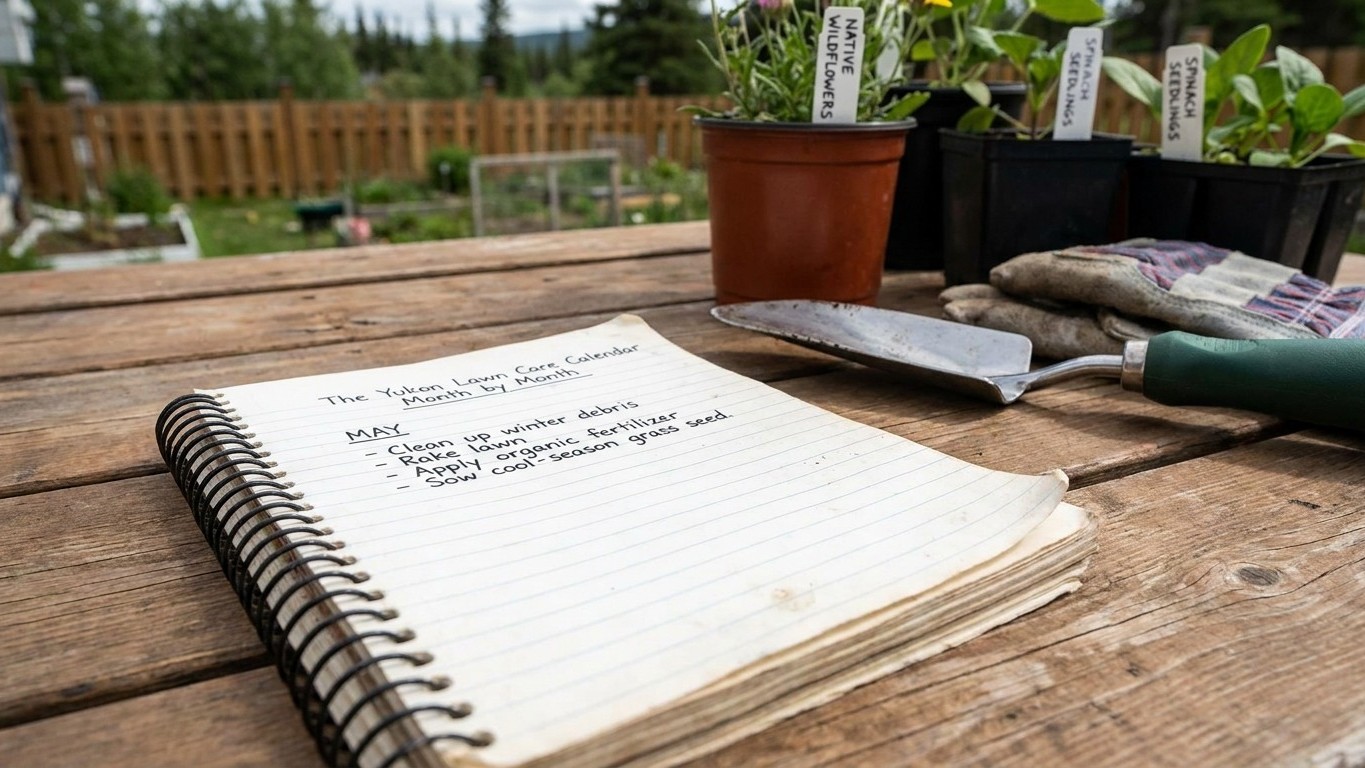

Yukon’s lawn calendar runs on cool-season grass and a growing season that closes fast. Near Whitehorse, Environment and Climate Change Canada’s 1981-2010 climate normals put the average first fall frost at August 25, and that date is a midpoint, not a promise, since roughly half the years on record see frost arrive later still. The single thing to act on: finish your last fall feeding and any overseeding well ahead of that date, because a cool-season lawn needs several weeks of active growth to harden off before the ground freezes.
The short answer for Yukon
Yukon sits in what The Homestead Post classifies as a cool-season lawn zone, based on the reference city of Whitehorse and its climate normals. Read against the season tolerances Clemson Cooperative Extension sets out in HGIC 1214, Whitehorse’s summer heat and winter cold both fall on the cool side of the line, so the grasses that thrive here are the same ones grown across the northern tier of the Lower 48 and the Canadian Prairies. That means Fine Fescues, Kentucky Bluegrass, Perennial Ryegrass, Rough Bluegrass and Tall Fescue, the five species Clemson HGIC 1214 and Penn State Extension both list as cool-season turf, are the realistic choices for a Yukon lawn. If you haven’t picked one yet, the Best Grass Seed for Yukon Lawns guide breaks down which of those five suits shade, wear or a low-maintenance yard.
Warm-season grasses like bermudagrass or zoysia are off the table here, not because they can’t be bought, but because Yukon’s winter lows will kill them outright over the first winter rather than just browning them off the way a light frost does further south.
The other number that anchors the whole calendar is the frost date. Environment and Climate Change Canada’s 1981-2010 climate normals for station Whitehorse A put the mean first fall frost at August 25. That’s an average across thirty years, not a hard cutoff. In roughly half of those years the first frost came later than August 25, and in the other half it came earlier. Treat it as the center of a window that might run into September in a mild year or bite in mid-August in a cold one. Everything else on this page, from when you stop feeding nitrogen to when you finish overseeding, is built around staying safely inside that window rather than gambling on the average holding.
Working through the year

This calendar picks up after the basics covered in Yukon Lawn Care, assuming you’ve already got seed in the ground or an established stand to maintain. Clemson Cooperative Extension’s HGIC 1219 Tall Fescue Maintenance Calendar lays out the standard cool-season lawn year: light spring work, steady summer maintenance, and the heaviest feeding and repair concentrated in fall. Yukon’s calendar follows the same shape, but every date on it has to be shifted to match a shorter, later-starting season than the one Clemson wrote it for in South Carolina.
Spring
Wait for the ground to thaw completely and drain before doing anything to the lawn. Raking out the gray or pink matted patches left by snow mold is the first job, and it should happen before the first mow, not after, since mowing wet matted grass just spreads the fungus around. Clemson’s calendar times the pre-emergent herbicide application to soil temperature rather than a fixed date, a rule that holds wherever you garden: watch the soil, not the square on the calendar, especially if crabgrass has been a problem in past years. Keep the first few mows light, taking off no more than a third of the blade at a time so the lawn isn’t stressed while its root system is still catching up after winter.
Summer
Yukon’s long daylight hours push a lot of top growth in a short window, but the season itself stays shorter and often cooler than the transition-zone climate Clemson’s calendar was written around. Mow tall fescue and the other cool-season species on the higher end of their tolerance through any hot, dry stretch, since a taller blade shades the soil and slows moisture loss. Water deeply and infrequently rather than little and often, so roots are encouraged to grow down rather than stay near the surface, and let rainfall carry most of the load in years when it’s adequate. Skip a heavy nitrogen feeding through the hottest, driest weeks. Clemson’s calendar treats summer as a holding pattern for cool-season turf, not a growth push, and that holds just as true in a Yukon July.
Fall
This is the stretch that matters most. Clemson’s calendar puts the season’s heaviest nitrogen application in fall, when cool-season grass builds the root reserves it draws on through winter and next spring’s green-up, and Yukon’s compressed season makes that timing even more important. Aim to finish that fall feeding and any aeration or overseeding well before Whitehorse’s mean first frost date of August 25, since a cool-season lawn needs several weeks of active growing weather after seed goes down to root in before the ground freezes. Aeration timed for fall, as Clemson’s calendar recommends, relieves the compaction a short growing season doesn’t otherwise give the lawn much chance to recover from on its own.
What changes across Yukon
Every figure on this page is measured at or near Whitehorse, which sits in a river valley in the southern half of the territory, at a lower elevation than much of the surrounding upland. That position gives it one of the milder, longer growing seasons available anywhere in Yukon, which means the rest of the territory should be treated as running behind it, not level with it.
Dawson City, several hundred kilometers north along the Klondike Highway, sits closer to the Arctic Circle and typically sees its growing season close earlier in fall and open later in spring than Whitehorse does. The Homestead Post doesn’t have a climate-normals figure specific to Dawson City to quote here, so treat Whitehorse’s August 25 mean frost date as an outer bound for the north of the territory rather than a working estimate, and shift fall deadlines earlier to be safe if you garden that far north.
Elevation matters as much as latitude. A lawn planted on a valley floor near a river will sit in a frost pocket on clear, calm nights, since cold air drains downhill and pools there, creating what growers call a frost pocket, while a lawn on a gentle slope a few hundred feet higher can stay several degrees warmer at the same hour. If your yard sits low relative to the surrounding land, expect frost to reach your lawn before it shows up on the regional forecast.
Communities further south and east, such as Watson Lake, sit at a broadly similar latitude band to Whitehorse but see their own local variation from terrain and distance from any moderating water body. None of these differences are large enough to change which grass species work, since the whole territory falls in the same cool-season zone, but they are large enough to shift a fall deadline by weeks in either direction. Treat every date in this calendar as a Whitehorse-centered estimate rather than a territory-wide rule.
The mistakes this climate punishes
Some habits that cost nothing in a longer season here cost you the whole lawn.
- Seeding cool-season grass too late in summer. Wait until August to overseed and you’re racing the calendar against Whitehorse’s mean first frost date of August 25. Grass sown that late may germinate but won’t get the several weeks of root growth it needs before the ground freezes, and a thin stand going into winter often doesn’t come back thick in spring.
- Cutting too short late in the season. A close fall mow leaves less leaf area for the plant to store energy in before dormancy. Clemson’s tall fescue calendar keeps mowing height up through fall for exactly this reason, and a lawn scalped in September shows the damage the following May as slow, patchy green-up.
- Feeding heavily right before frost. A late, high-nitrogen application pushes soft new growth that has no time to harden off before cold weather, and that tender tissue is what gets damaged first.
- Mistaking a brown fall lawn for a dead one. Cool-season grass goes dormant and straw-colored after repeated hard frosts. That’s normal winter dormancy, not death, and the same lawn greens back up on its own once soil warms in spring.
- Trying a warm-season species because it’s cheaper or easier to find. Bermudagrass and zoysia are built for the opposite half of the year. Planted here, they die outright over the first winter instead of going dormant and returning.
The pattern across all five: this climate has a short enough window that a mistake made in one season often can’t be corrected until the same season comes around again the following year.
Checking this against your county
Every date and figure in this calendar comes from a single station, Whitehorse A, and a single set of climate normals covering 1981-2010. Yukon’s other communities, and any lawn sitting in a valley bottom or at unusual elevation even within commuting distance of Whitehorse, can run meaningfully ahead or behind those numbers. Before you commit to a fall deadline or a spring start date, check current conditions and any local guidance through Agriculture and Agri-Food Canada, the federal department that publishes agricultural information for the territory, since Yukon’s own agriculture office doesn’t maintain a public calendar page that automated tools can reach. Treat this page as the Whitehorse-centered starting point, and adjust every date here against what you actually see happen in your own yard over a season or two.
Common questions
Can I patch a warm-season lawn I already planted with cool-season seed?
Yes, and for Yukon that’s really the only fix. If Bermuda or zoysia was planted by mistake, it won’t survive a Yukon winter regardless of care, so overseed the dead patches the following spring with one of the cool-season species. Tall Fescue and Kentucky Bluegrass blend well together and tend to fill in a mixed lawn evenly.
When is it too late to overseed in the fall?
There’s no single safe date published for every part of Yukon, but work backward from Whitehorse’s mean first frost of August 25 and give the seed several weeks of growing weather before that window closes. Since the frost date is an average and can arrive earlier in a cold year, sowing in early summer rather than late summer leaves more margin for error.
How do I tell snow mold damage from normal winter dieback?
Snow mold shows up as circular gray or pink matted patches right where snow sat longest, often with a faint fuzzy coating on the grass blades when you look closely. Ordinary winter dieback looks even and straw-colored across the whole lawn instead of patchy. Raking the matted areas gently once the ground firms up in spring usually lets the grass recover on its own within a few weeks.
Do I need to water my Yukon lawn all summer?
Not necessarily. Many established cool-season lawns in this climate get by on natural rainfall except during unusually dry stretches, and there’s no single irrigation rate that applies across the territory. Check the soil a few inches down rather than watering on a fixed schedule, and water deeply when it’s dry rather than lightly and often.