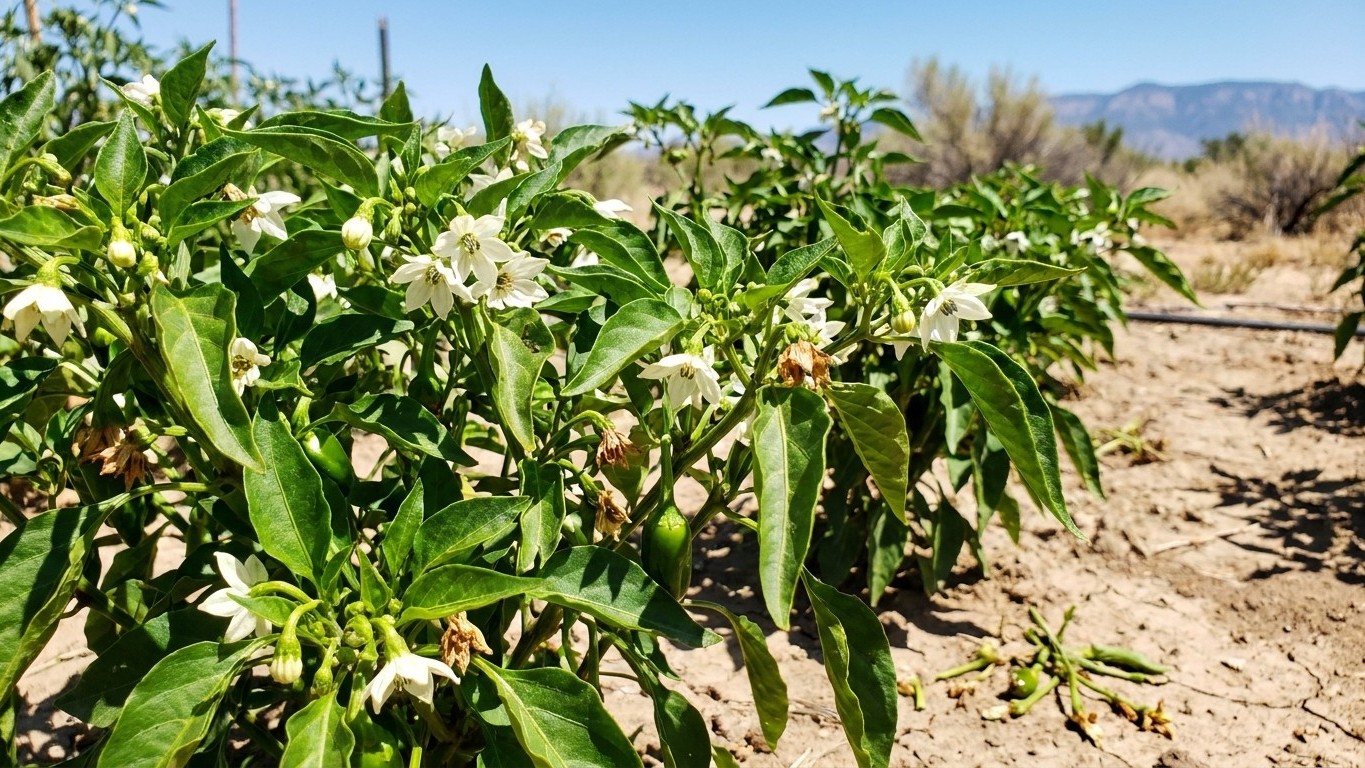

Albuquerque’s weather record shows 42.5 days a year at or above 90°F, and that number alone explains why pepper plants in New Mexico often flower heavily but set little fruit in midsummer. The other failure point, nights below 55°F, matters just as much, but this site doesn’t track summer night minima for New Mexico, so you’ll need to watch your own thermometer through the season rather than assume.
The short answer

Forty-two and a half days above 90°F is a lot of heat load spread across a growing season, and it’s the figure that decides whether a pepper plant in New Mexico spends July and August setting fruit or simply holding its blossoms and dropping them. Pepper flowers are sensitive: once daytime highs push past 90°F for a stretch, pollen becomes less viable and the plant aborts blossoms rather than waste energy on fruit that likely won’t finish. That’s not a disease or a nutrient problem. It’s the plant reading its own thermometer and making a survival call.
The Albuquerque figure is a reference-station average, not a forecast for every yard in the state. Higher elevations and mountain valleys will see fewer days that hot; low desert basins can run hotter and longer. Either way, once a gardener knows the general heat load for their part of New Mexico, the practical response is the same: expect a slowdown in fruit set during the hottest stretch of summer, and don’t panic when blossoms drop during a heat wave. For a deeper look at Why Peppers Fail to Set Fruit in New Mexico, it’s often temporary, and plants typically resume setting fruit once temperatures ease.
The cool end of the equation gets less attention but causes the identical failure. According to Utah State University Extension, pepper fruit set fails at both ends: nights below 55°F stop pollen from developing properly, just as days above 90°F do. This is the part that’s easy to miss in a state known for summer heat. Even in New Mexico, a run of unusually cool nights, especially in spring right after transplanting, or in a mountain-adjacent yard, can produce the same blossom drop as a heat wave.
Here’s the limit of what can be said with real data: this site carries the days-above-90°F figure for New Mexico, but it does not carry summer night minima. Nobody should guess at those numbers based on how far south or how high up they live. Latitude and elevation influence night temperatures, but they don’t predict them precisely enough to plan a garden around. The only reliable method is to track your own overnight lows during the growing season, ideally with a min-max thermometer in the garden itself, and watch for stretches where nights consistently sit below 55°F. That’s the number that matters, not a guess based on the map.
When to start seed here
When to Start Pepper Seed in New Mexico comes down to co, and pairing that timing with Pepper Varieties That Ripen in a New Mexico Season matters just as much as the start date itselfunting backward from a transplant date, and that transplant date depends on two things lining up: the last frost and warm enough soil. Here’s how to work through the arithmetic for a New Mexico garden, using Albuquerque as the reference point and adjusting for your own county.
- Find the reference frost window. At the Albuquerque airport weather station, NOAA’s 1991-2020 climate normals put the last spring freeze (32°F) in the 30 to 70 percent probability band between March 31 and April 12. That’s the airport figure only. Suburban and rural gardens around the state typically see their last frost land later than this, often by one to two weeks, and more at higher elevation.
- Wait for warm soil, not just a frost-free date. Peppers need soil at 60°F before transplanting, according to Utah State University Extension. Soil often lags behind air temperature by a week or two in early spring, especially if the ground was shaded or wet through winter. A frost-free date on the calendar doesn’t guarantee 60°F soil on that same day.
- Set the transplant date at whichever comes later. If your county’s typical last frost falls in mid-April but your soil doesn’t hit 60°F until the first week of May, May is your transplant target, not April.
- Count back 8 to 10 weeks for indoor seed starting. Utah State University Extension recommends starting pepper seed indoors 8 to 10 weeks before transplant. If your transplant date lands around the second week of April using the Albuquerque reference window, count back 8 to 10 weeks and you land somewhere in mid-February to early March for sowing indoors.
- Rerun the math for your own address. A gardener at higher elevation or in a cooler pocket of the state should push both the transplant date and the seed-starting date later, using their own observed frost and soil timing rather than the airport average.
None of this arithmetic changes because a garden is in New Mexico specifically. What changes is the raw material: the frost window, and how quickly local soil warms in spring. Get those two numbers right for your own yard, and the 8-to-10-week countdown does the rest.
What goes wrong here
- Blossom drop during a heat spell. Once days push past 90°F, which happens on average 42.5 days a year in the Albuquerque area, pepper flowers often drop before setting fruit. The remedy isn’t fertilizer or more water alone. Providing afternoon shade cloth during the hottest stretch of summer and keeping soil moisture even (not soaked, not dry) gives plants their best shot at holding onto blossoms until temperatures moderate.
- Blossom drop during a cool night. The same failure shows up at the other end. Utah State University Extension notes pepper fruit set fails when nights drop below 55°F, which can happen even in New Mexico during early spring cold snaps or in higher, cooler yards. Row covers overnight during a cool spell, or simply delaying transplant until nights have stabilized, reduces this risk. Watch your own overnight lows rather than assuming the season has warmed enough just because the calendar says June.
- Sunscald on fruit. New Mexico’s strong, high-elevation sun exposes ripening peppers to intense direct light, and fruit left uncovered by foliage can develop pale, papery patches called sunscald. This is more common on plants that have lost leaves to disease, pruning, or heat stress, since bare fruit takes the full brunt of the sun. Keeping plants full and healthy, and avoiding aggressive pruning during the hottest months, gives fruit natural shade from its own leaves.
- Blossom-end rot. This shows up as a sunken, leathery patch on the bottom of the fruit and is tied to inconsistent watering, which interrupts calcium uptake even when soil calcium levels are adequate. In a climate with hot days and low humidity, soil can swing between too dry and freshly watered more sharply than in wetter regions. A consistent watering schedule, plus mulch to slow evaporation between waterings, is the practical fix.
Checking this against your own county
Every figure here, the 42.5 days above 90°F, the March 31 to April 12 frost window, comes from a single reference station and applies most directly to that immediate area. Gardens elsewhere in New Mexico, especially at different elevations or in more sheltered or exposed microclimates, will see real differences in both heat load and frost timing.
For county-specific planting dates, frost data, and pepper variety guidance suited to your exact location, New Mexico State University’s Cooperative Extension Service, at aces.nmsu.edu, maintains local offices across the state. Their county agents can confirm how closely your yard’s conditions track the Albuquerque reference figures used here, and adjust the timing accordingly.
Common questions
Why do my pepper plants flower but never set fruit in July?
This is the classic hot-end failure. Once days repeatedly climb above 90°F, which the Albuquerque area sees on 42.5 days a year on average, pepper pollen loses viability and plants drop blossoms rather than set fruit. It typically resumes once a cooler stretch arrives.
Can cool nights cause the same problem as heat in New Mexico?
Yes. Utah State University Extension identifies nights below 55°F as the other end of the same failure. This can happen during early spring cold snaps or in cooler, higher-elevation yards even within a generally hot state, so tracking your own overnight lows matters more than assuming the season is warm enough.
How early can I transplant peppers outdoors in New Mexico?
Not before your soil reaches 60°F and your local frost risk has passed. Using Albuquerque’s reference window of March 31 to April 12 for last frost as a starting point, and adjusting later for your own county and elevation, is the safest approach rather than relying on a single statewide date.
Is sunscald the same thing as sunburn from too much heat?
Sunscald refers specifically to direct sun exposure on fruit that’s lost its leaf cover, producing pale, papery patches. It’s related to New Mexico’s strong sunlight but is a separate issue from the heat-driven blossom drop that stops fruit from forming in the first place.