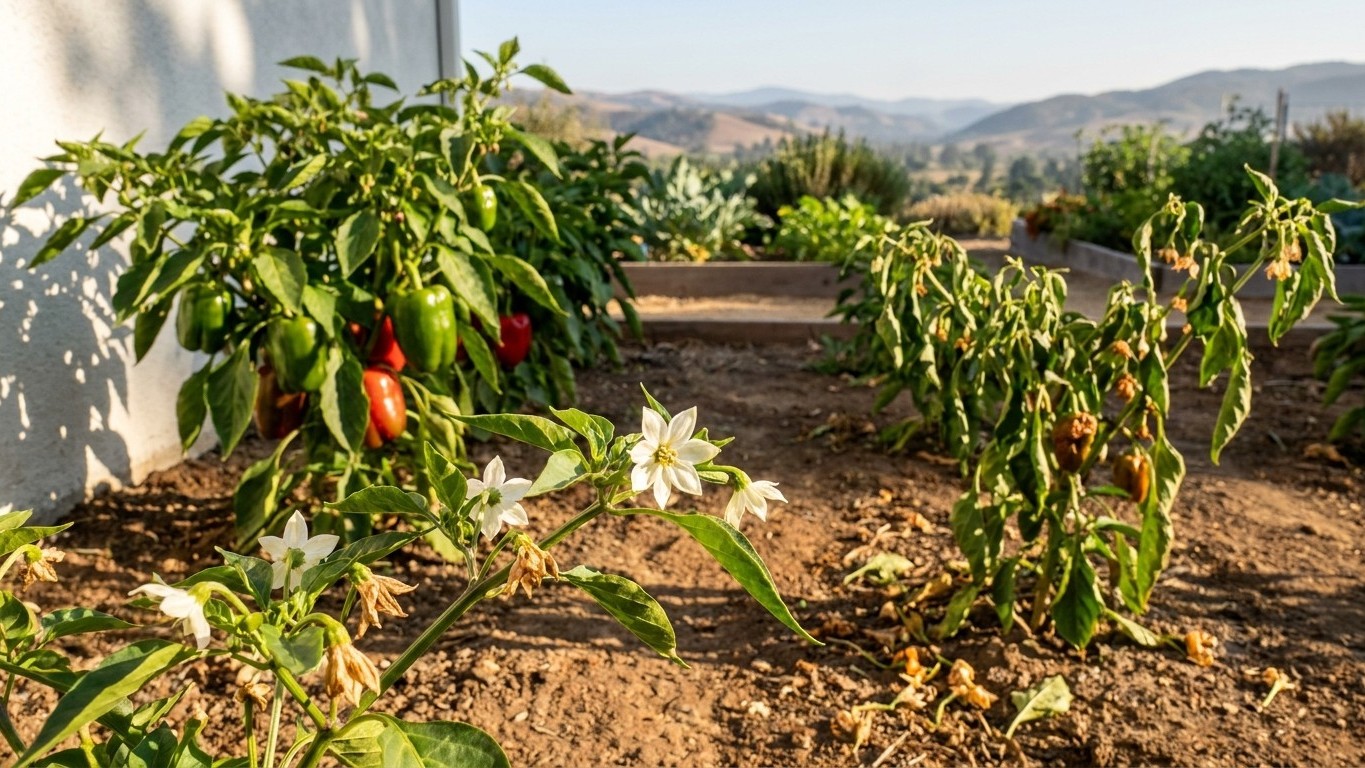

California pepper growers face a split climate: coastal and southern zones rarely see frost at all, while the Central Valley and Sierra foothills freeze most winters. The real fruit-set risk statewide is heat, not cold, but a few days over 90 F can still shut down flowering just as fast as a chilly night.
The short answer

At the Los Angeles reference station, NOAA’s 1991-2020 Climate Normals put the yearly average at 2.4 days reaching 90 F or higher. That’s a low number compared to inland desert regions, and it tells you something specific: for most of the growing season, extreme heat is the exception rather than the rule near the coast. Peppers set fruit best in a fairly narrow window, and when daytime highs climb past 90 F, the flowers often drop before they’re pollinated. With only 2.4 days a year crossing that line at this reference point, coastal and near-coastal California gardeners aren’t fighting heat-driven blossom drop nearly as often as growers in Fresno, Bakersfield or the low desert around Palm Springs. Choosing from among the Pepper Varieties That Ripen in a California Season can further stack the odds in your favor, since some cultivars set fruit more reliably across these swings than others.
That number comes with a big asterisk, though. It’s a single reference station, and California’s microclimates swing wildly over short distances. A garden fifteen miles inland from the coast, or one sitting in a valley pocket that traps afternoon sun, can run hotter than the regional average by a wide margin. If your yard sits against a south-facing wall or a stretch of concrete, treat the 2.4-day figure as a floor, not a guarantee. Getting the timing right in the first place, as outlined in When to Start Pepper Seed in California, can help offset some of that local variability.
Now the other end of the problem, and it’s the one growers tend to overlook. Pepper fruit set fails just as reliably when nighttime temperatures drop below 55 F, according to Utah State University Extension. Cool nights interfere with pollen viability the same way extreme heat does, and the plant responds the same way: flowers form, then drop without setting fruit. Understanding Why Peppers Fail to Set Fruit in California means recognizing that coastal California is famous for exactly this pattern, mild days followed by nights that dip well below what pepper flowers need, especially from late spring into early summer before the marine layer burns off consistently.
Here’s the catch this site can’t solve for you. There’s no dataset here tracking summer night minima by county or by microclimate, and that’s not a gap to paper over with a guess. Night temperature is hyperlocal. It depends on elevation, distance from the coast, cloud cover, and whether cold air pools in your particular yard. Don’t assume that because you’re at a certain latitude, or because a nearby city posts a certain average, your garden matches it. Put a min-max thermometer near your pepper bed for a few weeks in late spring. That’s the only way to know if your nights are clearing 55 F consistently enough to let fruit set proceed.
When to start seed here
Timing pepper seed in California means working backward from two separate anchor points, frost and soil temperature, and the answer looks different depending on where in the state you garden.
- Establish your frost situation first. Coastal and southern California are effectively frost-free. NOAA’s climate normals for the Los Angeles reference station show zero days at or below 32 F across 30 years of record, with a frost-free season listed at 365 days. If you garden in this zone, frost isn’t a scheduling constraint at all. If you garden in the Central Valley, the Sierra foothills, or higher-elevation interior valleys, your area does freeze in a typical winter, and you’ll need your local last-frost expectation from your own county resources rather than assuming the coastal pattern applies to you.
- Wait for 60 F soil, not just for frost to clear. Utah State University Extension is specific on this: pepper transplants should go in the ground once soil temperature reaches 60 F, after frost risk has passed. In frost-free coastal zones, soil temperature becomes the deciding factor almost by default, since there’s no frost date forcing your hand. Check soil temperature directly with a probe thermometer at planting depth rather than guessing from air temperature, since soil warms more slowly than the air above it.
- Count back 8 to 10 weeks for indoor seed starting. Once you know your transplant date, whether that’s set by frost clearing inland or by soil hitting 60 F near the coast, subtract 8 to 10 weeks to find your indoor sowing window. If your soil reaches 60 F in early April, for example, you’d start seed indoors sometime in late January to early February. Growers in warmer coastal pockets where soil warms earlier will start seed correspondingly earlier; growers in cooler interior valleys with a later frost clearance will push their sowing date back.
- Recheck against your local extension office before committing. Because frost timing and soil warming vary so much across California’s geography, the arithmetic above is a method, not a fixed calendar date. Redo the math with your county’s actual soil temperature data and frost pattern rather than borrowing a date from a different part of the state.
What goes wrong here
- Blossom drop from a hot spell. When daytime highs push past 90 F, even for a short stretch, pepper flowers can abort before pollination completes. This is less frequent in coastal California, where the 2.4-day average keeps extreme heat rare, but inland valleys and any yard with heat-trapping surfaces should watch forecasts closely during flowering. The remedy: run shade cloth over plants during flowering-stage heat spikes, water deeply the morning before a forecast hot day, and avoid pruning or transplanting right before a heat event, since stressed plants drop blossoms faster.
- Blossom drop from a cool night. The flip side matters just as much in a state with as many marine-influenced microclimates as California has. Nights below 55 F interfere with pollen the same way heat does, according to Utah State University Extension, and coastal gardens are more prone to this than inland ones. The remedy: track your own nighttime lows with a min-max thermometer through the flowering window, and if you’re consistently seeing sub-55 F nights, consider row cover removed by day, or hold transplanting until the marine layer pattern shifts warmer at night, which happens later in the season in many coastal spots.
- Sunscald where the sun is strong. California’s sun intensity, especially in the Central Valley and inland deserts, can scald exposed pepper fruit, leaving pale, papery patches on the side facing direct afternoon light. The remedy: keep foliage full through careful, minimal pruning so leaves shade developing fruit naturally, and add 30 to 40 percent shade cloth over exposed rows during the hottest stretch of summer afternoons.
- Blossom-end rot from inconsistent watering. This shows up as a sunken, leathery brown patch on the fruit’s blossom end, and it’s driven by calcium uptake problems that follow uneven soil moisture, a common issue in California’s dry summers when irrigation is inconsistent or water restrictions force gaps between waterings. The remedy: mulch heavily to even out soil moisture, and set a consistent irrigation schedule rather than letting the root zone swing between soaked and bone-dry.
Checking this against your own county
Everything above comes from state-level and single-station data, and California is too geographically varied for any of it to substitute for a local check. The gap between a Los Angeles-area garden and one in the Sacramento Valley or up in the Sierra foothills can mean a difference of weeks in frost timing and degrees in nighttime lows during flowering season.
University of California Agriculture and Natural Resources, at ucanr.edu, runs county-level Cooperative Extension offices across the state with localized planting guidance, soil temperature tracking, and pest and disease alerts specific to your growing region. Before locking in a transplant date or writing off a bad pepper season as bad luck, run your numbers past your county’s UC Cooperative Extension office. It’s the fastest way to catch a local quirk that state-level averages simply can’t show you.
Common questions
Does coastal California ever get frost?
Based on NOAA’s 30-year climate normals for the Los Angeles reference station, no freeze occurs in an average year, with zero days at or below 32 F recorded and a frost-free season of 365 days. This applies to coastal and southern California broadly, but not to the Central Valley, Sierra foothills, or higher interior valleys, which do freeze in a typical winter.
Can I skip starting seed indoors and direct-sow peppers in California?
Utah State University Extension recommends starting pepper seed indoors 8 to 10 weeks before transplanting, since peppers are slow to germinate and need warmth to establish. Direct sowing outdoors generally pushes maturity too late in the season to reliably harvest a full crop.
How long after flowering should I expect peppers to mature?
Once fruit set succeeds, expect roughly 35 to 45 days from flowering to harvest-ready fruit, according to Utah State University Extension. That clock starts at flowering, not at transplanting or sowing, so a plant that flowers late in a cool spell will finish later than the calendar might suggest.
Why are my peppers dropping flowers when it’s not even that hot outside?
Check your nighttime lows before assuming it’s a heat problem. Fruit set fails on both ends, nights below 55 F cause the same blossom drop as days above 90 F. Since this data isn’t tracked by territory here, put a thermometer in your garden overnight during flowering season to see where you actually stand.