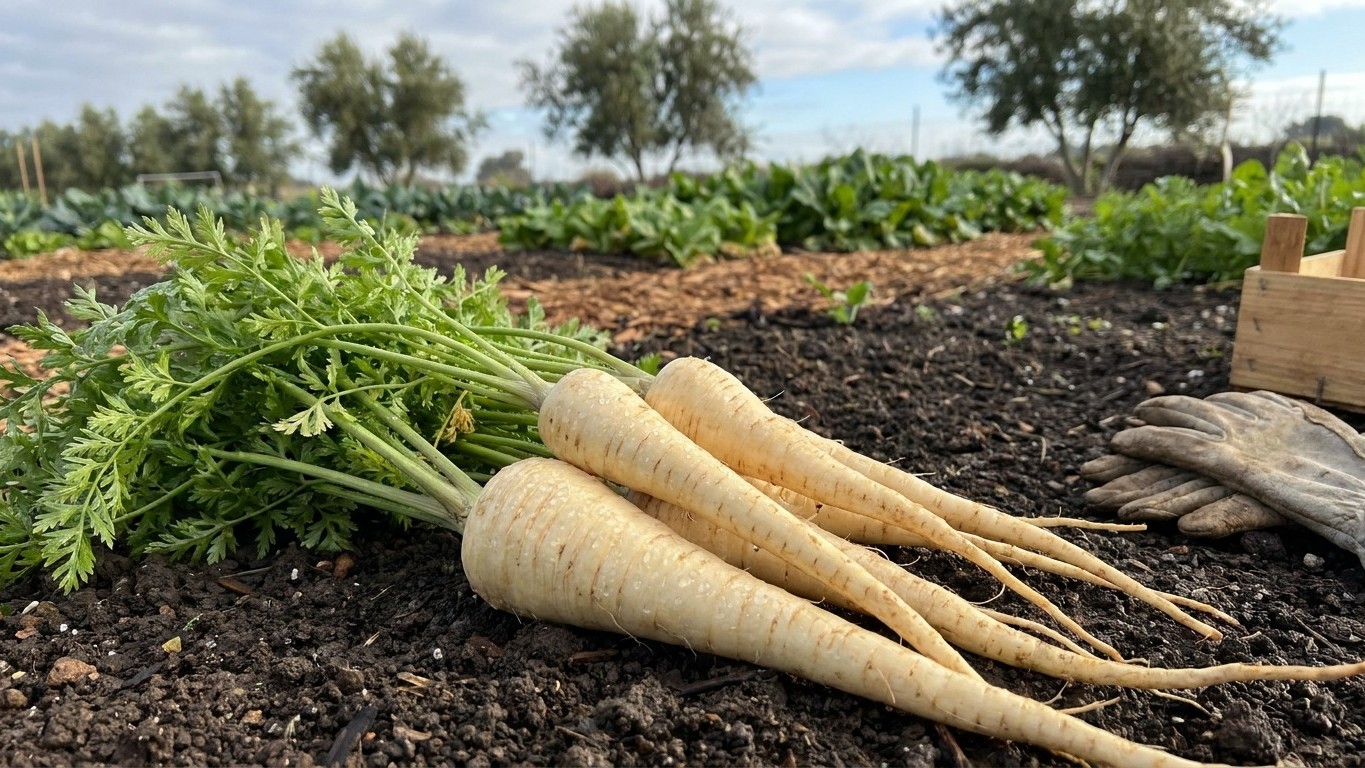

In coastal and Southern California, parsnips will grow long, healthy roots, but most winters won’t deliver the cold snap gardeners are hoping for. Inland, where the Central Valley and Sierra foothills see real freezes, the outcome flips entirely. The reference climate data behind this page comes from a Los Angeles station, and it points toward growth without sweetness.
The short answer

Does this stretch of California hand a parsnip several frosty weeks in a row, or does winter here simply stay mild? That’s the only question that decides whether the sweetness Utah State University Extension describes ever shows up in the root. The soil, the sowing date, none of it matters as much as this one climate fact.
What the numbers show
At the Los Angeles reference station, NOAA’s 1991-2020 Climate Normals put the average daily minimum temperature for the coldest month at 49.1 degrees Fahrenheit. That’s not a record low and not a seasonal average, it’s the typical overnight low during the coldest stretch of the year, sitting nearly 17 degrees above freezing. NOAA’s daily records for the same station go further: across 30 years, zero days dropped to 32 F or below, and the frost-free season is listed at the full 365 days.
Sweetens or just grows
That combination rules out sweetening in this reference climate. A parsnip left in the ground here will keep growing and stay perfectly edible, but it won’t get the several weeks of frost exposure that converts stored starch into sugar, because there’s effectively no frost to expose it to. Gardeners in coastal and Southern California should expect a mild, mineral-tasting root rather than the frost-sweetened one this crop is known for. Move inland toward the Central Valley or up into the Sierra foothills, where winter freezes are routine, and the calculation changes, though no comparable normals for those areas appear in the data used on this page.
Does the season fit?
Parsnips are sown in place, straight into garden soil, and the clock starts the day the seed goes in, not on some later transplant date. Utah State University Extension counts 100 to 120 days from that sowing to a mature root, with seed normally going in 2 to 3 weeks before the last spring frost. In a reference climate where no freeze occurs in an average year, that benchmark needs adjusting rather than abandoning.
- Germination comes first, and it’s slow: parsnip seed typically takes 14 to 21 days to emerge, so bare-looking soil after a week isn’t a failed sowing.
- Count the growing window from the seeding date: 100 to 120 days before the root is ready to pull, regardless of what the calendar says about frost.
- Look for a frost marker to time that sowing against: with no computable last spring frost date at this reference station and zero days at or below 32 F recorded over 30 years, the usual “2 to 3 weeks before last frost” rule has no frost to measure from.
- Substitute the real limiting factor. Heat, not frost, closes the sowing window here, since parsnip seed germinates poorly in hot soil, which pushes sowing toward late summer or fall for a winter harvest instead of the usual spring-to-summer schedule.
- Judge the fit on that basis: season length isn’t the constraint in a frost-free area, since nothing cuts the crop off early. Heat and water management during that 100-to-120-day stretch are what actually decide success.
In practical terms, the season fits here, just not on the spring template most seed packets assume. A fall sowing, timed to mature through the cooler, shorter days of winter, uses the same 100-to-120-day count without needing a last-frost date this climate doesn’t have.
What goes wrong here
Three problems account for most disappointing parsnip harvests, and two of them start in the soil rather than the sky.
- Forked, twisted roots. Heavy or stony ground blocks the taproot and forces it to split around obstructions, while overwatering has the same effect by encouraging shallow, branching side roots instead of one deep taproot. Utah State University Extension recommends deep sandy soil, or double digging heavy ground before sowing, plus watering deeply but less often rather than keeping the bed constantly saturated.
- A season that runs out. Sow too late relative to the 100-to-120-day count and heat or shortening daylight can catch the root before it’s finished sizing up. The fix is arithmetic: count forward from the sowing date, not backward from a harvest wish, and adjust the sowing month to the season available.
- A winter too mild to sweeten. This is the failure specific to coastal and Southern California’s climate. The root can reach full size and still taste flat, because sweetening requires several weeks of frost exposure that this climate, per the data above, doesn’t reliably provide. Harvesting on schedule rather than waiting for a chill that isn’t coming avoids a woody, overgrown root with no flavor payoff.
The Sap Warning
Parsnip greenery looks harmless, but North Carolina State University Extension’s Plant Toolbox is direct about it: “All parts of this plant contain furocoumarins which can make skin sensitive to light causing burns so be sure to wear gloves, long sleeves and long pants when dealing with it.” That covers the leaves, the stems, and the root itself, not just the foliage gardeners usually brush against while weeding.
The mechanism is what makes this catch people off guard. Furocoumarins in the sap don’t burn skin on contact. They need sunlight to activate, a reaction called phytophotodermatitis: sap lands on skin, ultraviolet light hits that same patch, and the skin becomes markedly more sensitive to that light, sometimes producing a burn that doesn’t appear until hours later. That delay is exactly why a bright afternoon spent pulling tops or harvesting roots is the riskiest moment, and why people who felt nothing while working are often surprised later.
Because the reaction depends on sunlight rather than the sap alone, washing hands afterward doesn’t undo exposure that already happened under sun. The protection has to come before contact: gloves, long sleeves, and long pants whenever hands and forearms are working around the foliage, the stems, or a freshly pulled root.
Checking this against your own county
Everything above comes from a single reference station in Los Angeles, and California’s climate swings harder over short distances than almost any other state. A backyard in Fresno, Bakersfield, or up in the Sierra foothills can see real winter freezes that this coastal data never captures, which changes both the sowing calendar and the sweetening outcome discussed here.
The University of California’s Agriculture and Natural Resources division runs county-based Cooperative Extension offices across the state, and that’s the right next stop for a local answer. A county office can pull the actual frost normals for your address, confirm whether winters run cold enough to sweeten a parsnip, and adjust sowing timing to local soil and heat rather than to a Los Angeles average. Find the office covering your county through UC ANR before betting a season on statewide generalizations.
Common questions
Do parsnips need frost to grow, or just to taste good?
Just to taste good. Utah State University Extension describes frost as what converts stored starch to sugar; the root will still size up and stay edible without it, just less sweet.
Can I still grow parsnips in frost-free Southern California?
Yes. The plant will grow through the full 100-to-120-day cycle without a problem, but expect a milder, less sweet root than one grown where winter frost is routine.
How long does parsnip seed take to sprout?
Fourteen to 21 days, according to Utah State University Extension. Bare-looking soil during that stretch doesn’t mean the sowing failed.
Is parsnip sap dangerous to touch when it’s not sunny out?
NC State Extension’s warning centers on skin becoming light-sensitive after contact with the sap, so the reaction depends on sunlight exposure afterward. Gloves and long sleeves are still the recommended protection any time you’re handling the plant.