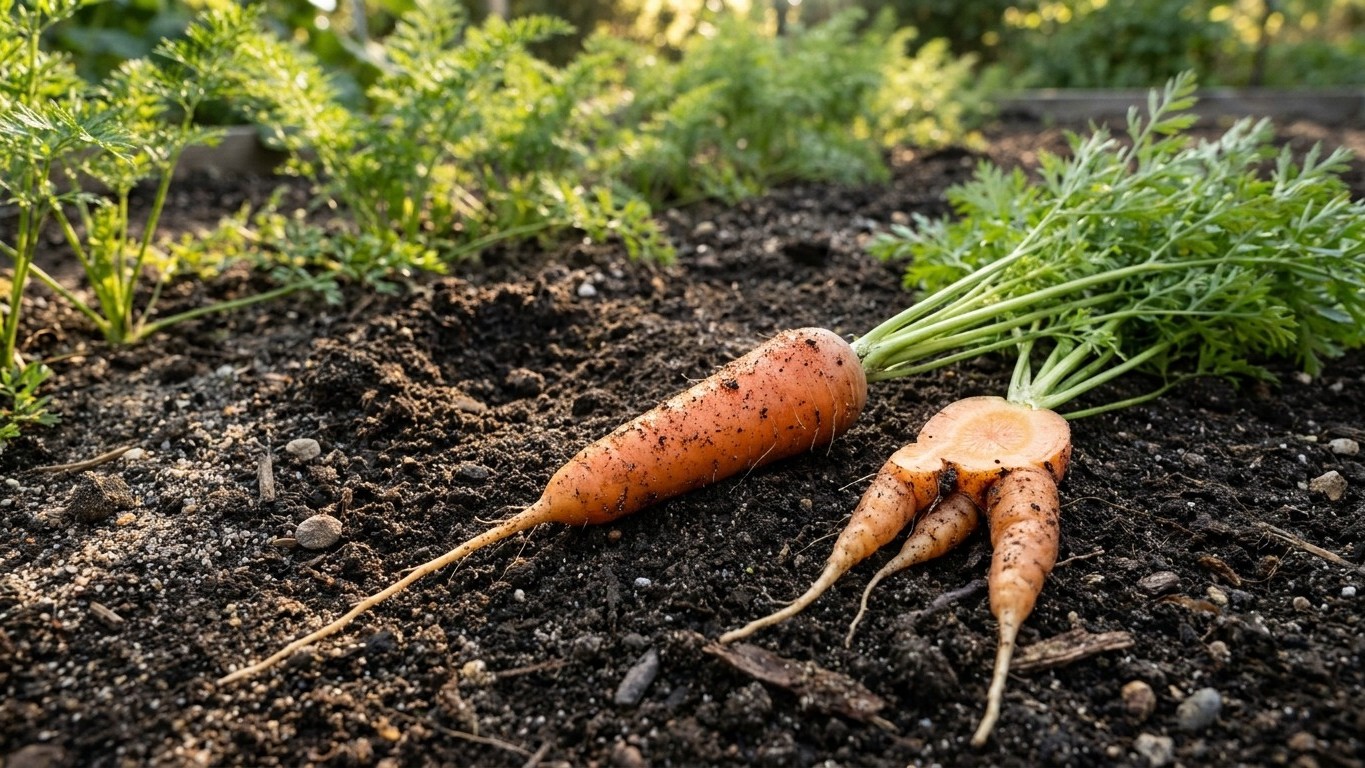

British Columbia’s farmland skews sandy and well drained, with only about 10 percent clay in a typical surface horizon. That’s good news for carrots: low clay means low fork risk in much of the province’s growing ground. But “typical” hides a lot of variation, and the difference between a straight root and a gnarled one usually comes down to what’s actually under your own boots, not the provincial average—which is exactly the question behind Will Carrots Fork in British Columbia Soil?
The short answer
The most common soil order mapped across British Columbia’s agricultural regions is a Brunisol, a young soil whose horizons are only just beginning to separate, typical of recent or coarse parent material. It shows up in about 33 percent of the mapped surface (Podzolic soils come next). The median surface sample runs slightly acid, with a pH around 5.8, and texturally it sits in loam to silt territory: roughly 52 percent sand, 10 percent clay, and 38 percent silt. Organic matter averages around 5.0 percent, and drainage is classed as well drained. That data comes from Agriculture and Agri-Food Canada’s Canadian Soil Information Service, drawing on nearly 2,600 mapped soil components across the province.
For a carrot, that profile is largely favorable. Utah State University Extension is blunt about what carrots need: deep, sandy, well-drained soil rich in organic matter. Heavy or rocky ground is what makes a taproot hit resistance, split its path, and come up forked or stubby. A soil that’s 52 percent sand and well drained, with organic matter already sitting around 5 percent, is close to what the crop wants without much intervention. You’re not starting from clay you need to fight.
That doesn’t mean every BC garden gets a free pass. The 10 percent clay figure is a median across thousands of sampled points, and a province this size holds hundreds of distinct soil series, not one. Coastal river bottoms, old floodplain silt, glacial till in the interior, and anything a builder has scraped, filled, or compacted during construction can sit far from that median. If your ground runs heavier than the provincial figure, or if you turn up cobbles and stones a few inches down, the fix Utah State recommends still applies: work in generous compost and double dig the bed to loosen and de-stone the top 12 to 15 inches before you sow. Where the native ground is shallow over hardpan or rock, or simply too compacted to loosen by hand, a raised bed filled with a loose, sandy, compost-rich mix sidesteps the problem instead of fighting it row by row.
Treat the provincial numbers as a starting point, not a verdict on your yard. They tell you what the region’s ground tends to do, not what your specific bed will do this season. Soil is only half the equation, though—pairing the right texture with When to Sow Carrots in British Columbia matters just as much for a straight, unforked root. The next section walks through how to find that out without sending a sample to a lab.
The test that settles it in your own garden
A soil map gives you a regional tendency. Your garden gives you an answer. These checks take an afternoon and need nothing beyond a shovel, a bucket of water, and your own hands.
- Dig a test hole 12 to 15 inches deep where you plan to sow. Carrots need that much loose, unobstructed depth to grow straight; anything shallower and the root will hit resistance and fork or curl.
- Check for stones and rubble as you dig. A fork happens the moment a taproot meets a rock, a root, or a hard clay lens and has to split around it. Pull out what you find and note how deep the obstructions start.
- Feel the texture. Grab a moist handful and squeeze. Sand falls apart and feels gritty. Clay holds a ribbon shape and feels slick. Loam does something in between, holding together loosely before crumbling. This tells you roughly where your patch sits relative to the province’s 52/10/38 sand-clay-silt figure.
- Watch how water drains. Fill the hole with water and time how long it takes to disappear. Water that lingers for hours signals compaction or a clay layer working against you; water that vanishes in minutes confirms a loose, well-drained bed like the one the provincial data describes.
- Decide from what you find. Loose, stone-free, well-draining ground needs little more than a season of light compost. Compacted, rocky, or slow-draining ground needs the double-digging and organic matter Utah State recommends, or a raised bed if the native soil simply won’t cooperate.
When to sow here
Carrots are sown directly into the ground; there’s no transplanting step to shift the calendar around, so every count below runs from the seeding date itself.
- Start from the frost baseline. Environment and Climate Change Canada’s 1981-2010 Climate Normals put the average last spring frost at the Vancouver Int’l A station on March 18. That’s a mean, not a guarantee: in roughly half of all years, frost arrives later than that date, so treat it as the midpoint of a window rather than a safe line to plant against.
- Confirm the soil, not just the calendar. Carrot seed needs the soil itself at 40 degrees Fahrenheit minimum before it will germinate at all. A mild March on paper means nothing if the ground is still cold and wet underneath; a soil thermometer pushed a couple of inches down settles the question faster than guessing from the air Temperature.
- Sow 2 to 3 weeks before your expected last frost. Carrots tolerate a light frost better than many root crops, which is why growers push the sowing date ahead of the frost-free date rather than waiting past it. Counting Back From the March 18 average puts an early sowing window in late February to early March in mild coastal ground, later inland where soil warms slower.
- Aim for the germination sweet spot. Seeds come up fastest and most evenly between 55 and 65 degrees Fahrenheit. Below that range, germination drags out over weeks instead of days; above it, in a hot dry stretch, the seed row can crust and dry out before the seedlings emerge.
- Adjust for your own microclimate. A raised bed warms faster than open ground in spring, which can pull your sowing window earlier. A shaded or low-lying yard that holds cold air will need to wait longer for that 40-degree soil floor, regardless of what the provincial average frost date suggests.
What goes wrong here
- Forking in heavy or compacted pockets. Even where the provincial average runs sandy, pockets of denser clay or construction fill exist. A taproot meeting resistance splits around it. The fix is the same one Utah State Extension gives for heavy ground generally: work in compost and double dig 12 to 15 inches deep before sowing, or build a raised bed where the native soil can’t be loosened enough.
- Poor or patchy germination in a warm dry spell. Carrot seed is small and sits shallow, so it dries out fast once soil temperature climbs well above the 55-65 degree sweet spot. Light, frequent watering to keep the top inch of soil consistently damp until seedlings emerge solves most of this; a light mulch of straw or fine compost over the row helps hold that moisture.
- Splitting from uneven watering. Once roots are established, a dry stretch followed by a heavy soak makes the root swell faster than its skin can stretch, and it splits. Steady, even watering on a set schedule, rather than watering only when the bed looks visibly dry, keeps growth even through the season.
- Stunted or twisted roots in shallow ground. If the loosened topsoil runs out at 6 or 8 inches instead of the 12 to 15 inches carrots want, the root has nowhere to go and curls or stops short. Checking depth with a shovel before sowing, as covered above, catches this before the seed ever goes in the ground.
Checking this against your own county
British Columbia doesn’t divide its agricultural advice by county the way some places do, but the province runs its own dedicated service for exactly this kind of question. The BC Ministry of Agriculture and Food publishes region-specific growing guidance and can point you toward local soil testing options and extension contacts for your part of the province. Given how much the mapped soil data varies between a coastal floodplain and an interior valley, that regional check is worth the few minutes it takes, especially before you invest in double digging a bed that might not need it, or skip a raised bed a rockier lot actually requires.
Common questions
Does British Columbia’s soil naturally suit carrots?
The dominant profile across the province’s mapped agricultural land runs sandy and well drained, with only around 10 percent clay, which favors straight roots over forked ones. But that’s a provincial median, not a guarantee for any one yard.
What pH do carrots need in BC soil?
The provincial data shows a median surface pH of about 5.8, slightly acid. No specific ideal pH range for carrots is established in the sourced data here, so a home soil test remains the only reliable way to check your own bed.
Can I sow carrots before the last frost in BC?
Yes. Carrots tolerate light frost, which is why the recommended window is 2 to 3 weeks before the average last frost date, not after it. Just confirm the soil itself has reached at least 40 degrees Fahrenheit first.
Why do my carrots keep forking even in loose soil?
Forking usually traces back to something a taproot physically hit: a stone, a hard clay lens, or shallow loosened depth. Digging a test hole 12 to 15 inches deep before sowing, as outlined above, usually reveals the obstruction before it becomes a crop problem.