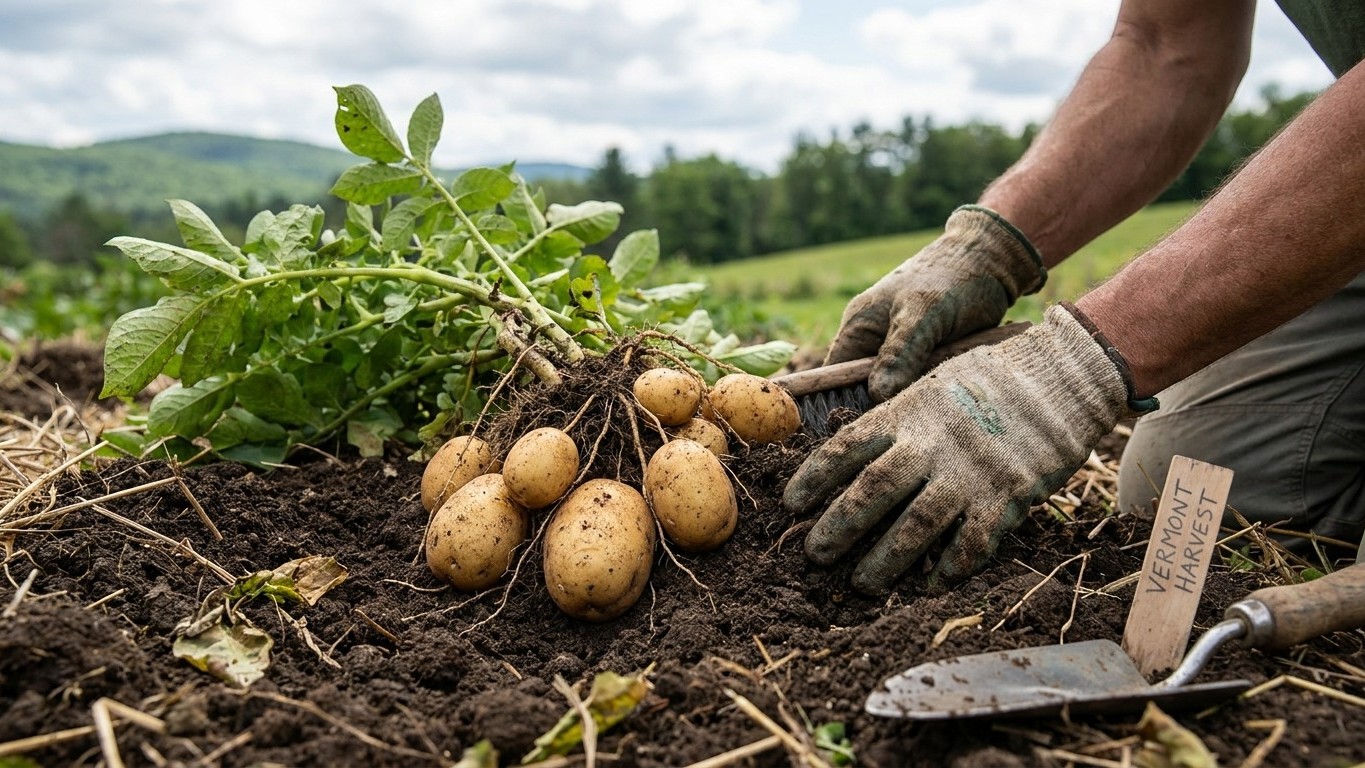

Vermont’s summers rarely turn hostile to potatoes. Burlington averages just 5.4 days a year at or above 90°F, according to NOAA NCEI Climate Normals, so the soil heat that stalls tuber growth almost never becomes a season-long problem here. The variable that actually decides your harvest is the state’s short, late spring, since the last frost lingers into early May even in the mildest corner of the state. Get the planting date right and Vermont’s cool nights do more for potatoes than most states’ entire summer.
The short answer
Two numbers, both tied to Burlington on Lake Champlain, tell you almost everything you need to know about growing potatoes anywhere in Vermont. The first is heat load: 5.4 days a year reach 90°F or higher, based on NOAA NCEI’s 1991-2020 Climate Normals for the reference station. The second is timing: the last spring frost falls between April 30 and May 10, drawn from the same NOAA NCEI dataset’s 32°F freeze-probability record at station USW00014742.
Utah State University Extension, which publishes the fact sheet growers rely on for potato heat tolerance, sets the threshold plainly: tuber set and fill are inhibited once soil temperatures climb above 90°F. That is the ceiling every potato grower is really working against, whether they know it or not. In a place with 90 or more days a year over that mark, a gardener has to plant early and dig before the heat arrives, treating the whole crop as a spring rush. Vermont is nowhere close to that situation, and choosing from the Potato Varieties That Suit Vermont matters more here than racing the heat. With barely five days a year even brushing 90°F in the air, soil temperatures rarely spend enough sustained time near the ceiling to shut tuber growth down mid-season.
That changes the whole strategy. A Vermont gardener does not need to sprint the crop into the ground and dig before summer, the way a grower in the Deep South or the desert Southwest does. The growing window here can run the full season, from spring planting through a fall harvest, without heat forcing an early dig, though knowing the right techniques for Harvesting and Storing Potatoes in Vermont still matters once that fall dig arrives. The frost dates matter far more than the thermometer in July.
Location inside the state still moves those numbers. Burlington sits directly on Lake Champlain, which is the mildest pocket in Vermont, so the April 30 to May 10 window is the shortest, mildest version of frost risk anyone in the state will see. The Green Mountains and the Northeast Kingdom run substantially later and shorter, sometimes by several weeks, which pushes both the safe planting date and the length of the frost-free season in a colder direction. The state-wide answer is that heat will not stop your potatoes here. The county-level answer is that you need your own frost date before you trust any calendar built around Burlington.
When to plant here
Potato planting dates are built backward, not forward. Instead of picking a date and hoping, you start from your local last frost and count back to the point where the soil, not the air, has reached the temperature potatoes need. For a detailed week-by-week breakdown, see When to Plant Potatoes in Vermont. That number, published by both Utah State University Extension and University of Maine Cooperative Extension Bulletin #2077, is 50°F soil temperature, reached 14 to 21 days before the last frost date.
- Find your local last frost window. For Burlington, NOAA NCEI puts it between April 30 and May 10. If you garden elsewhere in the state, this date shifts, sometimes by weeks, and you’ll need your own county’s figure before doing the math below.
- Count backward 14 to 21 days from that date. Starting from the earliest edge of Burlington’s window, April 30, subtracting three weeks lands you around April 9. Subtracting two weeks instead lands closer to April 16. Starting from the later edge, May 10, the same math puts the range between April 19 and April 26.
- Check actual soil temperature before trusting the calendar. A simple soil thermometer pushed 4 inches into the bed, checked in the morning over a few consecutive days, tells you when the ground itself has crossed 50°F. Calendar math gets you close; the thermometer confirms it.
- Plant once soil hits 50°F, even if that falls earlier or later than the calculated window. A warm early spring or a cold, wet stretch can shift the real date by a week or more in either direction from the arithmetic above.
That gives most of Vermont a realistic seed-potato planting window somewhere in the first three weeks of April, tightening toward late April in colder pockets away from Lake Champlain. Nothing about Vermont’s summer heat forces you to plant earlier than that math suggests, which is a real advantage over states where the spring window gets compressed by an early heat ceiling.
What the heat does to the crop
The mechanism is simple, and it is the single fact that decides whether a potato crop succeeds anywhere: once soil temperature climbs above 90°F, tuber set and fill are inhibited, according to Utah State University Extension. Potatoes are underground organs, and the plant reads soil heat as a signal to stop building the starch-filled tubers a gardener is actually growing for. That happens regardless of how much water reaches the roots. Watering does not fix it, because the problem isn’t drought stress, it’s a temperature threshold the plant’s own physiology enforces.
In states where that threshold gets crossed for weeks at a stretch, the only workable answer is to treat potatoes as a spring-only crop: plant as early as the soil allows, and dig before the ceiling arrives, accepting whatever size the tubers have reached by then. Vermont doesn’t ask that of its gardeners. With an average of 5.4 days a year reaching 90°F or above at the Burlington reference station, sustained soil-heat shutdowns of the kind that force early digging in hotter climates are rare here.
That means a Vermont grower can generally let the crop run its full course, planting in mid-to-late April and harvesting well into the fall, without the plant’s tuber-building machinery shutting off mid-summer. The trade-off runs the other direction: Vermont’s limiting factor is the length of the frost-free season itself, not heat stress within it. A late, cold spring or an early fall frost trims the growing window far more often here than a heat spike does. Plan around frost dates first, and treat summer heat as the one variable you mostly don’t have to manage.
What goes wrong here
- Planting uncertified seed potatoes. Grocery-store or unlabeled seed can carry viruses that certified seed programs screen out; buying certified seed potatoes is the single change that most reliably protects yield, and it costs nothing beyond the purchase itself.
- Planting into cold, wet soil before it reaches 50°F. Vermont’s spring soil holds moisture and cold longer than the air temperature suggests, and seed pieces set into ground that hasn’t warmed tend to rot before they sprout; checking soil temperature directly, rather than trusting a calendar date, avoids this.
- Skipping the hilling and ending up with green tubers. Tubers that develop near the surface get exposed to light and turn green, which makes them unfit to eat; mounding soil over the row as plants grow keeps developing tubers covered and light-free.
- Digging too early, before the season’s actual end. Since heat rarely forces an early harvest in Vermont, digging ahead of schedule usually just cuts short the tuber-fill period the plant would otherwise have used; letting the crop run closer to first fall frost, rather than an arbitrary summer date, generally produces a larger harvest.
Checking this against your own county
Every figure above is anchored to Burlington, the mildest, lowest, most lake-moderated spot in Vermont. That makes it a reasonable starting point and a poor final answer for most of the state. Elevation alone can push a frost date back by weeks, and the difference between a valley floor and a ridge a few miles away is often enough to matter for a crop planted in April. The Green Mountains run colder and later than the Champlain Valley, and the Northeast Kingdom later still.
Before locking in a planting date, check it against your own county through the University of Vermont Extension, which tracks local frost data and soil conditions county by county. A state-wide window tells you roughly which month to prepare for. Your own extension office tells you which week actually applies to your garden.
Common questions
Do potatoes need a special summer strategy in Vermont, the way they do in hot states?
No. Because Burlington averages only 5.4 days a year at or above 90°F, the soil-heat shutdown that forces gardeners in hotter states to dig a spring-only crop rarely happens here. A full-season crop, planted in April and dug in fall, is the standard approach statewide.
How do I know which potato variety suits Vermont’s season?
Utah State University Extension and University of Maine Cooperative Extension classify potatoes by season length, early, mid-season or late, rather than publishing a fixed number of days to maturity. The same sources describe use rather than texture labels: some varieties are suited to boiling and salads, others to baking and longer storage. Choosing by season class and intended use, rather than a maturity number, matches how the extension services themselves frame the decision.
What happens if I plant before the soil reaches 50°F?
Seed pieces set into soil colder than that tend to sit without sprouting and are more prone to rotting in Vermont’s often wet spring ground, according to the planting guidance from University of Maine Cooperative Extension Bulletin #2077. Waiting for the soil, not just the calendar, is the safer call.
Does watering help if a heat wave hits during the growing season?
Not for the specific problem heat causes. Once soil temperature crosses 90°F, tuber set and fill are inhibited by the heat itself, per Utah State University Extension, and that mechanism isn’t a moisture issue. Vermont’s low count of 90°F days means this rarely comes up, but where it does, watering doesn’t reverse it.