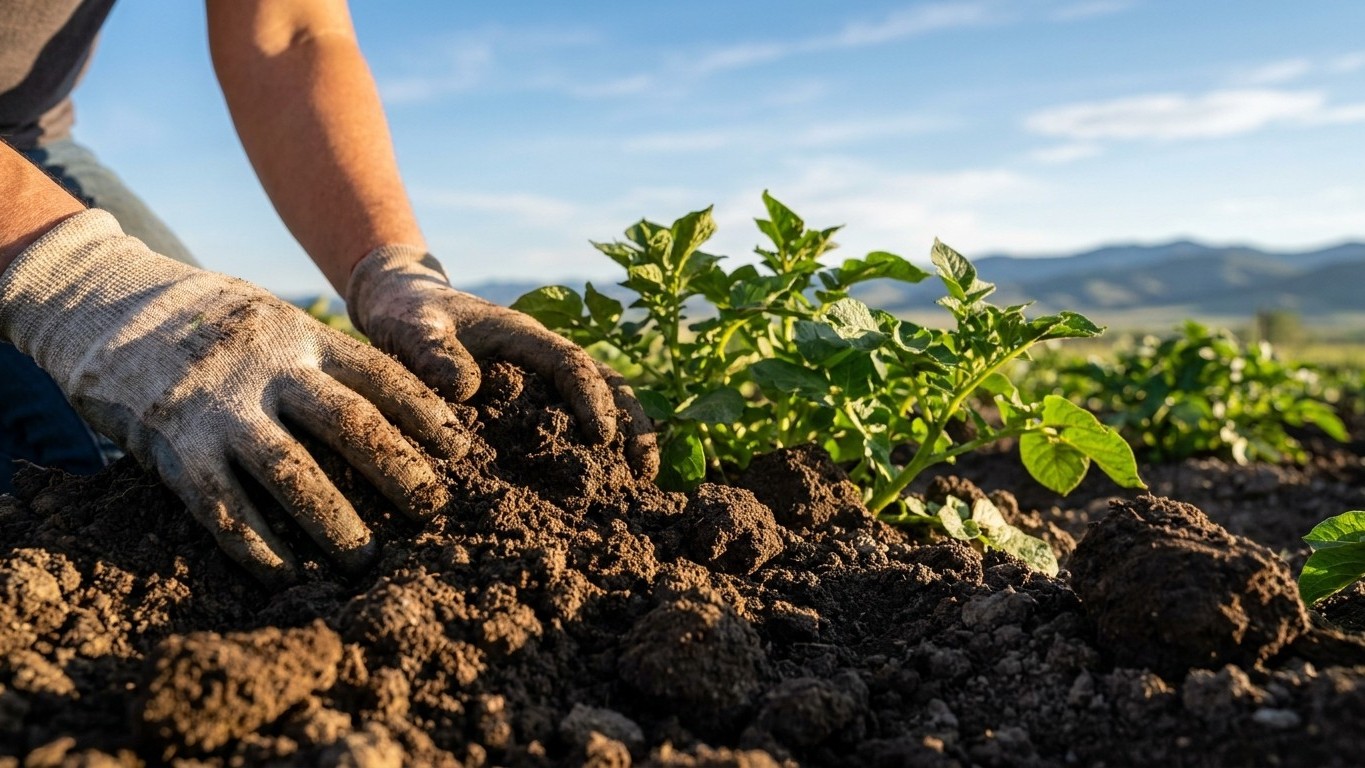

Wyoming’s summer heat is not what limits this crop. Cheyenne averages just 10.4 days a year at 90°F or higher, well under the threshold that shuts down tuber growth. The real constraint is timing: the last spring frost falls between May 7 and May 18, and at higher elevations a frost can return in any month. Plant early, hill properly, and Wyoming gardeners can run a full season rather than racing to beat the heat.
The short answer
Two numbers decide whether potatoes work in a given climate: how many days a year the soil bakes past 90°F, and how long the frost-free window actually runs. In Wyoming, at the Cheyenne reference station, NOAA NCEI Climate Normals for 1991-2020 put the average at 10.4 days a year reaching 90°F or more. That’s a fraction of what growers deal with in the Deep South or the low deserts of the Southwest, where triple digits stack up for weeks. Cheyenne’s last spring frost, per the same NOAA dataset, falls somewhere between May 7 and May 18 depending on the year.
Those two figures together answer the question this page is built to answer: does Wyoming summer heat stop potatoes from sizing up? No. Utah State University Extension identifies 90°F soil temperature as the ceiling above which tuber set and fill are inhibited. With only about ten days a year crossing that air-temperature mark, and soil temperatures typically running cooler than air temperature under normal moisture and mulch, Wyoming’s growing season rarely pushes potatoes past that limit. This is a state where a full-season crop, planted in spring and dug in early fall, is the realistic plan rather than a compressed spring-only dash to dodge summer. For a detailed breakdown of dates by region, see When to Plant Potatoes in Wyoming.
Why the frost date Matters More Than the heat here
The frost window is the tighter constraint. At around 6,000 feet in much of southeastern Wyoming, the frost-free season runs roughly 130 days, and that’s before accounting for higher valleys and foothill gardens where frost risk extends further into the calendar on both ends. A gardener here loses more potato-growing time to a late May cold snap than to a July heat wave. That reshapes the whole planning calendar: instead of asking “how do I keep this crop alive through August heat,” the Wyoming question is “how early can I safely get seed potatoes into the ground, and how do I protect young plants if frost returns after emergence.”
Choosing early-season and mid-season varieties, rather than late-season types, gives Wyoming gardeners more margin against that short window, since Utah State University Extension and University of Maine Cooperative Extension both classify varieties by season length rather than a fixed day count. Neither source publishes a specific days-to-maturity figure for named cultivars, so the practical approach is to pick by season class and adjust planting date around your county’s own frost data, not around a number printed on a seed catalog. For guidance on which cultivars fit this pattern, see Potato Varieties That Suit Wyoming, and plan ahead for Harvesting and Storing Potatoes in Wyoming once the short season closes in seed bag.
When to plant here
The planting date isn’t picked from a calendar page. It’s counted backward from the local frost window, using soil temperature as the actual trigger. Here’s how that arithmetic works using Cheyenne’s own numbers:
- Start with the last frost window. For the Cheyenne area, NOAA NCEI puts that window between May 7 and May 18.
- Subtract 14 to 21 days. Utah State University Extension and University of Maine Cooperative Extension both place potato planting 14 to 21 days ahead of the last frost date, since seed potatoes tolerate cool soil better than emerged foliage tolerates frost.
- Run the math on both ends of the window. Twenty-one days before May 7 lands on April 16. Fourteen days before May 18 lands on May 4. That gives a rough planting window of mid-April to early May for the Cheyenne area specifically.
- Confirm with a soil thermometer before committing. The date math is a starting estimate; the actual green light is soil temperature reaching 50°F at planting depth, checked directly rather than assumed from the calendar.
- Delay if a cold, wet spell is forecast. Soil that’s cold and saturated at planting sets up rot before it sets up sprouts, regardless of what the date on the calendar says.
This same backward count works for any county in the state. Swap in the local last-frost date, subtract 14 to 21 days, and check soil temperature before putting seed in the ground.
What the heat does to the crop
The mechanism matters more than any single date on a calendar. Utah State University Extension is explicit that tuber set and fill are inhibited once soil temperature climbs above 90°F. Below that threshold, the plant keeps building tubers. Above it, growth effectively stalls, and no amount of irrigation reverses that stall. Watering a stressed potato plant during a heat spike keeps the foliage from wilting, but it does not restart the biological process that packs starch into developing tubers once soil temperature has crossed the line.
This is where Wyoming’s climate profile actually works in the gardener’s favor. With Cheyenne averaging only 10.4 days a year at 90°F air temperature, and soil temperature typically trailing several degrees behind peak air temperature under normal garden conditions, most Wyoming gardens simply don’t spend much of the season above that ceiling. That means the standard advice for hot-summer states (dig a spring crop early and skip trying to carry potatoes through the hottest weeks) doesn’t apply here in the same urgent way. A Wyoming grower can plant in the mid-April to early-May window described above and let the crop run through summer into a fall harvest without summer heat itself being the thing that ends the season.
Where heat still matters is in isolated pockets: raised beds with dark soil, gardens against south-facing walls, or unusually hot, dry stretches in July. In those specific microclimates, midday soil temperature can spike even when the regional average stays low. Mulch and consistent moisture reduce that risk by moderating soil temperature swings, but the fix is preventive, not curative. Once soil has spent extended time above 90°F, no amount of after-the-fact watering brings back lost tuber sizing.
What goes wrong here
- Planting uncertified seed potatoes. Grocery-store potatoes and saved tubers from a previous crop can carry viruses invisibly. Certified seed potatoes are tested and tagged specifically to avoid that risk, and it’s the single most important purchase decision in the whole process.
- Planting into cold, wet soil before it reaches 50°F. Seed pieces sitting in cold, saturated ground are prone to rot before they ever sprout. Wait for the soil temperature check described above rather than planting on a fixed calendar date.
- Skipping the hilling and ending up with green tubers. Tubers that develop near or breaking the soil surface turn green with light exposure and produce solanine, making them unsafe to eat. Hilling soil up around the base of the plant as it grows keeps developing tubers covered and in the dark.
- Digging the crop too early. Pulling potatoes before the foliage has died back naturally means thinner skins that bruise and store poorly. Letting the vines die down on their own before harvest gives tubers time to finish setting their skins for storage.
Checking this against your own county
A statewide frost window is a starting point, not a fixed instruction. Wyoming’s elevation swings from roughly 3,100 feet along the eastern border to well over 6,000 feet across much of the interior, and that difference alone can shift a last-frost date by weeks between a low valley and a mountain-adjacent garden. North-facing slopes, low-lying frost pockets, and higher-elevation towns all push the safe planting date later than the Cheyenne figures used here.
The most reliable next step is checking those numbers against your own county through the University of Wyoming Extension, which tracks local frost data and growing conditions specific to each region of the state rather than relying on a single statewide average.
Common questions
Is Wyoming too cold to grow potatoes?
No. The frost-free season is shorter than in warmer states, running roughly 130 days at around 6,000 feet, but that’s enough time for a full potato crop once planting is timed correctly around the local last-frost date.
Do I need to worry about summer heat killing my potato plants in Wyoming?
Not in most of the state. Cheyenne averages only 10.4 days a year at 90°F or above, well under the level Utah State University Extension identifies as the point where tuber set and fill are inhibited. Isolated hot microclimates, like raised beds against a sunny wall, are the exception worth watching.
What happens if I plant potatoes too early, before a late frost?
Emerged foliage can be damaged or killed by a hard frost, though the seed piece itself underground typically survives cold soil better than the leaves survive freezing air. That’s why the 14 to 21 day counting method uses the last frost date as the reference point, not the first mild day of spring.
Should I choose early, mid-season, or late-season varieties in Wyoming?
Early and mid-season varieties give more margin against a variable frost window, since neither Utah State University Extension nor University of Maine Cooperative Extension publishes a fixed days-to-maturity number, only season classes. Matching a shorter season class to your county’s frost-free window reduces the risk of an early fall frost cutting the season short.