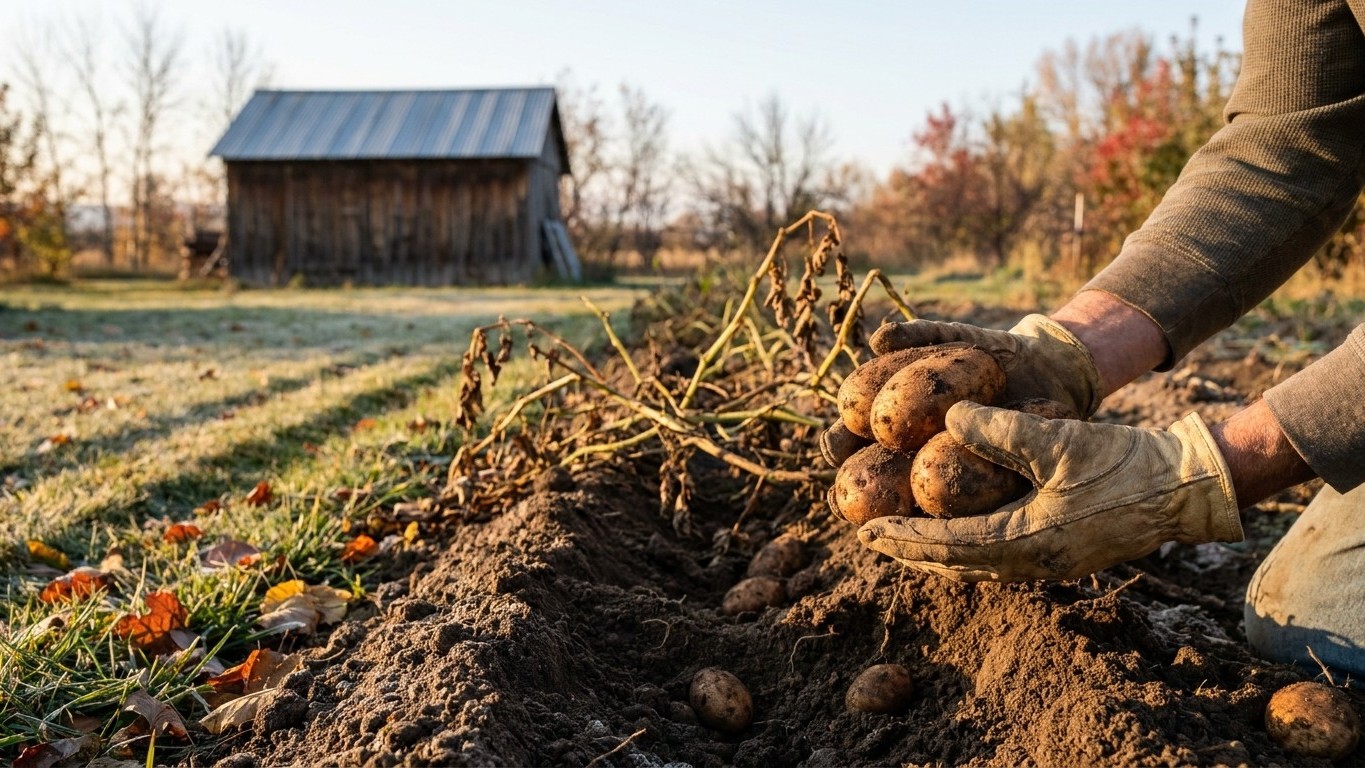

Idaho’s potato crop comes out of the ground on a tight calendar dictated by a frost date that arrives earlier than most people expect, and the state’s winter cold decides whether a backyard storage spot works at all. Get the timing wrong on either end and a season’s harvest can rot, sprout, or freeze before spring.
The short answer
Two numbers frame everything here. Idaho’s first fall frost, based on 1991-2020 climate normals from a reference station in Boise (station USW00024131), falls somewhere between October 7 and October 21. That’s the window growers watch to get tubers dug before a hard freeze reaches into the soil. The second number matters just as much once the crop is out: the mean minimum temperature of Boise’s coldest month sits at 25.4°F. That’s not a record low, it’s the average low on a typical night in the depth of winter, and it’s well below the 40-45°F that stored potatoes need to stay in good shape.
What that means for digging
Vines usually die back or get frost-killed before the frost date itself, and growers dig within a couple of weeks of that die-back rather than waiting for the calendar frost to force the issue. Waiting past the October 7-21 window risks digging into soil that’s already cold enough to chill the tubers hard, which sets up problems later in storage.
What that means for storage
With a coldest-month average low of 25.4°F, an unheated garage, shed, or uninsulated porch in Idaho will not hold steady in the 40-45°F range through winter. It will track much closer to outdoor air on cold nights, and 25.4°F is a freeze for potatoes, full stop. That single number is the reason storage location matters as much as harvest timing in this state. A space needs either added insulation, a buffer against exterior walls, or a heat source to keep it out of the freeze zone once January arrives.
It’s also worth flagging that Boise sits in a low valley, and most of Idaho’s growing ground sits higher and colder than that. Anyone farther from the valley floor should expect an earlier frost and a colder coldest month than these Boise-based figures show, which pushes the whole digging window earlier and makes an unheated storage space an even riskier bet.
Curing, and where
Before potatoes go into long-term storage, they need to cure. Utah State University Extension recommends curing at 55-60°F with high humidity for 2 to 3 weeks. That step lets cut or bruised skins heal over, which is what keeps rot from starting once the tubers are stacked together in a bin or box for the winter.
The curing steps
- Dig the tubers as soon as vines have died back, ideally with dry soil clinging loosely rather than wet, and avoid washing them before curing.
- Move them out of direct sun immediately. Sunlight on exposed tubers causes greening within hours, and that’s a separate problem from curing.
- Set them in a single layer or shallow crates in a spot holding 55-60°F with high humidity, out of direct airflow that would dry the skins too fast.
- Leave them undisturbed for 2 to 3 weeks, checking occasionally for any tubers showing soft spots or rot, and pulling those out so they don’t spread to the rest.
- Once skins are set (they no longer scuff or peel with a light rub), move the batch to the colder, darker space used for winter storage.
Where this works in Idaho
Harvest in Idaho lands in early-to-mid October in most years, right as outdoor highs are dropping into the 50s and 60s and nights are cooling fast. That timing actually helps: a shaded porch, an attached garage, or a cool basement corner often sits close to that 55-60°F range for a stretch of weeks right after harvest, especially before nighttime lows start dragging indoor unheated spaces down. A detached, uninsulated garage is less reliable, since it will often swing colder than 55°F on the chillier October nights, particularly at higher elevations where the season is already shifting toward winter faster than in the Boise valley. A basement with a stable temperature is usually the safest bet for hitting the full 2-to-3-week window without the space dipping too cold partway through.
Storing through this winter
Once cured, potatoes need a dark space and a temperature in the 40-45°F range, per Utah State University Extension, or 38°F at 95% humidity, per the University of Maine Cooperative Extension. Both sources agree on the core idea: cold, dark, and humid, but not freezing and not warm enough to trigger sprouting.
That’s where Idaho’s winter numbers become the deciding factor. A root cellar or below-grade space that stays buffered by surrounding earth can often hold in that 38-45°F band naturally, since soil temperature at depth changes far more slowly than air temperature. An attached basement, especially one near a foundation wall away from heating ducts, frequently lands in a similar range. Those are the spaces that work.
An unheated outbuilding is the opposite case. With Boise’s coldest-month average low at 25.4°F, and colder still at higher elevations across the state, a shed or detached garage with no insulation and no heat source will spend a good part of winter well under the 38°F floor that the University of Maine sets, and far under the 40-45°F range Utah State recommends. That’s a hard freeze for stored tubers, and it ruins them just as completely as a warm attic would by pushing them into premature sprouting. The fix isn’t complicated, but it is necessary here: add insulation, bank the storage bin against an interior wall, or move the crop somewhere with even a modest, steady heat source once nighttime lows start dropping into the 20s.
What goes wrong here
Idaho’s frost timing and winter cold create a specific set of failure points, and most of them trace back to a gap between when the calendar says to act and when the local space actually behaves.
- Digging too late. Waiting past the October 7-21 frost window, especially at higher elevations where frost arrives sooner than in the Boise valley, means digging into soil that’s already chilled the tubers. Dig as soon as vines die back rather than waiting for a hard frost to force the decision.
- Curing in a space that’s already too cold. An unheated garage in early-to-mid October can already be running below the 55-60°F curing range at higher elevations. Move the curing batch to a basement or an interior room if outdoor highs are already dropping into the 40s at harvest time.
- Storing in an uninsulated outbuilding through winter. With a 25.4°F average low in the coldest month, a detached shed or garage will freeze stored potatoes solid at some point in a typical winter. Insulate the space, bank the storage container against an interior wall, or relocate the crop to a basement.
- Letting light reach stored tubers. Both curing and storage need dark conditions. A garage with a window or a basement corner lit by a bare bulb left on will green the skins over time, which is a separate issue from cold damage but just as much a reason for spoiled stock.
- Skipping the sort before storage. Any tuber with a soft spot, cut, or sign of rot at the end of curing should be pulled and used first rather than stored, since one bad potato in a bin can spread rot through the rest over a long Idaho winter.
- Treating disease or insect pressure without a plan. If pests or fungal issues show up on the vines before harvest, an appropriate insecticide or an appropriate fungicide applied ahead of digging protects the tubers going into storage; skipping that step lets problems that started in the field show up months later in the bin.
Common questions
How early should I plan to dig potatoes in Idaho?
Aim to dig as soon as the vines die back, and no later than the start of Idaho’s first fall frost window of October 7 to October 21 based on the Boise reference station. Growers at higher elevations should expect that window to arrive earlier, since Boise sits in a lower, warmer valley than much of the state.
Can I cure potatoes outside in Idaho?
Only if the space stays in the 55-60°F range recommended by Utah State University Extension. An open porch or uncovered space works for part of an October day but rarely holds that range overnight once temperatures start dropping toward the harvest-season frost window.
Will an unheated garage work for winter potato storage in Idaho?
Not reliably. The coldest month’s average low of 25.4°F in the Boise reference data is well below the 40-45°F range Utah State University Extension recommends, and below the 38°F floor set by the University of Maine Cooperative Extension. An uninsulated garage will likely freeze the crop at some point in winter.
What humidity level should stored potatoes have?
The University of Maine Cooperative Extension recommends 95% humidity at 38°F for storage. High humidity during curing is also important, per Utah State University Extension, since it helps skins heal without drying out the tubers.