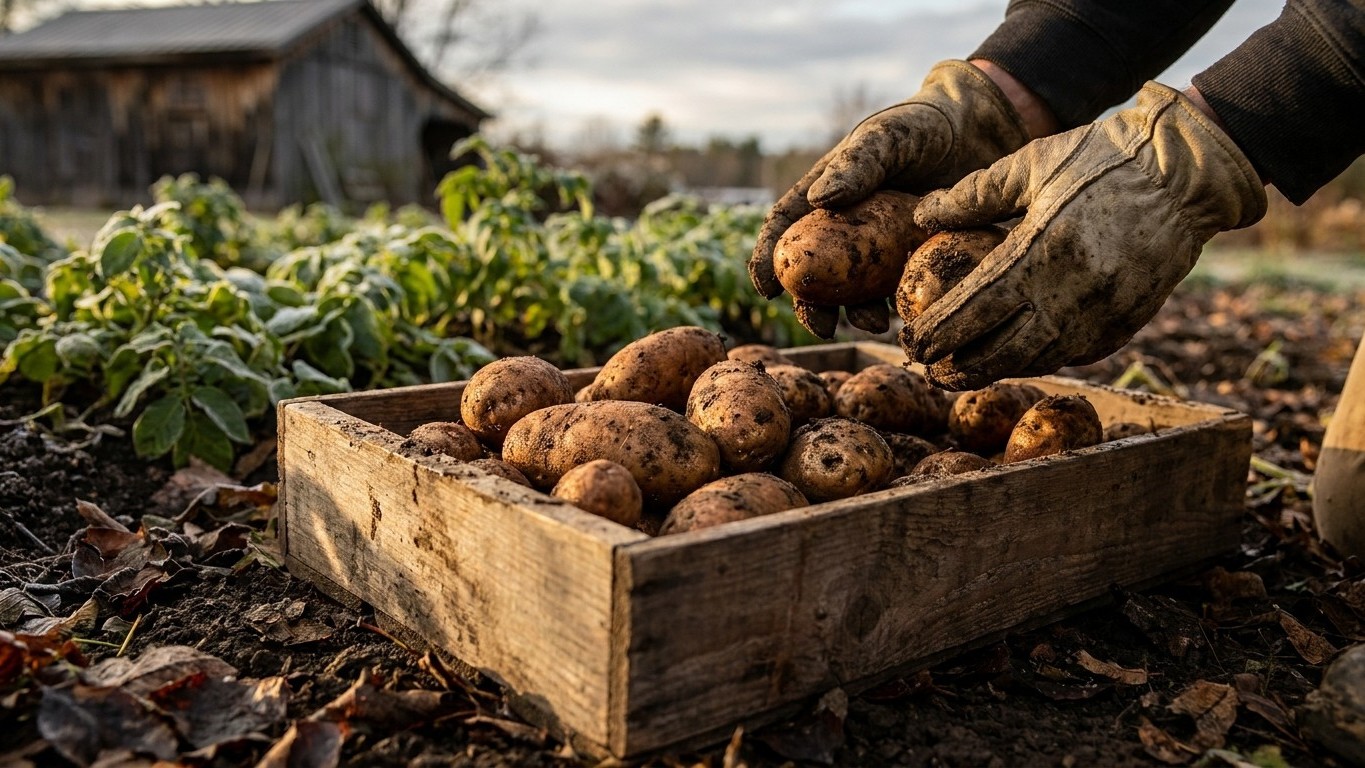

Maine’s growing season ends fast once fall arrives, and that timing decides everything about how this crop gets handled. Dig too late and frost damages tubers still in the ground. Store them in the wrong space and Maine’s winter cold undoes weeks of careful curing in a matter of days. The window for getting this right is narrow, and it’s shaped entirely by two numbers: when the first frost lands, and how cold storage space actually gets once January hits.
The short answer
In the Portland area, the first fall frost typically arrives somewhere between October 9 and October 21, based on NOAA NCEI’s 1991-2020 Climate Normals for that station. That’s the freeze-probability window, the range where a 32 F freeze becomes likely enough to plan around. Potatoes need to come out of the ground before that window closes, because a hard freeze reaching into the soil damages tubers even if the foliage above ground looks fine.
Here’s the catch for anyone gardening outside the immediate coast: Portland sits at the mild end of Maine’s climate. Inland counties and anything north of the coastal strip see frost arrive earlier in fall, sometimes by a couple of weeks or more, and the growing season closes accordingly sooner. If you’re gardening in Aroostook County or the western mountains, treat the Portland window as the late edge of your calendar, not the standard.
The bigger number, though, is the one that governs everything after harvest: 15.6 F. That’s the mean daily minimum temperature for Portland’s coldest month, drawn from the same NOAA NCEI Climate Normals dataset. This isn’t a record cold snap or a one-night anomaly. It’s the average low, night after night, for the coldest stretch of a typical winter. And it answers the storage question immediately.
An unheated garage, shed, or porch in Maine does not hold 40-45 F through the winter. It freezes. With nightly minimums averaging 15.6 F for weeks at a stretch, any structure without insulation and some heat source will drop well below freezing, and stay there. That single fact rules out the casual storage setups that work fine in milder states. Potatoes stored in an unheated outbuilding here don’t just get chilly, they freeze solid, and a frozen potato is a ruined one. Whatever space you choose has to be buffered from that outdoor minimum, whether that’s an insulated basement, a root cellar dug below the frost line, or a heated interior space kept deliberately cool.
Curing, and where
Before storage even starts, potatoes need to cure. Utah State University Extension recommends curing at 55-60 F with high humidity for two to three weeks. That range matters because it lets cut or bruised skin heal over, which cuts down on rot once the tubers go into long-term storage. The problem in Maine is timing: harvest happens right around the first frost window, meaning outdoor air is already cooling fast and won’t reliably sit in that 55-60 F band on its own.
A shaded porch might work in late September, but by the time frost risk is real in early-to-mid October, outdoor temperatures in Maine are already dropping below that curing range most nights. That rules out open-air curing as a dependable option for most of the state once harvest actually happens. The spaces that do hold 55-60 F reliably in a Maine autumn are the ones with some insulation from outdoor swings, a basement being the most common example, since basement temperatures lag well behind outdoor air and tend to sit in a moderate range through fall.
- Dig potatoes on a dry day, once the vines have died back, and before the first frost window arrives in your part of the state.
- Brush off loose soil but don’t wash the tubers; moisture on the skin during curing invites rot rather than healing it.
- Move them immediately to the coolest interior space that still holds 55-60 F, typically a basement rather than a garage or porch once October temperatures set in.
- Keep humidity high during this stage, covering the potatoes loosely with burlap or leaving them in slatted crates rather than sealed containers.
- Hold them there for two to three weeks, checking periodically for any tubers that show soft spots and pulling those out before they spread rot to the rest.
Storing through this winter
Once cured, potatoes need a different environment entirely. Utah State University Extension puts long-term storage at 40-45 F, kept dark. The University of Maine Cooperative Extension gives a slightly more specific target: 38 F at 95 percent humidity. Both point the same direction, cold but not freezing, and humid enough that the tubers don’t shrivel.
This is where Maine’s 15.6 F coldest-month minimum becomes the deciding factor for the whole winter, not just a cold snap. A storage space has to land in that 38-45 F range consistently from harvest through spring, which in a state with nightly averages in the mid-teens for the coldest stretch means insulation or some buffering from outdoor air is non-negotiable. A basement that stays cool but doesn’t freeze tends to fit this window naturally, especially the portion of the basement farthest from any heated living space, since basement temperatures in Maine homes often run cooler than the rest of the house without dropping to outdoor extremes.
A true root cellar, dug into the ground below the frost line, does even better, because soil at depth stays far more stable than any above-ground room regardless of what the air temperature is doing outside. The tradeoff is that not every home has one, and building one is a bigger project than most gardeners take on for a single season’s harvest.
What doesn’t work is anywhere that tracks outdoor air too closely. A garage with a single layer of siding, an attached shed, an unheated porch closed in for winter, these spaces might sit in the 40-45 F range in November, but by January, with that 15.6 F average minimum pulling them down night after night, they cross into freezing territory. Potatoes don’t tolerate that. Once frozen, the starches convert and the texture turns soft and grainy, and there’s no reviving them. On the other end, storing potatoes somewhere too warm, like a heated basement corner near a furnace, pushes them past 45 F and triggers sprouting well before spring, which is its own kind of loss even though it looks less dramatic than a freeze.
What goes wrong here
- Frost reaches the ground before harvest. Growers who wait too long into October, especially inland or north of the coast where frost arrives earlier than Portland’s window, risk tubers damaged by cold soil even when they look untouched above ground. The remedy is digging before the local frost window opens, not after it closes.
- Curing space runs too cold. Once outdoor temperatures drop below the 55-60 F range that Utah State University Extension calls for, an open porch or unheated garage won’t cure potatoes properly, it just chills them. Move curing indoors to a basement or similarly buffered space as soon as outdoor air trends downward in early fall.
- Storage space freezes over winter. With Portland’s coldest-month minimum averaging 15.6 F, any storage area without insulation or heat buffering will drop well below the 38-45 F range that both Utah State University Extension and the University of Maine Cooperative Extension recommend. Move stored potatoes to a basement interior or true root cellar before the coldest months arrive, not after a batch has already frozen.
- Humidity drops too low in dry basement air. Furnace-heated basements often run dry in winter, and the University of Maine Cooperative Extension’s 95 percent humidity target is hard to hit in a bone-dry room. Covering bins with damp burlap or storing in slightly humid corners away from heating equipment helps close that gap.
- Disease pressure at harvest goes unmanaged. Maine’s damp fall conditions can favor fungal and insect issues in the field before digging even starts. Both university extensions point to appropriate fungicide and appropriate insecticide use as part of a normal management program, applied according to label guidance rather than skipped because harvest is close.
Common questions
Can I store potatoes in an unheated garage in Maine?
Not through the full winter. With Portland’s coldest-month mean minimum at 15.6 F, an unheated garage will drop well below the 40-45 F range that Utah State University Extension recommends, and below the 38 F the University of Maine Cooperative Extension cites. Expect freezing, not safe storage, once the coldest months set in.
When should I dig potatoes in Maine before frost hits?
Coastal Portland’s first fall frost typically falls between October 9 and October 21, according to NOAA NCEI’s 1991-2020 Climate Normals. Inland and northern Maine see frost earlier, so treat that window as the late edge rather than a fixed date, and dig before local frost risk becomes likely.
Is a basement good enough for both curing and storage?
Often yes, but not always the same part of the basement. Curing wants 55-60 F, closer to typical basement temperatures in early fall, while storage wants 38-45 F, which usually means a cooler section of the basement, away from heating equipment, once winter arrives.
Why do stored potatoes shrivel even if they don’t freeze?
Low humidity is the usual cause. The University of Maine Cooperative Extension’s storage target includes 95 percent humidity alongside the 38 F temperature, and a dry basement or heated storage room falls well short of that, drawing moisture out of the tubers over the winter months.