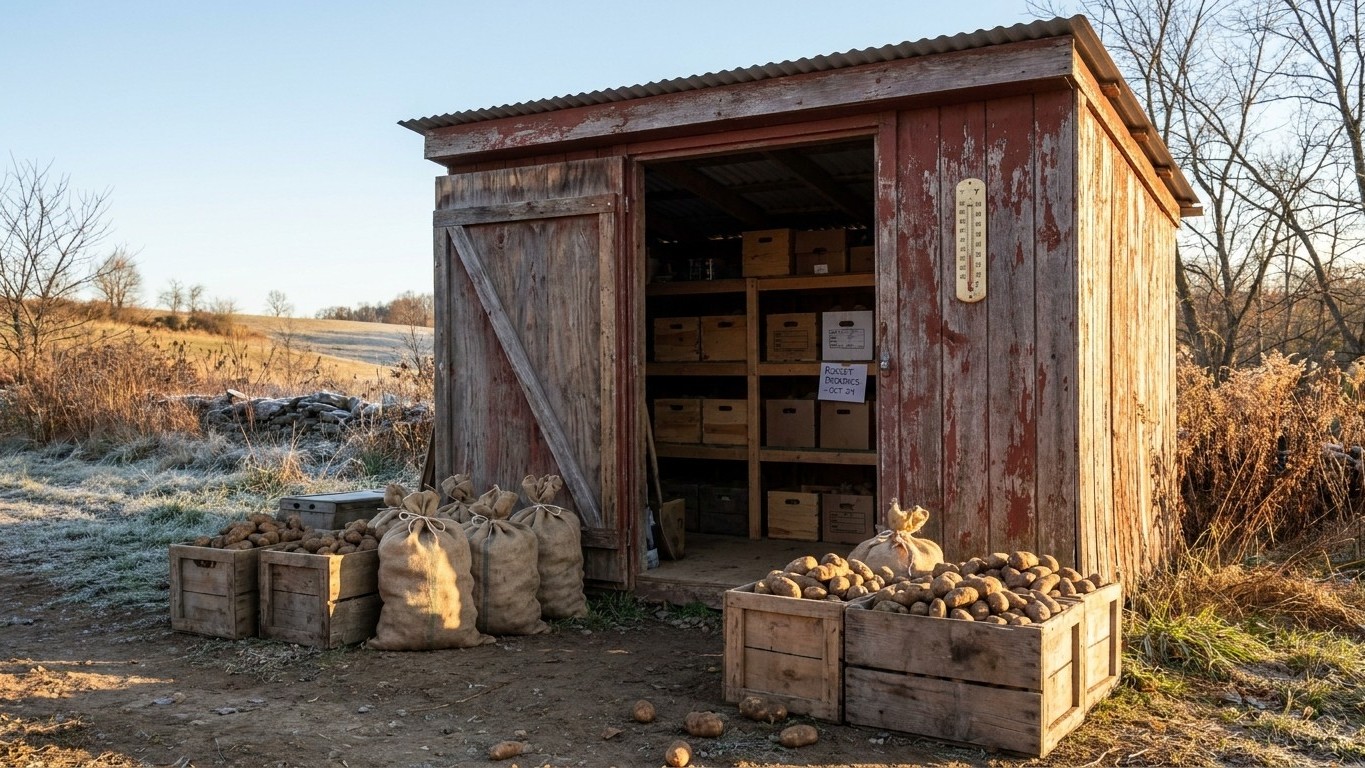

Pennsylvania growers generally pull their potato crop before the first fall frost, which arrives between November 5 and November 16 in the Philadelphia area (source: NOAA NCEI). Curing needs 55-60 F for two to three weeks, something an unheated garage rarely holds this late in the season. Storage after that wants 40-45 F, and the state’s coldest month averages a mean minimum of just 26.0 F, cold enough to freeze a shed but workable in a basement.
The short answer
The frost date does the real work of setting your harvest calendar. Once vines die back from a hard frost, or you cut them down deliberately, tubers sit in the ground for roughly two weeks to toughen their skins before digging. In the Philadelphia corridor, that puts most harvesting in mid to late October, with the window closing as the November 5 to November 16 frost band approaches. Growers in the northern tier and the Alleghenies should plan two to four weeks earlier, since that region’s spring runs that much later and its growing season compresses on both ends.
The second number matters just as much, and it gets ignored more often. A mean minimum of 26.0 F in the coldest month is not a record low. It is the average low temperature a space experiences on a typical cold night, and it tells you whether an unheated structure is a viable place to hold potatoes for four or five months. A detached garage or a garden shed with no insulation will track close to outdoor air on many nights, which means temperatures well below the 40-45 F storage target the University of Maine and Utah State University Extension recommend, sometimes below freezing outright.
That does not rule out unheated storage everywhere in the state. A basement, an attached garage with some heat bleed from the house, or a root cellar dug into the ground all buffer against that 26.0 F average because soil and building mass hold heat longer than open air. The failure mode isn’t the average cold snap, it’s the week in January when temperatures drop hard and an under-insulated space follows right along with them. Anyone storing potatoes through a Pennsylvania winter needs a thermometer in the actual storage spot, not just a guess based on the outdoor forecast.
So the short version: dig ahead of that November frost window, cure somewhere warmer and more humid than most outdoor spaces offer at that point in the season, then move tubers into a space that can hold 40-45 F even when the coldest month of the year is doing its worst.
Curing, and where
Utah State University Extension recommends curing at 55-60 F with high humidity for two to three weeks before storage. That window falls in mid to late October across most of Pennsylvania, when outdoor daytime highs in the southeast often still sit in that range but nighttime lows are already dropping into the 40s. Finding a spot that holds steady in that band takes some thought rather than just setting boxes on a porch.
- Check the space before harvest, not after. A basement corner away from a furnace, an insulated garage bay, or an enclosed porch with a thermometer left overnight for a few days will tell you whether it actually holds 55-60 F once outdoor temperatures start their fall slide.
- Rule out the obvious mismatches. An unheated, uninsulated garage in the northern tier or the Alleghenies is already too cold by the time potatoes are typically dug there, since that region’s season runs weeks behind the southeast. A sunny porch works during the day but often swings too cold at night in late October.
- Add humidity deliberately. Curing wants high humidity along with the temperature range, so a damp basement or a space with burlap sacks kept slightly moist beats a bone-dry garage even if the temperature happens to line up.
- Keep tubers out of direct light. Curing spots should stay dim; light exposure during this stage encourages greening, which is a separate problem from temperature or humidity but just as avoidable.
- Move to permanent storage once skins have set. After two to three weeks in that 55-60 F range, tubers are ready for the colder, darker conditions of long-term storage, and holding them in the curing spot longer than that offers no benefit.
Storing through this winter
Once cured, potatoes want a different, colder environment: 40-45 F according to Utah State University Extension, or 38 F at 95% humidity according to the University of Maine. Both figures sit well above the 26.0 F mean minimum of Pennsylvania’s coldest month, which is exactly why an unheated outbuilding is a gamble rather than a plan. On an average cold night, a poorly insulated shed will drift toward that 26.0 F figure, freezing tubers solid and turning them soft and inedible once thawed. That’s not a rare event; it’s the statistical norm for the coldest month, not an outlier week.
A basement is the most reliable answer across most of the state, since below-grade spaces stay buffered by the surrounding soil and rarely track outdoor air closely even during sustained cold snaps. An attached garage can work if it shares a wall with heated living space, but a detached garage or a garden shed usually cannot be trusted through January and February without supplemental insulation or heat. The goal is a space that reads consistently in the 38-45 F band on a thermometer left in place, not one that merely feels cool to the hand on a mild afternoon.
Humidity deserves the same attention as temperature. The University of Maine’s 95% figure is high, and most home storage spaces run drier than that, particularly a heated basement corner near a furnace. Low humidity causes potatoes to shrivel over months of storage even if the temperature is correct, so a bin lined with damp burlap, occasional misting of the floor, or a covered container with ventilation holes helps close that gap. Darkness matters as much as either figure: light exposure during storage, not just curing, triggers greening and sprouting regardless of temperature.
Checking the crop periodically through the winter catches problems before they spread. A single soft or rotting tuber left in a bin can affect neighbors within weeks, so a quick look every few weeks, pulling any obviously bad tubers, costs little and protects the rest of the stored crop through to spring.
What goes wrong here
- Digging after a hard frost has already hit the vines and soil. Frost-damaged foliage can mask tuber damage underneath, and a frozen top layer of soil makes digging harder and bruises skins. Track the November 5 to November 16 frost window for the Philadelphia area, adjusted two to four weeks earlier for the northern tier and Alleghenies, and dig ahead of it rather than after.
- Curing in a space that’s already too cold by late October. An unheated garage in the higher elevations of the state often misses the 55-60 F curing target within days of harvest. Move curing indoors to a basement or a heated but low-traffic room if the usual outbuilding isn’t reading warm enough.
- Storing in a shed or garage that freezes during the coldest month. With a mean minimum of 26.0 F, unheated outbuildings across Pennsylvania will dip below freezing on a routine basis, not just during extreme events. A basement or an insulated space with a working thermometer is the safer default for the whole winter.
- Storing in a spot that’s too warm, usually a heated basement near a furnace. Sprouting and softening happen quickly above 45 F. Move storage bins to the coolest corner of the basement, away from heat sources and ductwork.
- Skipping humidity control. A dry basement, even at the right temperature, shrivels potatoes over a Pennsylvania winter that runs several months long. Damp burlap or a loosely covered container with some ventilation helps close that gap without introducing standing moisture that encourages rot.
Common questions
Can potatoes survive a light frost still in the ground?
Vines are damaged by frost well before the tubers underneath are affected, since soil insulates them somewhat. Even so, once frost has hit the foliage it’s a signal to finish harvesting soon rather than a reason to wait.
Is an unheated garage ever good enough for winter storage in Pennsylvania?
It depends heavily on insulation and location within the garage. Given the state’s coldest month mean minimum of 26.0 F, a fully unheated, uninsulated garage is a risk in most winters; an attached, partially heated garage bay is a better bet than a detached one.
Does the harvest timing differ much across the state?
Yes. The November 5 to November 16 window applies to the Philadelphia area specifically. The northern tier and the Alleghenies run two to four weeks later in spring, which shifts the whole growing season and, with it, the practical harvest calendar for those regions.
What if I don’t have a basement or root cellar?
Look for the coolest, darkest interior space in the home that still stays above freezing, an unheated closet on an exterior wall, for instance, and monitor it with a thermometer through the winter rather than assuming it holds the target range.