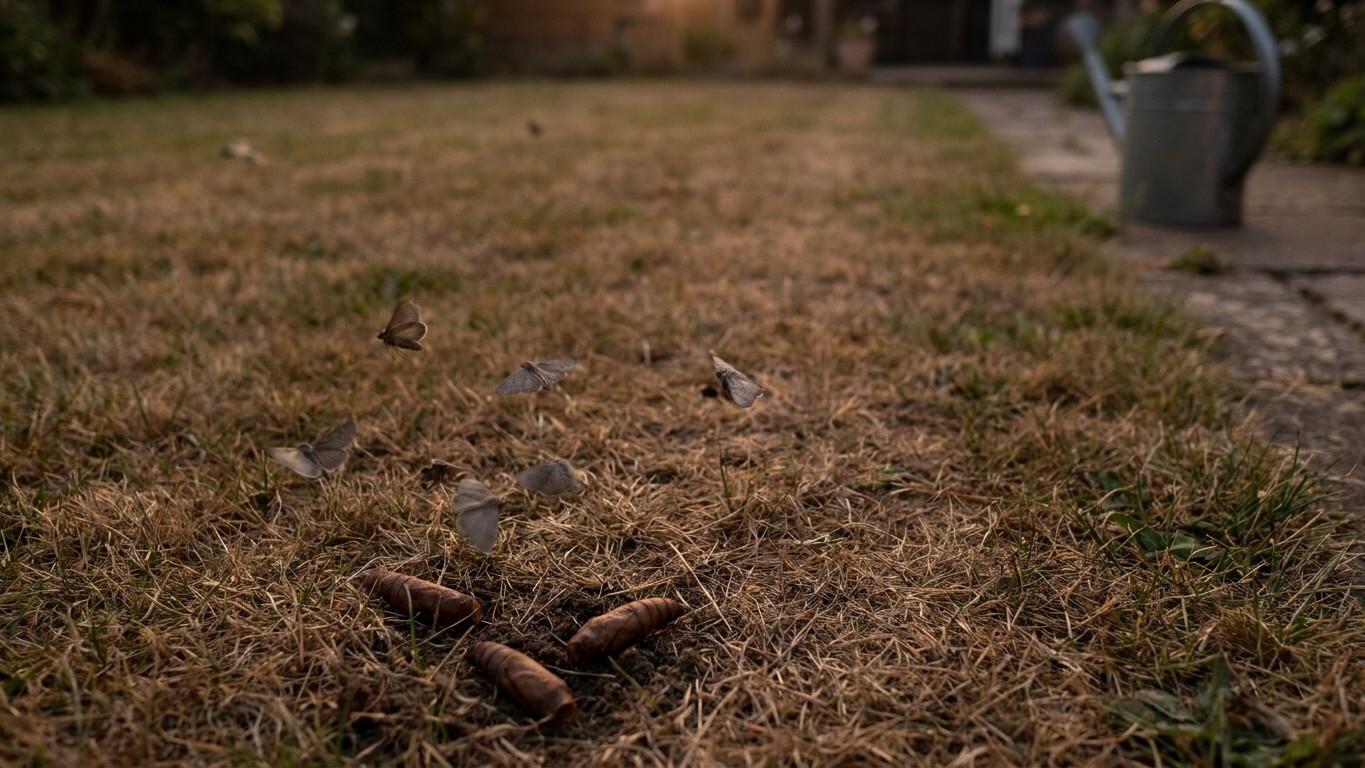

Small, ragged brown patches that show up in a matter of days, paired with tan moths that flutter up from the grass every time you walk across the lawn at dusk, are the two signs of sod webworm damage. The moths themselves don’t eat anything. Pull back the thatch at the edge of a brown patch and look for grayish caterpillars and silk-lined tunnels before you treat anything.
The damage you see first

Sod webworm damage starts small: a patch the size of a dinner plate, then a few more scattered nearby, often near a slope or a sunny edge where the turf was already thin. The blades look chewed and notched rather than uniformly brown, and if you look closely the grass is skeletonized at the tips rather than wilted top to bottom. That’s the tell that separates it from drought stress, which tends to fade a whole lawn evenly instead of leaving these ragged islands.
Cool-season lawns, Kentucky bluegrass and the fescues among them, often go tan and uniform across the whole yard during summer heat. That’s dormancy, not damage, and it recovers on its own once the weather breaks. Warm-season grasses like bermudagrass, zoysiagrass and St. Augustinegrass are actively growing through summer, so patchy browning there is less likely to be dormancy and more worth a closer look.
To confirm the cause, get down on your knees at the border between healthy grass and a brown patch. Part the thatch with your fingers rather than pulling up a whole plug. Sod webworm larvae are gray to light brown caterpillars, about half an inch to an inch long depending on age, and they build loose silk tunnels through the thatch where they hide during the day. You’ll often find small green-brown pellets of frass mixed into the tunnel, which is the larvae’s droppings and a strong sign you’ve found the right culprit before you found the insect itself.
Confirming it is this and not something else
The standard way to check numbers without digging up the lawn is a soap flush. Mix a couple tablespoons of dish soap into a gallon of water and pour it slowly over a few square feet at the edge of a suspect patch. Within several minutes, any larvae hiding in the thatch will surface, irritated by the soap, and you can count what comes up. A scattering of a few caterpillars across that area is not unusual and is not worth treating. Most lawns carry a background population of sod webworms without any visible harm, because birds, parasitic wasps and predatory beetles keep the numbers down on their own.
Treating a lawn that only shows a light population wastes money and does more harm than the insect would have. Broad-spectrum sprays kill the ants, wasps and ground beetles that were already holding the webworms in check, which can let the next generation build up unchecked. Spraying on sight, before confirming with the flush test, is the single most common mistake homeowners make with this pest.
If the flush test instead brings up a dense mat of wriggling larvae, or the brown patches are spreading week over week rather than staying put, that’s a different situation and worth acting on. It’s also worth ruling out other culprits before you commit to a webworm-specific treatment. Damage that peels back like a loose carpet, rather than staying rooted with chewed tips, points to white grubs instead, which feed on roots rather than blades. Raised ridges of soil or a spongy, uneven surface with no chewed grass at all usually means moles in the lawn, which are digging for grubs and earthworms rather than eating your turf directly. Sorting out which of these you actually have is worth doing before spending on any control, chemical or otherwise, and general background on the range of lawn pests is covered in our Lawn Pests overview.
When it does its damage
The life cycle behind the timing
Adult sod webworm moths are the ones you see at dusk, small and tan, flying in a zig-zag pattern low over the grass or flushing up in a cloud when disturbed. They don’t feed on the lawn. Their only job at that stage is mating and laying eggs, which they scatter into the grass canopy over a period of days. Those eggs hatch into the larvae that actually cause the damage, and it’s only the young larval stage that control measures are aimed at. Older larvae burrow deeper into the thatch and become harder to reach, and once they pupate back into moths, spraying accomplishes nothing.
The practical problem is that the moth flight you notice at dusk happens before the damage shows up, sometimes by several weeks, since eggs need time to hatch and young larvae need time to feed enough to visibly thin the grass. By the time you see brown patches, the larvae responsible may already be maturing past the stage where treatment works well. Watching for the moths themselves, rather than waiting for damage, gives you a earlier warning, though it doesn’t tell you whether the population behind them is large enough to matter.
In warmer climates with a longer growing season, sod webworms can complete multiple overlapping generations in a single year, which means the moth-flight-to-damage cycle repeats more than once between spring and fall. In cooler regions with a shorter warm season, there may only be one or two generations, and the damage window is correspondingly narrower and more predictable. Because the exact timing shifts with your local climate and with how warm a given year runs, the moths at dusk are a better field signal than any calendar date. Once you see a flight, mark it and check the thatch with the soap test two to three weeks later, when eggs have had time to hatch into young, treatable larvae.
What actually works
Cultural controls come first
A lawn mowed at the correct height for its species, per Clemson Cooperative Extension’s HGIC 1205 (Mowing Lawns), recovers from feeding damage faster because it carries more leaf area to photosynthesize through the setback. Reducing thatch buildup also removes the daytime hiding cover larvae depend on, and following a sound nitrogen program under Clemson’s HGIC 1201 (Fertilizing Lawns) helps damaged turf push new growth rather than sitting stalled.
Biological options
Sprays containing Bacillus thuringiensis kurstaki (Btk) target caterpillar pests including sod webworms and are sold at most garden centers for home use. They work best applied in the evening, close to when young larvae are actively feeding on the surface, and they break down quickly in sunlight, so timing matters more than with a residual chemical. Beneficial nematodes, sold under species names like Steinernema carpocapsae, are another home-available option, applied to moist soil and watered in immediately since they die quickly if they dry out.
Chemical options, by active ingredient
- Bifenthrin and permethrin: pyrethroid insecticides sold in home lawn granules and sprays.
- Carbaryl: an older broad-spectrum insecticide, still sold for home lawn use in some states.
- Spinosad: a lower-toxicity option derived from soil bacteria, sold for home gardens and marketed as safer around pollinators when applied as directed.
- Chlorantraniliprole: longer-lasting and often marketed through lawn care companies rather than retail shelves.
Whichever product you choose, water the lawn lightly before application to move larvae up toward the surface, then apply in the evening when larvae are active and avoid mowing or watering it off for the period stated on the label. Check your own state’s rules on any restricted-use product before buying, since availability differs by state and by formulation.
Making the lawn less inviting
Watering habit matters more than any single spray. Frequent, shallow watering keeps the top layer of thatch moist and encourages the dense, tangled growth young larvae hide in, while deep, infrequent watering that lets the surface dry between sessions makes that layer less hospitable. A lawn already under drought stress also shows webworm damage more severely, simply because it has less reserve to grow through the setback.
Mowing height and turf recovery
Mowing at the upper end of the recommended range for your grass keeps more leaf surface in reserve and shades the thatch layer, which works against the moths looking for a place to lay eggs. The right height varies by species, and grasses with stronger drought and wear tolerance also tend to bounce back from feeding damage with less visible scarring.
| Grass | Mowing height | Drought tolerance | Wear tolerance |
|---|---|---|---|
| Tall Fescue | 2.5 to 3.5 in | Fair | Fair |
| Kentucky Bluegrass | 2 to 3 in | Fair | Good |
| Zoysiagrass | 0.75 to 2 in | Good | Very good |
| Bermudagrass | 0.75 to 1.5 in | Excellent | Excellent |
| St. Augustinegrass | 2.5 to 4 in | Good | Fair |
Figures for Tall Fescue, Zoysiagrass, Bermudagrass and St. Augustinegrass come from Clemson Cooperative Extension’s HGIC 1214 (Selecting a Lawn Grass); the Kentucky Bluegrass figures come from Penn State Extension’s lawn establishment guidance. A lawn already carrying strong drought and wear tolerance, like bermudagrass or zoysiagrass, tends to fill back in from webworm feeding faster than a lawn on the fair end of that scale, which is one more reason species choice affects how much a webworm outbreak actually costs you in appearance.
Common questions
Will sod webworms kill my whole lawn if I do nothing?
Rarely. Sod webworm feeding thins and scars the grass blades but usually doesn’t kill the crown or roots, so a lawn with reasonable vigor grows back over a few weeks once feeding stops. Repeated heavy infestations on an already-weak lawn are the exception, since there’s less reserve to regrow from.
Why do I see the moths but never find the caterpillars?
The moths and the damaging larvae aren’t in the same place at the same time. Moths fly and lay eggs at dusk, then the eggs need time to hatch, so a flush test done the same night you notice moths often comes up close to empty. Wait a couple of weeks after a moth flight before testing.
Can I just water more and skip treatment entirely?
Sometimes, if the population is light and the lawn is otherwise healthy. Deep watering and a proper mowing height help the grass outgrow light feeding on their own, but a dense larval population confirmed by the soap flush test usually needs more than watering to stop the spread before it widens.
Is it safe to treat if I have a dog that’s out on the lawn all the time?
That depends entirely on the specific product and its label, which will state re-entry time for pets and people. Read the label of whichever active ingredient you buy rather than assuming, since re-entry intervals differ between bifenthrin, carbaryl, spinosad and the biological options.