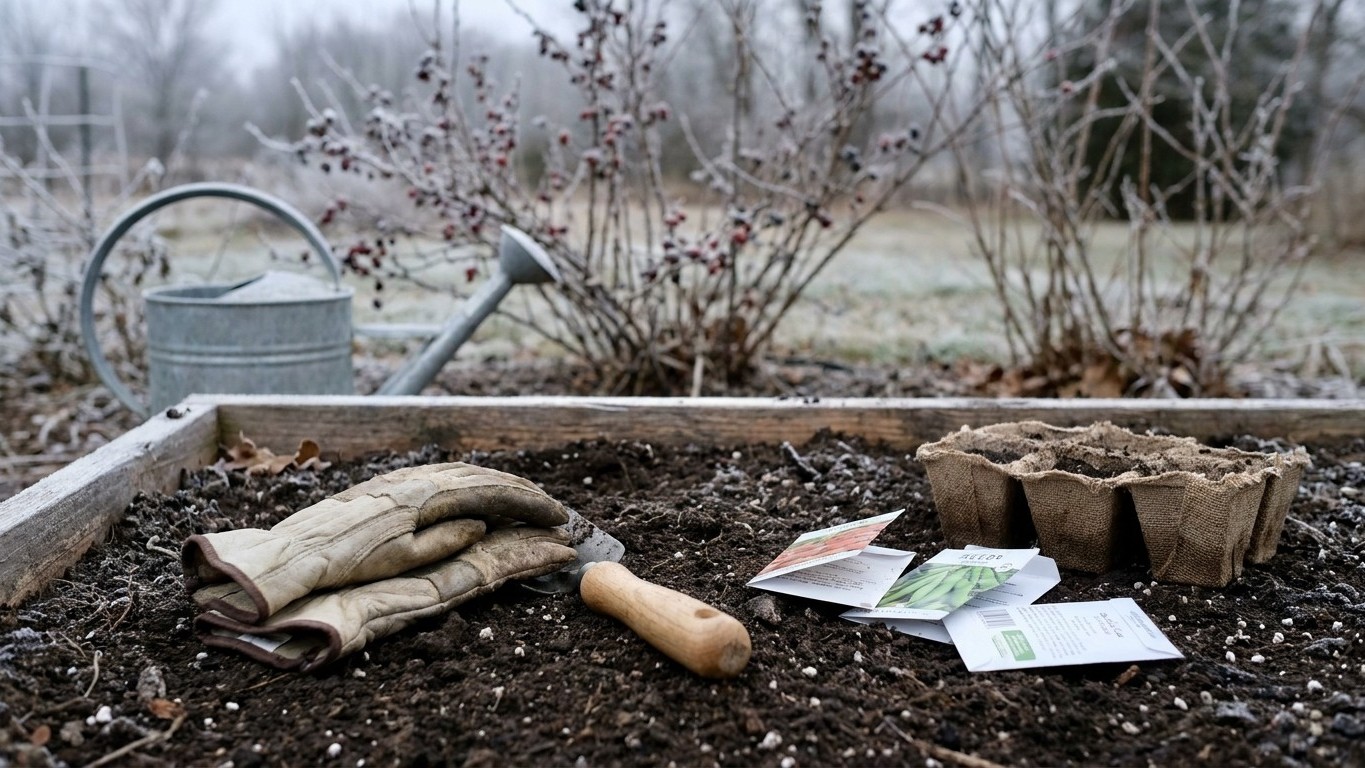

Nothing goes into open ground in Saskatchewan in February. The soil across the province is frozen solid, and the mean frost-free window runs from May 18 to September 18, a full three months away from where the calendar sits right now. What the month is actually good for is indoor seed starting, forcing a few dormant roots, and the dormant-season jobs, pruning, soil testing, seed ordering, that make everything planted later go smoother.
What goes in the ground in February

Saskatoon, the reference point for Environment and Climate Change Canada’s normals for this region, sits in Canadian hardiness zone 3a, according to Natural Resources Canada’s 1991-2020 plant hardiness data. That’s the Canadian system, built on seven climate variables rather than the single minimum-temperature figure the USDA scale uses, so it does not convert cleanly to a USDA number a reader might know from a catalog or a nursery tag. Zone 3a is cold by any measure, and it explains why February here is a non-starter for outdoor planting of any kind.
The mean last spring frost at the Saskatoon SRC station is May 18. That’s a midpoint, not a guarantee: in one year out of two, the frost actually falls later than that date. The mean first fall frost is September 18, giving a typical frost-free stretch of around four months. February sits nowhere near either end of that window, and no amount of a mild afternoon or a sunny week changes what the ground is doing six inches down, which is staying frozen.
So say it plainly: no seed, bulb, or transplant goes into open Saskatchewan soil this month. What is realistic is narrower and mostly indoors. Dormant fruit stock, bare-root trees and canes ordered for spring delivery, can be held in cold, damp storage now if it arrives early, ready to go into the ground only once the soil has thawed and drained. Rhubarb and chicory roots lifted and stored from a previous season can be brought into a dark, cool spot indoors to force tender stalks and shoots for the table, a genuine February harvest that has nothing to do with outdoor soil temperature. Cold frames and low tunnels, if they were set up in fall, are mostly holding pattern devices right now under snow cover rather than active growing space; checking that covers are intact and that meltwater isn’t pooling against them is worth five minutes on a mild day.
What to start under cover
Indoor seed starting in February works backward from that mean last frost of May 18, not from the date on the wall calendar. Onions and leeks are the crops that justify starting this early: they need 10 to 12 weeks of growth indoors before they’re sturdy enough to move outside, which lines up almost exactly with a mid-May transplant date. Started now, they’ll be the right size when the ground is finally workable.
Peppers and tomatoes are a different story, and this is where the two failure modes show up. Peppers generally want 8 to 10 weeks indoors before transplant, tomatoes 6 to 8. Started now, both would be ready to move outside well before mid-May, and by the time the soil and air actually cooperate, the plants are rootbound, leggy, and stressed from being held too long in small containers under indoor light. That’s the first mistake: starting too early because the calendar says “spring is coming” rather than counting weeks from the frost date.
The opposite mistake matters here too, even though the frost-free season is short. With only about 123 days between the mean last and first frost, waiting until the ground thaws to start anything from seed indoors leaves warm-season crops racing a season that closes again by mid-September. Onion and leek seed started now is the safe bet; everything else, tomatoes, peppers, and similar warm-season transplants, has weeks yet before starting makes sense.
What is ready to pick
Little to nothing comes out of a Saskatchewan garden outdoors in February, and there’s no point dressing that up. In zone 3a, overwintered kale, leeks, or other cold-hardy crops that survive under snow in milder climates rarely make it through this depth of cold intact, so counting on an outdoor harvest this month isn’t realistic here.
What does keep the household fed is indoor and stored. Sprouts and microgreens grown on a windowsill or under a simple grow light take one to two weeks from seed to harvest and don’t care what the thermometer outside is doing. The rhubarb or chicory being forced from dormant roots, mentioned above, counts as a real February crop too, ready in a few weeks once brought into warmth and darkness.
The bigger job this month is checking what’s already in storage rather than picking anything fresh. Squash should feel firm with no soft spots; a squash starting to give under light pressure near the stem end is on its way out and should be used first. Potatoes need a dark, cool, dry spot; any that have gone soft, green, or sprouted eyes long should be pulled before they spread rot to the rest of the bin. Onions stored well should be firm and dry at the neck; papery softness or a sour smell means that one goes now, not later. A ten-minute check through the root cellar or pantry shelf once a week saves a much bigger loss down the line.
The jobs that matter this month

February carries a real workload even with frozen ground outside, and skipping it costs time later rather than now.
Dormant pruning and planning
Fruit trees and cane fruit are pruned while fully dormant and before sap starts moving, and a stretch of cold, calm weather in late winter is often the easiest window to see branch structure clearly without leaves in the way. Cuts made now heal over as growth resumes; the same cuts made after buds swell stress the plant and invite disease into fresh wounds.
Seed ordering belongs on this month’s list too, and it’s less optional than it sounds. Popular varieties, particularly short-season types bred for a zone 3a frost window, sell out of seed companies’ stock well before the outdoor planting window opens, and reordering in April often means settling for whatever’s left rather than what was actually planned. Sketching out next season’s crop rotation on paper now, while there’s no pressure to get seed in the ground, produces a better plan than doing it in a rush later.
Soil, tools, and storage
Soil testing can happen now if samples are sent to a lab, giving results back in time to plan amendments before the ground opens up. Turning an outdoor compost pile does little in deep freeze, but an indoor worm bin or a kitchen scrap bucket can keep organic matter moving toward spring-ready compost. Cleaning and sharpening pruners, loppers, and spades now means no delay once the season actually starts, and checking raised beds, cold frames, and fencing for winter damage, split boards, sagging wire, catches small repairs before they become spring emergencies.
What not to do in February
The most common misstep this month is treating a mild, sunny afternoon as spring. Air temperature can climb well above freezing on a clear February day in Saskatchewan while the soil six inches down stays locked in ice; nothing about that warm afternoon makes it safe to direct-sow anything or move a seedling outside.
A close second is uncovering mulched beds or cold frames too early after a warm spell, only to have them exposed when temperatures drop back hard, as they reliably do this time of year. Mulch and frame covers exist to buffer exactly that swing; pulling them back on the first mild day undoes months of protection for no real gain.
Feeding nitrogen to dormant fruit trees, canes, or perennial beds this month is also a waste at best and a problem at worst. Dormant plants aren’t taking up nutrients the way they will once growth resumes, and a jolt of nitrogen applied too early can push soft new growth right before a hard freeze, which then kills back the very growth it caused. Fertilizer decisions wait for the plant to show it’s actually growing, not for the gardener’s calendar.
Starting warm-season seedlings indoors too far ahead of the frost date follows the same logic as the mulch mistake: enthusiasm now creates a weaker plant later. Counting weeks backward from May 18 rather than guessing at a start date avoids both problems.
Checking this against your own county
A province-wide frost window is a starting point, not an instruction specific to any one yard. Saskatchewan is a big place, and elevation, proximity to a lake, and simple north-south distance move real frost dates by weeks in either direction from the Saskatoon SRC figures used here. A garden in the province’s north routinely sees a shorter frost-free season than one near the southern border, even in the same general zone rating.
For a county-level read on timing, the Saskatchewan agriculture and natural resources service is the right next stop, along with the province’s own planting calendar resources, before locking in a February seed-starting date based on provincial averages alone.
Common questions
Can garlic still be planted in Saskatchewan in February?
No. Garlic is a fall-planted crop in this climate, and Saskatchewan soil in February is frozen and unworkable regardless of variety. Any garlic meant for outdoor planting should already have gone in the previous fall.
Is it too early to start tomato seeds indoors in February?
For most of the province, yes. Tomatoes need only 6 to 8 weeks indoors before the mean last frost of May 18, which points to a March start rather than February. Starting now risks rootbound, leggy plants by transplant time.
What Canadian hardiness zone is most of Saskatchewan in?
Saskatoon, the reference point used for this region’s data, sits in Canadian zone 3a per Natural Resources Canada’s 1991-2020 normals. That figure uses the Canadian system, based on seven climate variables, and does not convert directly to a USDA zone number.
What can actually be harvested in a Saskatchewan garden in February?
Outdoors, essentially nothing. Indoors, sprouts, microgreens, and forced rhubarb or chicory from stored dormant roots are realistic February harvests, alongside checking stored squash, potatoes, and onions for spoilage.
Gardeners who plant by the Moon can check the February 2027 moon planting calendar, a tradition rather than a proven method.