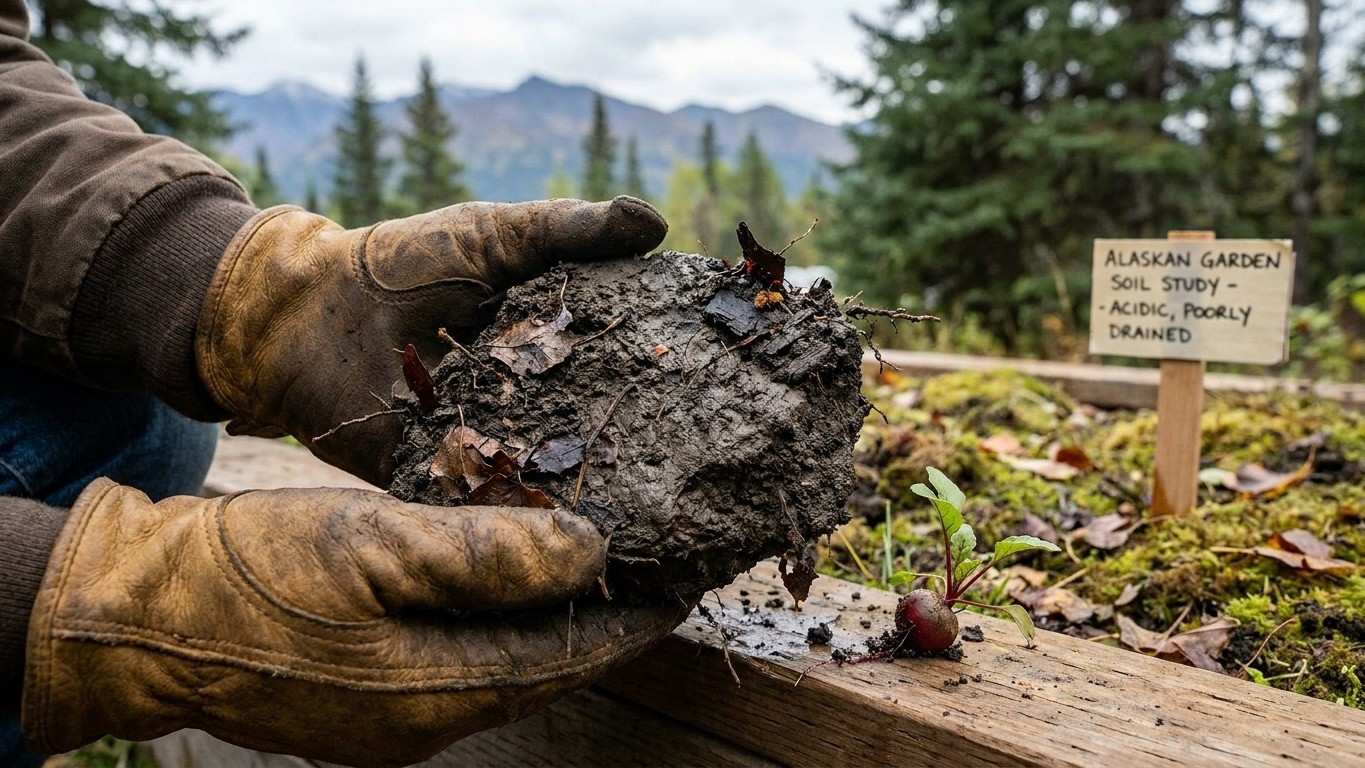

Beets sown directly in Alaska ground face two separate problems: soil that rarely resembles the deep, sandy loam beets prefer, and a six-week window right after sowing where water stress can push the crop to bolt before it ever sizes up a root. The fix starts with knowing what’s actually under your boots (often acidic, poorly drained, sitting close to permafrost) and working backward from the state’s last-frost window, roughly May 3 to May 12, to time sowing and watering correctly, a topic covered in detail in this guide on When to Sow Beets in Alaska.
The short answer
The soil USDA lists as representative of Alaska, the Tanana series, isn’t what most people picture when they hear “Alaska dirt.” It’s a Gelisol, meaning permafrost sits within reach of the soil profile, and its surface horizon runs about 30 percent sand, 7 percent clay and 63 percent silt, classifying as loam to silt. Surface pH averages around 4.7, which counts as strongly acid. Drainage is rated poor. Organic matter in that surface layer runs about 90 percent, a figure high enough to signal a natural peat, muck, or forest-litter layer rather than a worked garden bed.
None of that lines up well with what beets actually want. Extension guidance on home garden beets calls for deep, sandy, well-drained soil rich in organic matter, amended with no more than 1 inch of composted organic matter per 100 square feet. The Tanana series delivers silt instead of sand, poor drainage instead of good, and acidity well outside the comfort zone for a root crop that does better closer to neutral. Where a garden bed actually sits on ground resembling this series, expect standing moisture in low spots and a taproot that forks or stalls when it can’t push down through compacted, waterlogged silt.
As for heat, the specific driver behind woody roots when water stress and warm soil combine: the day-count above 85 F for a reference Alaska city isn’t part of the sourced climate data used here, so no number appears below. What the frost-date records do confirm is a short, cool growing season, one where the upper 80s and 90s are the exception rather than the rule at this latitude. That shifts the practical risk. In much warmer beet-growing regions, heat paired with dry soil drives woodiness. In Alaska’s case, the more likely trigger is water stress on its own, independent of heat, simply because the thermometer rarely climbs high enough to be the main culprit.
Worth saying plainly: Alaska spans hundreds of mapped soil series, and the Tanana series is only the one USDA lists as representative of the state as a whole. It’s a starting point for thinking about drainage, acidity, and organic content, not a stand-in for what’s actually in a specific yard, which could be riverbottom silt, glacial till, or fill brought in during construction, a variability explored further in this overview of Beet Soil in Alaska. A soil test remains the only way to know what’s really there.
The six weeks that decide it here
Beets are sown in place, never transplanted, and the standard guidance is to get seed in the ground 2 to 3 weeks before the last spring frost. In much of Alaska’s populated south-central region, that frost date falls between May 3 and May 12, based on 30-year climate normals for freeze probability. Working backward, that puts direct sowing somewhere in mid to late April, which means the first six weeks of a beet’s life, the exact window when water stress triggers premature flowering, lands squarely in Alaska’s snowmelt period.
That timing matters because snowmelt on permafrost-influenced, poorly drained ground doesn’t behave like an ordinary spring rain. The upper few inches can stay saturated for days after melt, sitting on top of soil that’s still partly frozen underneath and can’t absorb more water even where it’s needed. Then, as days lengthen toward the solstice and the sun works through nearly around-the-clock daylight, that same saturated surface can dry out fast, especially in beds that have been raised or amended with lighter material to fix drainage. The net effect isn’t steady drought and it isn’t steady flooding either. It’s a swing, and the swing itself is the risk, since seedlings that experience a hard fluctuation between soggy and dry roots are more likely to read that as stress and switch into bolting mode than seedlings kept on an even, moderate moisture level.
The extended daylight of an Alaska spring cuts both ways here. Long light hours push growth along fast, part of why gardeners at this latitude can grow food at all in a short season. But that same light speeds evaporation from thawed surface soil, especially in beds without mulch, meaning a bed that looked adequately moist in the morning can be dry by evening during a stretch of clear late-spring weather. For beets sown in that mid to late April window, checking soil moisture by hand rather than by the calendar matters more here than in a climate where spring rain falls on a predictable rhythm.
What goes wrong here
- Waterlogged, forked roots: the state soil’s poor drainage rating, plus a fine silt-heavy texture (63 percent silt against 7 percent clay and 30 percent sand), lets water sit in low spots rather than move through. A taproot pushed through compacted, saturated silt often forks or stalls short. Raise the bed 6 to 8 inches above grade and work in coarser material before sowing, rather than trying to fix drainage after seedlings are up.
- Stunted growth from strong acidity: a surface pH around 4.7 sits well into acid territory, more acid than most root vegetables handle comfortably. A basic soil test before sowing tells you whether the bed needs lime worked in ahead of time, far easier than correcting pH once beets are established.
- Cold, spongy beds that never warm up: where mapped surface organic matter runs as high as it does in the Tanana series, around 90 percent, indicative of raw peat or forest litter rather than cultivated soil, that same material holds cold and moisture longer into spring. Bringing in mineral soil or finished compost to build the actual planting bed, rather than gardening directly on unamended native ground, warms the root zone faster.
- Bolting before the root sizes up: water stress in the first six weeks after sowing, precisely the stretch that lands in Alaska’s swing-prone snowmelt period, triggers premature flowering. Watering on a consistent schedule through that early window, rather than waiting for the soil to look visibly dry, is the direct fix; a floating row cover also buffers both moisture loss and the day-to-night temperature swings that come with a short, high-daylight spring.
- Woody roots by midsummer: even without much high heat, uneven moisture on its own toughens a beet root. Mulching once seedlings are established evens out the moisture supply between waterings, which matters more here than chasing an 85 F heat threshold this climate rarely reaches.
- Running out of season: beets typically need 60 to 80 days from seeding to harvest, and the milder parts of south-central Alaska run roughly 143 frost-free days, far shorter in the Interior and north. Sowing at the earliest safe point, 2 to 3 weeks ahead of the local last-frost date, leaves the least margin for error and the best shot at a full-sized root before fall frost returns.
Checking this against your own county
Everything above starts from one mapped soil series and one weather station’s climate normals, which is exactly why it’s a starting point and not a planting plan. Alaska’s growing conditions change dramatically over short distances, between a south-central garden near tidewater and one a few hundred miles into the Interior, and between a yard built on native silt and one filled with trucked-in topsoil. The only way to know what’s actually true for a specific bed is a soil test and a look at local frost records, not statewide averages.
The University of Alaska Fairbanks Cooperative Extension Service runs district offices across the state and is built for exactly this kind of question, from soil testing to localized frost guidance to variety performance under real Alaska conditions. Bringing in a soil sample before amending anything, rather than guessing from statewide figures, is the single most useful step before the next sowing window opens.
Common questions
When should I sow beets in Alaska?
Direct-sow 2 to 3 weeks before the local last spring frost. In much of south-central Alaska, that frost date falls between May 3 and May 12, per 30-year NOAA climate normals, putting typical sowing in mid to late April, since beets don’t transplant well and need to be seeded in place.
How long do beets take to mature in Alaska?
About 60 to 80 days from seeding to harvest, per Extension guidance, counted from the day seed goes into the ground rather than from any transplant date, since beets are never transplanted.
Why do my beets keep bolting?
Bolting comes from water stress in the first six weeks after sowing, exactly when Alaska gardens are working through the swings of snowmelt season. Consistent watering through that early window, rather than watering only after the soil visibly dries out, is the fix Extension guidance points to.
Is Alaska soil good for beets?
The state’s own representative soil, the Tanana series, is a poorly drained, strongly acid silt loam sitting near permafrost, which doesn’t match what beets want: deep, sandy, well-drained, organic-rich ground. That soil is only a statewide starting point, though; a local soil test is the only way to know what a specific yard actually offers.