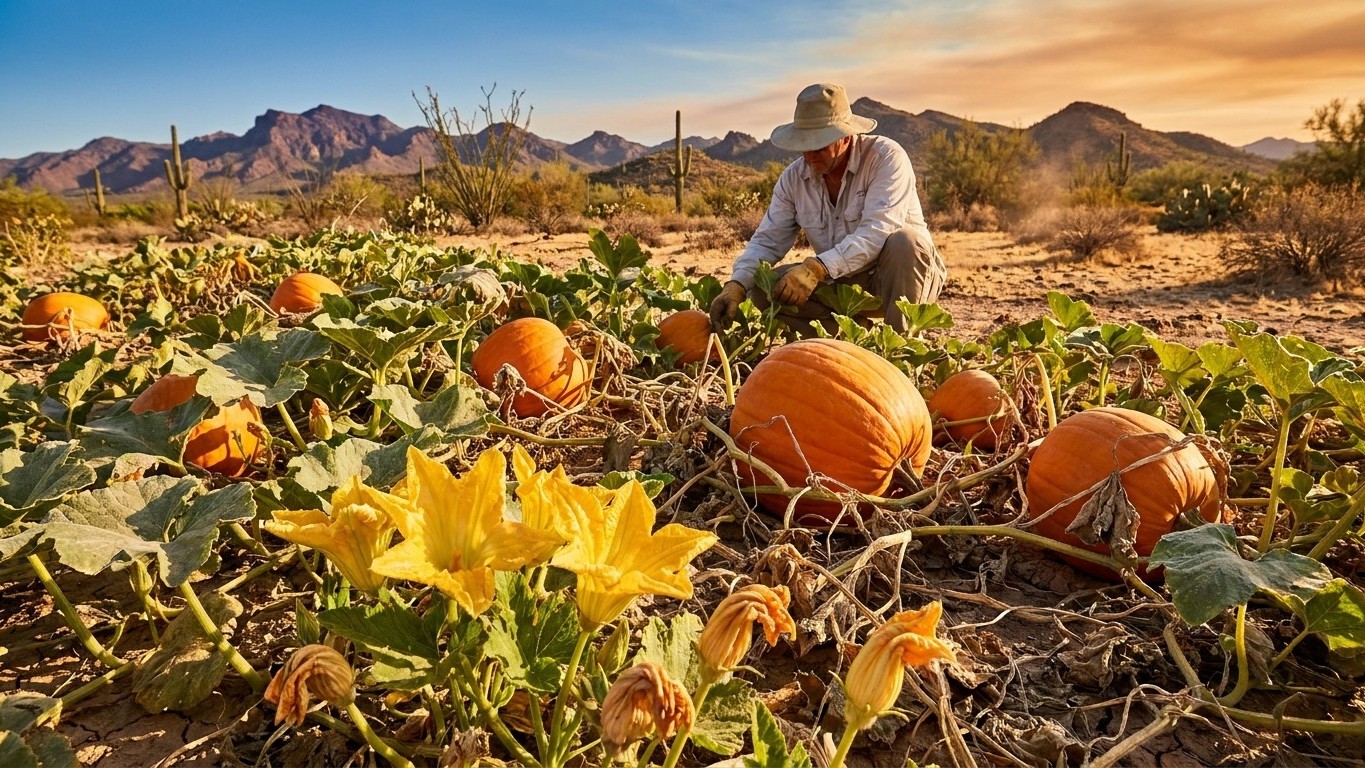

In most of Arizona’s low desert, including Phoenix and Tucson, frost simply isn’t the obstacle. NOAA lists the frost-free season there at 365 days, so the countdown that works in colder states doesn’t apply. The real deadline is summer heat, which shuts down flowering for months. In the high country around Flagstaff, the climate flips entirely, and a real fall frost does end the season.
The short answer
Start with what NOAA’s climate data actually says for the low desert, drawn from the station record at Phoenix (USW00023183): there is no reliable first fall frost. Across the 1991-2020 normals period, that same station only dropped to 32°F in 6 of 30 springs, and the official frost-free season is listed as a full year. That single fact rewrites the whole question. In states with a real autumn freeze, gardeners count backward 45 to 55 days from that date, since Utah State University Extension notes pumpkins need that stretch after flowering, not from seeding, to mature. In low-desert Arizona, there’s no frost date to count backward from, which makes the question of When to Sow Pumpkins in Arizona depend on heat timing rather than frost timing.
So what replaces it? Heat. A pumpkin flower that opens during the hottest stretch of a low-desert summer typically fails to set fruit at all, sometimes for a stretch of months, according to the caution built into this territory’s own climate record. That means the 45-to-55-day clock only matters if it starts on a flower that opened during a survivable window, one that isn’t buried in triple-digit heat. A grower aiming for fall pumpkins needs flowers opening early enough that the 45-to-55-day window lands before the heat returns the following year, or timed so it runs entirely inside the cooler months when flowers are more likely to set at all. This is exactly why the question of Will Pumpkins Ripen Before Frost in Arizona? plays out so differently here than in colder states.
The high country is a different story, and the facts available here don’t extend a specific frost date to that region. What can be said plainly: Flagstaff and similar elevations do freeze hard, on a schedule this page can’t quote a number for, because the station data cited above comes from the low desert. Anyone gardening above the Mogollon Rim needs a frost date sourced locally, not borrowed from a Phoenix-area record.
| Region | Fall frost reality | What actually limits the season |
|---|---|---|
| Low desert (Phoenix, Tucson) | No reliable fall frost; frost-free season listed as 365 days | Summer heat halting flowering for months |
| High country (Flagstaff and above) | Real fall freeze occurs; specific date not published in this data set | A genuine frost deadline, confirm locally |
Either way, the number that matters for ripening is still 45 to 55 days measured from the day a flower opens, and that number doesn’t change by region. What changes is which threat, heat or frost, decides whether that window ever gets to run its full course.
When to sow here
Utah State University Extension’s guidance is built around soil temperature, not the calendar date of the last frost, and in low-desert Arizona those two things aren’t just different, they barely relate to each other at all. Here’s how the sequence actually plays out in words rather than a single date:
- Because the low desert has no dependable spring frost to begin with, the rare cold snap NOAA’s data shows arriving between late December and mid-January is already well behind by the time anyone is thinking about planting. There’s no “two weeks after last frost” math to do, because there usually isn’t a last frost to count from.
- Soil still needs to reach 65°F before seed goes in, and soil warms slower than air. Even once daytime highs feel comfortably warm, the ground several inches down is still catching up, often by a matter of weeks compared to when the air itself first felt spring-like.
- Row covers can pull that timeline forward by roughly two weeks, warming the soil underneath faster than open ground would warm on its own. That’s the one lever a low-desert grower has to move sowing earlier, since there’s no frost date to plant around in the first place.
- Once soil holds at 65°F, sowing can happen for a first attempt at spring-into-early-summer flowering, timed to try to land fruit set before the deep summer heat arrives and shuts flowering down.
- A second sowing, timed for late summer, aims to flower once temperatures ease enough for fruit set to resume, giving the 45-to-55-day clock a real shot at running to a colored, hardened pumpkin before the calendar runs out.
None of this is a frost calculation. It’s a soil-temperature and heat-avoidance calculation, and treating 65°F soil as if it were tied to a frost date, the way a gardener in a colder state might, will produce a planting schedule that doesn’t match how this climate actually behaves.
What goes wrong here
- A flower opens right as summer heat peaks and never sets fruit. This is the single biggest cause of a disappointing low-desert pumpkin patch. The remedy is timing sowing so flowering falls before the hottest stretch, or delaying the second attempt until the heat has genuinely broken, rather than fighting the heat with a mid-summer sowing.
- A fruit that sets late never finishes coloring. If a flower opens too close to the point where the 45-to-55-day window would run into cooling fall temperatures, growth slows and the rind can stall out pale or unevenly colored. The remedy is counting backward from whatever window is realistic for that year’s fall temperatures, and treating any flower opening past that point as unlikely to finish.
- In high-country gardens, a fruit still green gets caught by an early freeze. Since a real frost does arrive at elevation, a fruit that hasn’t hardened its skin by the time cold hits won’t survive it. The remedy is harvesting with the stem attached before frost, exactly as Utah State University Extension recommends, rather than waiting for a last flush of color.
- The vine weakens and dies back before the skin hardens. Stress from pests, most commonly the squash bugs and cucumber beetles covered on this site’s dedicated pages, can take a vine down before fruit finishes maturing even when timing and temperature were otherwise on track. Keeping vines monitored and intact through the final stretch matters as much as getting the sowing date right.
Checking this against your own county
Arizona’s elevation swings from below sea level near Yuma to well over 7,000 feet around Flagstaff, and no single planting calendar covers that entire range. The frost and heat figures in this article come from a Phoenix-area station and describe low-desert conditions specifically. Before relying on them, check with the University of Arizona Cooperative Extension, which maintains county-level offices with local frost data, soil temperature guidance, and planting windows suited to each region’s actual elevation and microclimate. That’s especially important for anyone gardening in the high country, where the frost season this article couldn’t quote a date for is very real and needs a locally sourced number.
Common questions
Does low-desert Arizona ever get a real killing frost?
Rarely. NOAA’s climate normals for the Phoenix-area station show 32°F occurring in only 6 of 30 spring seasons, and the frost-free season is officially listed at 365 days. A cold snap can still bring 32°F between late December and mid-January in some years, but it isn’t a dependable annual event.
Can I sow pumpkins in the middle of summer in Phoenix or Tucson?
It’s the least reliable window. Extreme summer heat interrupts flowering and fruit set for a stretch of months, so a mid-summer sowing risks flowers that open and simply fail to set fruit at all, regardless of how healthy the vine looks.
How do I know if my soil has actually reached 65°F?
A soil thermometer pushed a few inches into the bed, checked in the morning before the sun has warmed the surface, is the direct way to confirm it. Air feeling warm isn’t proof the ground underneath has caught up, since soil consistently lags behind air temperature by weeks.
What varieties do well in Arizona?
Named pumpkin varieties suited to home gardens include Jack Be Little, Cinderella, Connecticut Field, Sugar Pie, Baby Boo, Howden, Big Max, Autumn Gold, and Small Sugar. No days-to-maturity, size, or color data for these specific varieties is included here; the 45-to-55-day window after flowering applies as the general figure regardless of which one is planted.