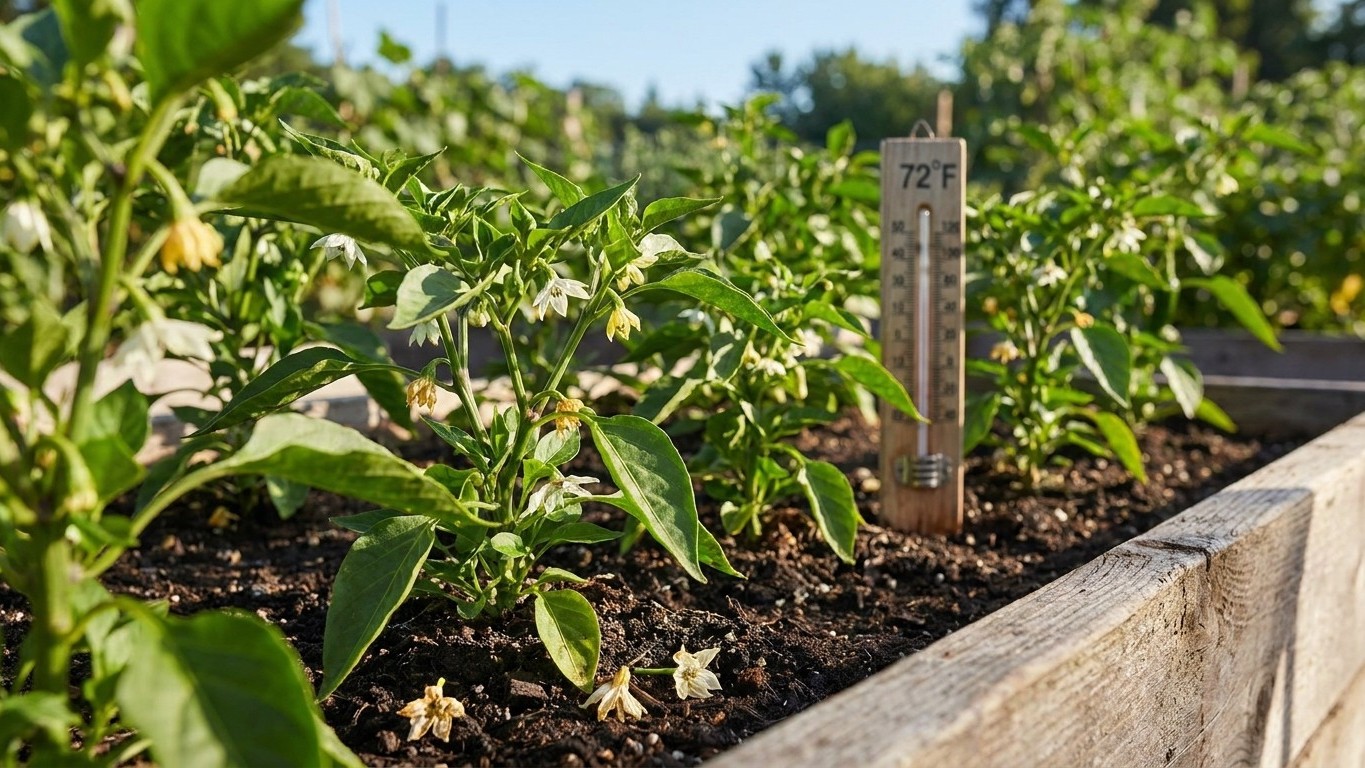

In South Dakota, the window for starting pepper seed indoors runs roughly from mid-February to mid-March. That’s because transplanting happens after the last spring frost, which falls between April 29 and May 9 near Sioux Falls, and only once the soil has warmed to 60°F. Counting back 8 to 10 weeks from that transplant date is what sets the start line.
The short answer
Sioux Falls averages 13.8 days a year at or above 90°F, based on NOAA NCEI Climate Normals for 1991-2020. That’s not a huge number compared to states further south, but it’s enough to matter for pepper flowers. Pepper fruit set fails when daytime highs push past 90°F, because the plant drops blossoms rather than pushing fruit through heat stress. In a typical South Dakota summer, that means a handful of days, usually clustered in July, where flowers that open during the heat spike simply fall off instead of setting fruit.
The flip side matters just as much, and it’s the one growers overlook. Pepper fruit set also fails when nights drop below 55°F, according to Utah State University Extension. A stretch of cool nights in late spring or a surprise cold snap in early summer can stall a pepper plant just as effectively as a heat wave does, even if the days feel warm and pleasant.
Here’s the catch for South Dakota gardeners specifically: this site tracks days above 90°F by territory, but it does not carry summer night minimum temperatures. That figure isn’t published here, and it shouldn’t be guessed at from latitude or from how cold the winters get. Those numbers don’t translate into a reliable summer night low. A river valley, a low-lying yard, or an open field can all run several degrees cooler at night than a station reading taken elsewhere in the same county, and that gap is exactly what determines whether pepper flowers hold or drop on any given night.
The practical move is to watch your own nighttime lows through late spring and early summer rather than relying on a regional average. A basic min-max thermometer left outside, or a smartphone weather app with hourly history for your specific location, will tell you far more than any state-level figure. If you’re seeing repeated nights under 55°F even in June, that’s the signal to delay setting plants outside, add row cover, or accept a slower start to fruiting.
When to start seed here
The arithmetic behind the seed-starting window is straightforward once you break it into pieces. Here’s how to work it out for your own county rather than relying on a single fixed date:
- Find your local last frost date. Near Sioux Falls, that’s April 29 to May 9, based on the 30-70% probability band for a 32°F freeze from NOAA NCEI’s 1991-2020 Climate Normals. Suburban and rural yards outside town typically see frost linger later than the airport station reports, sometimes by one to two weeks, and low spots or elevated ground can shift that further. Check your own county extension office or a personal weather log if you have one.
- Add the soil-temperature condition. Frost date alone isn’t the trigger. Utah State University Extension is clear that pepper transplants go outside after frost and once soil has reached 60°F. In a cool, wet spring, soil can lag well behind the air, so the real transplant date may land a week or two after the frost-free date, not right on it.
- Set your transplant target date. Combine the two conditions above and pick the later of the frost-free date or the date soil typically hits 60°F in your yard. For most South Dakota gardens tracking close to the Sioux Falls averages, that lands somewhere in mid to late May.
- Count back 8 to 10 weeks for seed starting. Utah State University Extension recommends starting pepper seed indoors 8 to 10 weeks before that transplant date. Working back from a mid-to-late May transplant target, that puts the seed-starting window at roughly mid-February to mid-March.
- Adjust for your own risk tolerance. Starting at the 10-week mark gives larger, more established transplants but demands more indoor light and space for longer. Starting closer to 8 weeks means smaller transplants at set-out time, which can actually handle the transition to outdoor conditions with less shock.
None of this needs to be exact to the day. What matters is the sequence: lock down your local frost date first, watch your soil rather than the calendar for the 60°F mark, then count backward from there.
What goes wrong here
- Blossom drop during a hot spell. With 13.8 days a year averaging 90°F or above in the Sioux Falls area, a summer heat spike is common enough to expect. Flowers open during those days and drop without setting fruit. The remedy is timing and shade: avoid transplanting right before a forecasted heat run if possible, and use light shade cloth over plants during the hottest afternoons in July to reduce blossom loss.
- Blossom drop from a cool night. Nights below 55°F cause the same blossom failure as heat does, just from the other direction. Since this site doesn’t track summer night lows for South Dakota, the fix is to monitor your own yard with a simple outdoor thermometer through late spring and early summer, and hold off on setting plants out, or cover them overnight, if a cold stretch shows up in the forecast.
- Sunscald on fruit and stems. Strong summer sun combined with those 90°F-plus days can scald exposed fruit and stems, especially on plants that lost leaves to wind, hail, or disease earlier in the season. Keep foliage full and healthy through the season so it naturally shades developing fruit, and avoid heavy pruning during the hottest weeks.
- Blossom-end rot. This shows up as a dark, sunken patch on the bottom of the fruit and is tied to inconsistent water reaching the plant, not a soil nutrient the gardener is usually missing. Deep, even watering on a regular schedule, rather than letting soil swing between soaked and dry, is the practical fix, especially during those hot stretches when water demand spikes fastest.
Common questions
Can I Start Pepper Seed earlier than mid-February to get a head start?
Starting much earlier than 10 weeks before transplant usually backfires. Plants get root-bound or leggy indoors waiting for outdoor conditions to catch up, and older transplants often transition more roughly than younger, more compact ones.
What if my soil hits 60°F before the last frost date passes?
Wait for both conditions. Utah State University Extension ties safe transplanting to frost passing and soil reaching 60°F. A late-season frost can still kill young pepper plants even if the soil has warmed, so use the later of the two dates.
Does the 35 to 45 day figure for pepper fruit apply from the seed-starting date?
No. That range measures time from flowering to harvest, not from sowing or transplanting. Total time from seed to first ripe fruit runs considerably longer once you add germination, indoor growing time, and the wait for the plant to reach flowering size.
Should I pick a specific variety to handle South Dakota’s heat swings better?
Utah State University Extension names several pepper varieties suited to home gardens but does not attach heat tolerance ratings, days-to-maturity figures, or size data to any of them. Rather than picking by name alone, focus on the timing and watering practices above, since those drive fruit set regardless of variety.