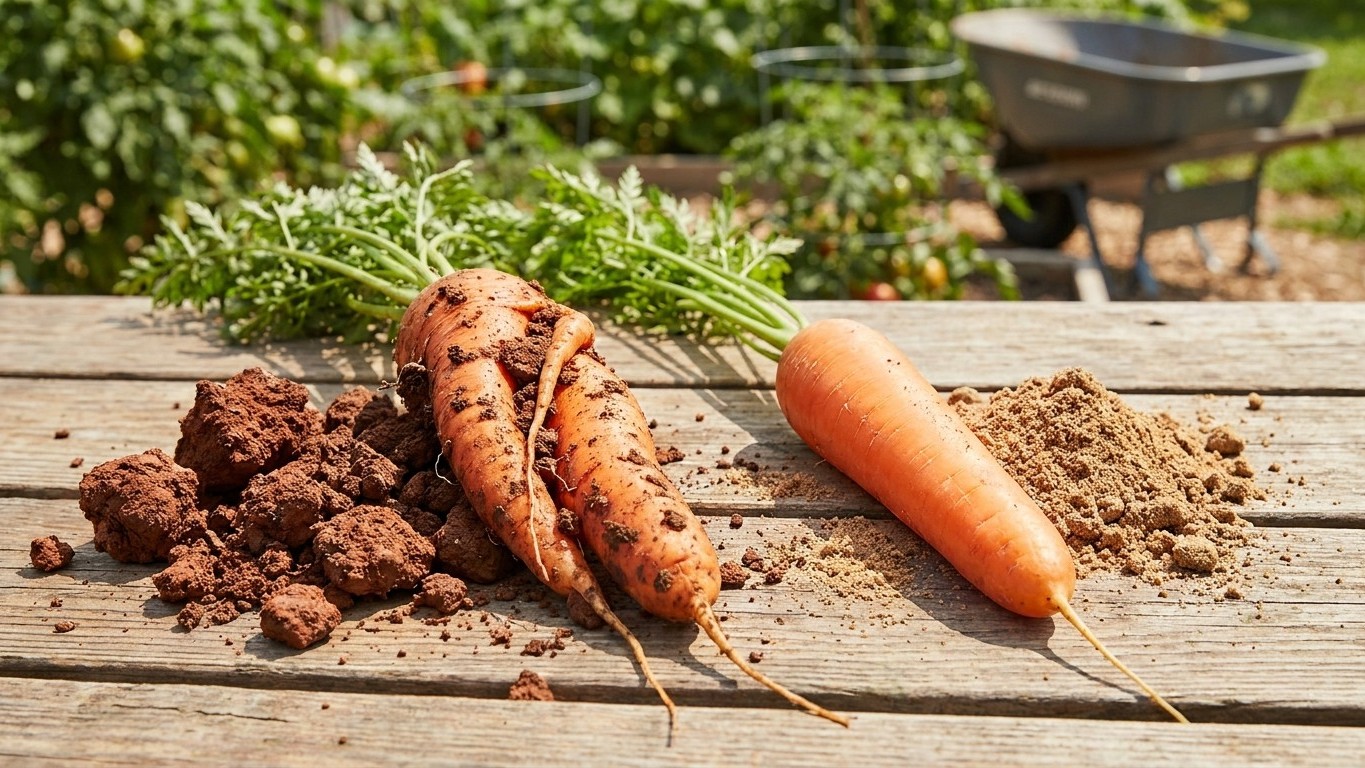

Tennessee’s benchmark soil carries just 11 percent sand against 68 percent silt and 20 percent clay, and that ratio alone tells you most of what you need to know before you sow a single carrot seed. A carrot root pushing through that much silt and clay will hit resistance, split around stones, and fork instead of running straight. The fix is not a different seed. It’s the ground you put it in.
The short answer
The soil USDA lists as representative of Tennessee is the Dickson series, an Ultisol, which is a category of old, heavily weathered and leached soil that runs naturally acid and short on nutrients. The surface horizon comes in at about pH 5.0, strongly acid, with a texture of 11 percent sand, 20 percent clay and 68 percent silt, organic matter around 1.5 percent, and a drainage class of moderately well drained. Those numbers come from USDA NRCS Soil Data Access, averaged across 115 mapped components of the series.
Run that texture against what a carrot actually wants. Utah State University Extension is blunt about it: carrots need deep, sandy, well-drained soil rich in organic matter, and heavy or rocky ground makes the root fork. Dickson soil is the opposite of sandy, which raises the question of Will Carrots Fork in Tennessee Soil? With silt making up more than two-thirds of the profile and clay adding another fifth, a carrot taproot pushed into unamended Dickson ground has every reason to split, curl, or stop early against compaction. Add the acidity, at pH 5.0, and you’ve also got a soil that’s working against the plant’s nutrient uptake before the root even hits resistance.
None of that means carrots won’t grow in Tennessee. It means the ground has to be changed before the seed goes in, and timing that work correctly matters just as much as the soil prep itself, which is why knowing When to Sow Carrots in Tennessee is worth settling before you touch a shovel. Utah State’s Extension answer for heavy soil is direct: work in plenty of compost and double dig the bed, breaking up the profile to at least 12 inches and loosening it well past the depth the root will travel. Where the native ground is shallow, rocky, or compacted in a way double digging won’t fix, a raised bed filled with a loose, sand-and-compost mix sidesteps the problem entirely, and it’s the more reliable option if you’ve never worked that bed before.
One caution matters more here than almost anywhere else in this project. Tennessee spans hundreds of individual soil series, from Mississippi River bottomland silt to Cumberland Plateau shale-derived clay to Nashville Basin limestone soils, and Dickson is simply the one USDA names as representative of the state as a whole. It is a starting point for what the region’s ground tends to do, not a diagnosis of what’s under your own garden bed. A subdivision lot with fill dirt trucked in during construction, or a bottomland garden a quarter-mile from a creek, can look nothing like the Dickson profile above. That’s what the next section is for.
The test that settles it in your own garden
- Dig a test hole at least 12 inches deep where you plan to sow. Carrots need that depth of loose ground to run straight, so this is the same depth you’d be preparing for planting anyway.
- Look before you touch anything. Note the depth at which the soil changes color or gets noticeably harder to dig, and count how many rocks or chunks of gravel you hit along the way. A carrot root forks around every obstruction it meets, so a handful of pea gravel at 6 inches down is a bigger problem for this crop than for almost anything else you’d grow.
- Feel the texture between wet fingers. Grab a handful of moist soil and squeeze it into a ball. Sandy soil falls apart when you poke it. Clay-heavy soil holds a shape and feels sticky or slick. Silt sits somewhere between the two, smooth rather than gritty, and often holds together loosely without the stickiness of clay.
- Watch how water moves through it. Fill the same hole with water and time how long it takes to drain away. Water that vanishes in a few minutes points to sandy, fast-draining ground. Water that sits for an extended period signals clay or compaction, the same condition that produces forked roots and rot around the crown.
- Compare what you found to the Dickson numbers above. If your hole showed loose, gritty, fast-draining ground, your garden is running lighter than the state average and carrots will likely do fine with routine compost. If it showed a sticky ball, standing water, and rock at shallow depth, treat your bed as heavier than the state figures and plan on double digging or a raised bed before you sow.
When to sow here
Carrots are sown directly into the ground. There’s no transplanting step to count from, no seedling tray to move outside on a schedule, just seed in soil, and the 70 to 100 days to harvest run from that sowing date. Getting that date right matters more for carrots than for a lot of other vegetables, because germination is slow and picky about temperature to begin with.
- Start with your last spring frost window. NOAA’s 1991-2020 climate normals put the 32°F freeze probability window for Middle Tennessee, at the Nashville-area station used in these records, between March 31 and April 12. That’s a real range, not a single date, and it reflects the spread of years the station recorded.
- Adjust for where you actually garden. East Tennessee and the Cumberland Plateau run cooler and later in spring than the Nashville area the station above represents. If you’re gardening up in those elevations, push your working frost date later rather than earlier.
- Count backward two to three weeks from that last frost date. Carrots tolerate a light frost once they’re up, and cold soil that isn’t frozen won’t stop the seed from starting, so the standard advice is to sow ahead of the last frost rather than after it. Two to three weeks ahead of an early-April last frost lands sowing somewhere in the second half of March for much of Middle Tennessee, later for the cooler eastern parts of the state.
- Check the soil temperature before you commit seed to the ground. Carrots need soil at a minimum of 40°F to germinate at all, and they germinate best in the 55 to 65°F range. A soil thermometer pushed a couple of inches into the bed on a normal morning tells you more than any date on a calendar. If the ground is still colder than 40°F, wait, regardless of what the frost-window arithmetic suggests.
- Expect slow, uneven emergence even when timing is right. Carrot seed is small and germination is naturally slow. Cold snaps right after sowing will stretch that further, so patience matters as much as the date you pick.
What goes wrong here
- Forking in heavy, unamended ground. A profile running 68 percent silt and 20 percent clay, like the state’s Dickson series, resists a straight taproot and splits it around any pocket of compaction or buried stone. The remedy is the one Utah State University Extension gives for heavy soil generally: work in plenty of compost and double dig the bed to loosen it well past root depth, or skip the fight altogether and plant in a raised bed filled with a loose, sandy mix.
- Poor germination during a hot spell. Carrot seed germinates best between 55 and 65°F, and Tennessee’s spring can swing warm fast once it turns. A late sowing that hits soil already climbing past that range will come up thin and patchy. Sowing on the early side of the recommended window, and keeping the bed shaded and consistently moist right after seeding, keeps the seed bed closer to that ideal range.
- Splitting from uneven watering. Roots that grow through a stretch of drought and then get hit with a heavy rain, or a long hose session after weeks of neglect, tend to crack along the length of the root as they swell suddenly. A steady watering schedule, rather than a feast-or-famine one, prevents the sudden growth spurt that causes the split.
- Stunted, shallow roots from acidic, low-organic-matter soil. The state’s representative surface soil sits around pH 5.0 with roughly 1.5 percent organic matter, both of which work against strong root development if left uncorrected. Compost addition raises organic matter and gradually moderates pH, doing double duty against both problems at once.
Checking this against your own county
The Dickson figures above describe a soil series USDA maps as representative of Tennessee as a whole, not the dirt under your specific garden bed. Before you commit a season’s worth of seed to a bed you haven’t tested, the University of Tennessee Institute of Agriculture’s Extension service runs county offices across the state that can walk you through a soil test, tell you what series is actually mapped under your address, and give planting guidance calibrated to your county’s own frost pattern rather than a single station’s regional average. Find your local office through UT Extension. A twenty-dollar soil test from that office will tell you more about your carrot bed than any state-level average ever will.
Common questions
Does Tennessee’s clay soil mean I can’t grow carrots at all?
No. It means unamended clay-heavy ground will produce forked, stunted roots more often than not. Double digging with compost, or switching to a raised bed with a loose sandy mix, addresses the problem directly rather than ruling the crop out.
How deep should I dig before sowing carrots in heavy Tennessee soil?
Utah State University Extension’s general guidance for heavy soil calls for double digging, which means loosening the ground well past the depth the mature root will reach, generally at least 12 inches, so the taproot has no compacted layer to fork around.
Why did my carrots come up thin and patchy this spring?
Carrot seed germinates best between 55 and 65°F and needs soil at a minimum of 40°F to germinate at all. A late sowing that hits already-warm soil, or a sudden cold snap right after seeding, both produce weak, uneven germination.
Is the frost date the same across all of Tennessee?
No. The NOAA climate normal cited here, a last spring frost window of March 31 to April 12, comes from a Middle Tennessee station. East Tennessee and the Cumberland Plateau run cooler and later in spring, so gardeners there should push their working sowing date later.