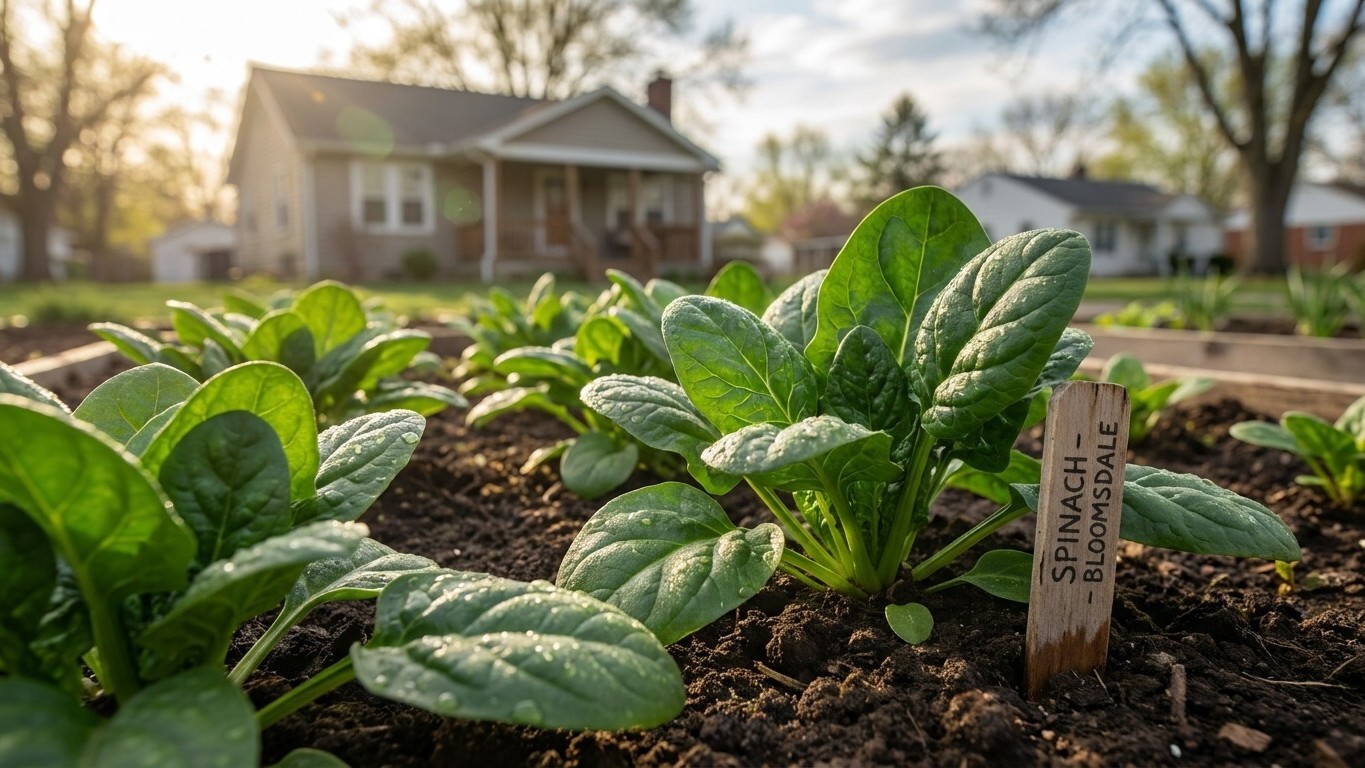

In the Montreal region, spring-sown spinach typically starts bolting by late May to early June, well before the summer solstice arrives. A second, shorter round can go in from mid-July into early August for an autumn harvest, and the specifics of When to Sow Autumn Spinach in Quebec are worth planning around. The trigger here is day length more than heat: Quebec’s summers run cool by North American standards, but the days themselves get long enough to push spinach toward flowering regardless of temperature.
The short answer
Start with the number that actually matters for this crop: 15 hours and 29 minutes of daylight on the longest day of the year at the reference station near Montreal. That’s the mechanism at work. Spinach is one of the plants that flowers, or bolts, in response to long days as well as warm temperatures. A cool Quebec summer does nothing to cancel that signal. The plant doesn’t measure the thermometer first; it measures the light. So even in a year with a mild July, spinach sown too late in spring will still run to seed once the days stretch long enough.
Now compare that against the heat side of the equation. The reference station near Montreal averages 0.0 days a year at 90°F or above. That’s essentially no extreme heat load at all, which tells you something useful: Quebec is not a place where scorching afternoons are what end the spinach crop. Utah State University Extension notes that spinach grows best where temperatures stay under 75°F, and that same 75°F line is also where the leaves start turning bitter. In a climate with almost zero days above 90°F, the air rarely gets punishing enough to hit that ceiling hard on its own, especially in spring and early autumn.
Put those two facts side by side and the answer is plain: in Quebec, day length is the dominant limit on spinach, not heat. Heat plays a supporting role, mostly in high summer when soil temperatures climb even if air temperatures stay moderate, and it can tip already-stressed plants into faster bolting or bitter leaves. But the calendar problem, the reason spinach won’t just sit in the garden all summer, is the light. This distinction matters because it changes what a gardener should actually do about it, and it’s the core question behind Will Spinach Bolt Early in Quebec?. Watering more, mulching heavily, or picking a shadier bed won’t stop the day-length signal. What works is timing: getting the crop in the ground early enough in spring to finish before the long days take over, then coming back for a second crop once the days start shortening again in late summer.
That framing also explains why Quebec gardeners sometimes get frustrated comparing notes with growers farther south. A grower in a hotter, shorter-day-length region loses spinach to heat first. A Quebec grower loses it to day length first, often while the weather still feels perfectly pleasant. The plant is reacting to something the gardener can’t feel on their skin.
How long the spring window really is
- Start with the frost date. The average last spring frost near Montreal falls on May 6. That’s a mean date from Environment and Climate Change Canada’s 1981-2010 climate normals for the MONTREAL/ST-HUBERT A station, not a guarantee. In roughly half of all years, frost arrives after that date, so treat it as the middle of a range rather than a safe line to plant against.
- Move sowing earlier than the frost date itself. Spinach seed goes in the ground 2 to 3 weeks before the last frost, which puts a typical sowing window somewhere around mid-to-late April for gardens near this reference station. Spinach tolerates cool soil far better than most vegetable seed, which is exactly why this early window exists.
- Track the growth ceiling. Once seedlings are up, growth stays strong as long as conditions remain under that 75°F mark. In April and much of May near Montreal, that ceiling is rarely a problem, which is one reason this stretch of spring is the easiest part of the year to grow spinach here.
- Watch the days lengthen, not the thermometer. As the calendar moves from late April toward the June 21 peak of 15 hours 29 minutes of daylight, the bolting signal builds steadily. By the time days are within an hour or two of that peak, plants that were sown on schedule are usually finishing up, and later plantings are already running to seed.
- Total usable stretch. Counting from a mid-to-late April sowing through to bolting in late May or early June gives a working spring window of roughly 6 to 8 weeks. That’s the real planting calendar for Quebec spinach, not the full length of spring itself.
The autumn crop, and when the soil lets you sow
A second spinach crop is possible once the days start shortening after midsummer, but two separate obstacles bracket that window, one at each end of the calendar.
Soil too warm to germinate
Utah State University Extension is specific on this point: spinach seed germination drops off once soil temperature climbs above 80°F. That’s a soil measurement, not an air temperature, and soil in a sunny bed can run warmer than the air reads on a thermometer at head height. Quebec’s low heat load, with an average of 0.0 days a year above 90°F in the air, means soil is less likely to sit at scorching levels for long stretches compared with hotter regions. But midsummer sun on bare or lightly mulched soil can still push it past that 80°F mark in July, which is exactly why direct sowing that early tends to disappoint. The practical fix is patience: waiting until soil cools as August arrives and nights lengthen, rather than fighting germination in the hottest weeks of summer.
Autumn frost sets the deadline
At the other end, the average first fall frost near Montreal lands on October 5, again a mean figure from the same Canadian climate normals, and again a midpoint rather than a firm date; frost can and does arrive later than that in many years. Utah State’s guidance for a fall crop is to count back 50 to 75 days from the date a gardener actually wants to harvest, since the source publishes no fixed days-to-maturity figure for spinach. Aiming to harvest by roughly the third week of September, ahead of that average frost date rather than right up against it, means counting back to a sowing window of about mid-July through the first week of August. That’s a narrower target than it looks on paper, sandwiched between soil that’s still too warm in early July and a frost date that isn’t guaranteed to hold off until October.
Checking this against your own county
Every figure above comes from one reference station near Montreal, and Quebec is not one climate. Upland and northern districts run weeks behind that station’s frost dates, and microclimates within a single county can shift a sowing window by a week or more in either direction. For local frost data, soil conditions, and variety guidance suited to a specific region, the Ministère de l’Agriculture, des Pêcheries et de l’Alimentation du Québec (MAPAQ) is the provincial authority to check directly at mapaq.gouv.qc.ca. Gardeners farther from the St. Lawrence lowlands should treat the dates in this article as a starting estimate, then adjust based on their own recorded frost history rather than assuming the Montreal-area numbers apply exactly where they garden.
Common questions
Will shade or extra water stop spinach from bolting in Quebec?
No. Bolting here is driven mainly by day length, and shade or watering doesn’t change how many hours of daylight the plant is receiving. Those steps can help keep soil and leaves cooler, which matters for flavor and for slowing growth stress once the 75°F ceiling is crossed, but they won’t cancel the long-day signal itself.
Which spinach varieties are recommended for a Quebec garden?
Utah State University Extension names Bloomsdale, Melody, Teton, and Olympia as spinach varieties, without publishing days-to-maturity or performance data for any of them specific to a cool, long-day climate like Quebec’s. Choosing among them comes down to seed availability and personal preference rather than any documented advantage for this region.
Is there really a fall spinach crop worth planting in Quebec?
Yes, but the window is tight. Soil needs to cool below the 80°F germination threshold, which usually rules out early-to-mid July sowing, while the average October 5 frost limits how late a crop can go in and still mature. That leaves roughly a few weeks in midsummer as the practical sowing target, following the 50-to-75-day count-back Utah State recommends.
Can I grow spinach through the full summer near Montreal?
Not reliably. The long days around the June 21 peak of 15 hours 29 minutes push spring plantings to bolt by late May or early June, and the same long-day pressure continues through most of the summer months. The practical approach is two separate crops, one finishing before the solstice and another started once soil cools in late summer, rather than one continuous summer-long planting.