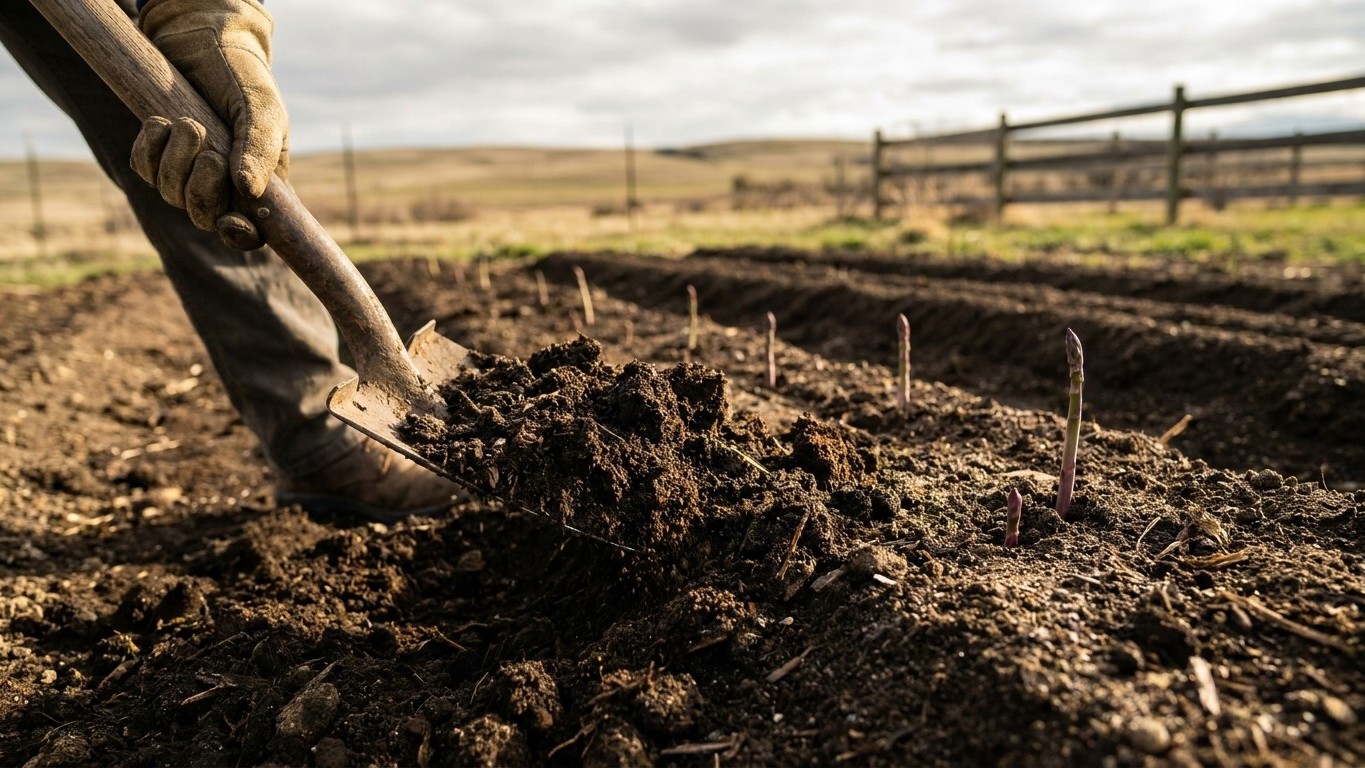

A bed of asparagus in Manitoba is not a one-season decision. Plant the crowns and you commit that patch of ground for ten to fifteen years, with no harvest at all until the third spring. Before deciding When to Plant Asparagus Crowns in Manitoba, the only soil condition the source sets is drainage. Manitoba’s dominant ground, a heavy Chernozem, is rated imperfectly drained, which makes that one requirement the thing to settle before any crown goes in the furrow.
The short answer
Fifteen years is a long lease to hand to a single patch of dirt. Most vegetables get amended every spring and forgiven every fall; asparagus gets one chance, because once the crowns are down and producing, digging them up to fix a drainage problem means starting the whole three-year wait over again. That’s what makes the soil question here different from almost anything else in the garden.
Across Manitoba’s mapped agricultural surface, the commonest soil order is a Chernozem, the deep, dark grassland soil the prairies are known for, rich in organic matter and naturally fertile. It covers about 41 percent of the mapped ground, with Gleysolic soils as the next most common. The median surface reads alkaline, around pH 7.6, and the texture leans loam to silt: roughly 45 percent sand, 24 percent clay, 31 percent silt, with organic matter near 5.5 percent. On the drainage question that matters most here, the classification for this soil is imperfectly drained.
That word, imperfectly, is the one to sit with. It doesn’t mean waterlogged, and it doesn’t mean unusable. It means water moves through more slowly than a naturally well-drained soil, and asparagus crowns sitting in standing water for long stretches will rot before they ever get a fair shot at fifteen productive years. None of this is a verdict on one particular yard. The state soil figure is a province-wide median drawn from thousands of mapped points; a garden on a river terrace, in a low spot, or on ground a builder has filled or scraped can be nothing like it. Will Manitoba Soil Hold an Asparagus Bed for Fifteen Years? is a question a homeowner has to answer for their own patch, not assume the provincial number applies.
The fix, where drainage is doubtful, is straightforward: build up rather than dig down. A raised bed or a mounded row lifts the crowns above the water table and lets excess moisture drain to the sides instead of pooling around the roots. Working in extra organic matter, or coarse sand where the ground runs heavy in clay, loosens the structure enough for water to move through instead of sitting. None of that changes the alkaline pH of the underlying ground, and the asparagus source itself says nothing about a preferred pH, so there’s no target number to chase there. The task is drainage, not chemistry.
Will the summer here water it for you?
The bed’s own water rule is specific: 1 to 2 inches every other week for the first two years while the crowns establish, then a lighter 1 to 2 inches every three weeks once the planting matures. Manitoba’s summer rainfall, measured at the Winnipeg Richardson International Airport station, comes in at about 9.7 inches total across June, July and August, broken down as June 3.54 inches, July 3.13 inches, and August 3.03 inches, the driest of the three.
- Establishment years, roughly 2 to 4 inches a month needed. A bed asking for 1 to 2 inches every two weeks works out to somewhere near 2 to 4 inches monthly. June’s average of 3.54 inches can cover the lower end of that on its own, but July and August, at 3.13 and 3.03 inches, fall short of the upper end most months.
- The gap widens in August. August is the driest month on record here, and it’s also peak heat for evaporation. A young bed still needing regular deep watering in its first two summers will likely need supplemental water in August even in an average year, and more in a dry one.
- Mature bed, lighter demand. Once the every-three-week schedule kicks in, the math works out closer to 1.3 to 2.7 inches a month, a range Manitoba’s summer normals can often meet, particularly in June and July.
- Rain that falls doesn’t always soak in. A single summer thunderstorm tends to run off rather than penetrate, especially on the province’s silt-heavy, imperfectly drained ground. A monthly total on paper isn’t the same as steady moisture reaching the crown roots.
- The gauge on the plot settles it. These are long-term normals for one reference station, not a forecast and not a guarantee for any single yard. A rain gauge and a look at the soil a few inches down after a dry week are what tell a gardener whether the hose needs to come out.
When to put the crowns in
Crowns go into the ground in early spring, as soon as the soil can be worked. In Manitoba, that timing sits around the mean last spring frost date of May 23, recorded at the Winnipeg Richardson International Airport station. That date is an average, not a promise: in one year out of two, the last frost actually falls later than May 23, so a gardener planting right on that date is planting into a coin-flip. Treat it as the midpoint of a window worth watching, not a safe green light.
The crowns themselves go into furrows about 8 inches deep. Rather than filling the furrow in all at once, the backfilling happens gradually across the season, adding roughly 2 inches of soil back over the crowns every other month through the year as the new growth pushes up. That slow burial gives the developing root system room to spread before it’s fully covered.
There’s no shortcut on the harvest timeline. No spears get cut at all in the first two years, no matter how tempting the first shoots look. Harvest doesn’t start until the third spring, and even then it’s limited: a first harvest window of about 4 weeks, extending to roughly 6 weeks the following year, then up to about 8 weeks once the bed is fully established. The signal to stop cutting for the season isn’t a date on the calendar; it’s the spears themselves. When most of them come up thinner than a pencil, that’s the plant telling the gardener the season’s harvest is over, regardless of how many weeks have passed.
Seed is the slower alternative to crowns. Starting from seed adds an extra season of growing before the seedlings are ready to be handled and transplanted like crowns, pushing the whole timeline back further before that third-year harvest becomes possible. For gardeners who don’t want to wait that long, four varieties turn up in the Utah State University Extension source, identified only by their sex: Jersey Giant and Jersey Knight are all-male, while UC 157 F1 and Purple Passion are male and female. No flavor comparison, yield figure, or reason to prefer one over another is published there, so none is claimed here.
Checking this against your own county
Every number above comes from a province-wide soil median and a single weather station near Winnipeg. Manitoba stretches across river bottoms, upland districts, and agricultural zones that don’t all behave the same way, and the province’s far north isn’t represented in the soil survey at all. A garden thirty miles north or west of that reference station can run weeks behind on frost timing, or sit on ground nothing like the median texture reported here.
The most useful next step for any Manitoba gardener is a call or visit to Manitoba Agriculture, the province’s own extension service. They can point to local frost records, soil test options, and drainage guidance specific to a given district, rather than a provincial average.
Common questions
Can asparagus handle Manitoba’s alkaline soil? The asparagus source doesn’t publish a preferred pH, so no ideal number can be given here. Manitoba’s median surface soil pH runs around 7.6, alkaline, but that’s a province-wide figure, not a reading from any individual garden. A soil test is the only way to know a specific plot’s pH.
Do I need to worry about winter cold killing the crowns? The source used for this page is silent on any winter chilling requirement, and no chilling figure is supplied here because none is published. Hardiness zone maps exist for other purposes, but they aren’t a substitute for a chilling number that simply isn’t in the record.
How soon can I plant if I miss the early spring window? Crowns go in as soon as the ground can be worked in early spring, timed around the mean last frost date of May 23. Since that date is only an average, waiting a bit longer into a cool spring is often safer than rushing a planting into ground that’s still frozen or waterlogged.
Is a raised bed necessary for every Manitoba garden? Not necessarily. It depends on how well a specific plot drains, not on the province-wide median. Ground on a slope or a sandier pocket may drain fine as is; low-lying or heavy clay spots are where raising the bed becomes worth the extra effort.