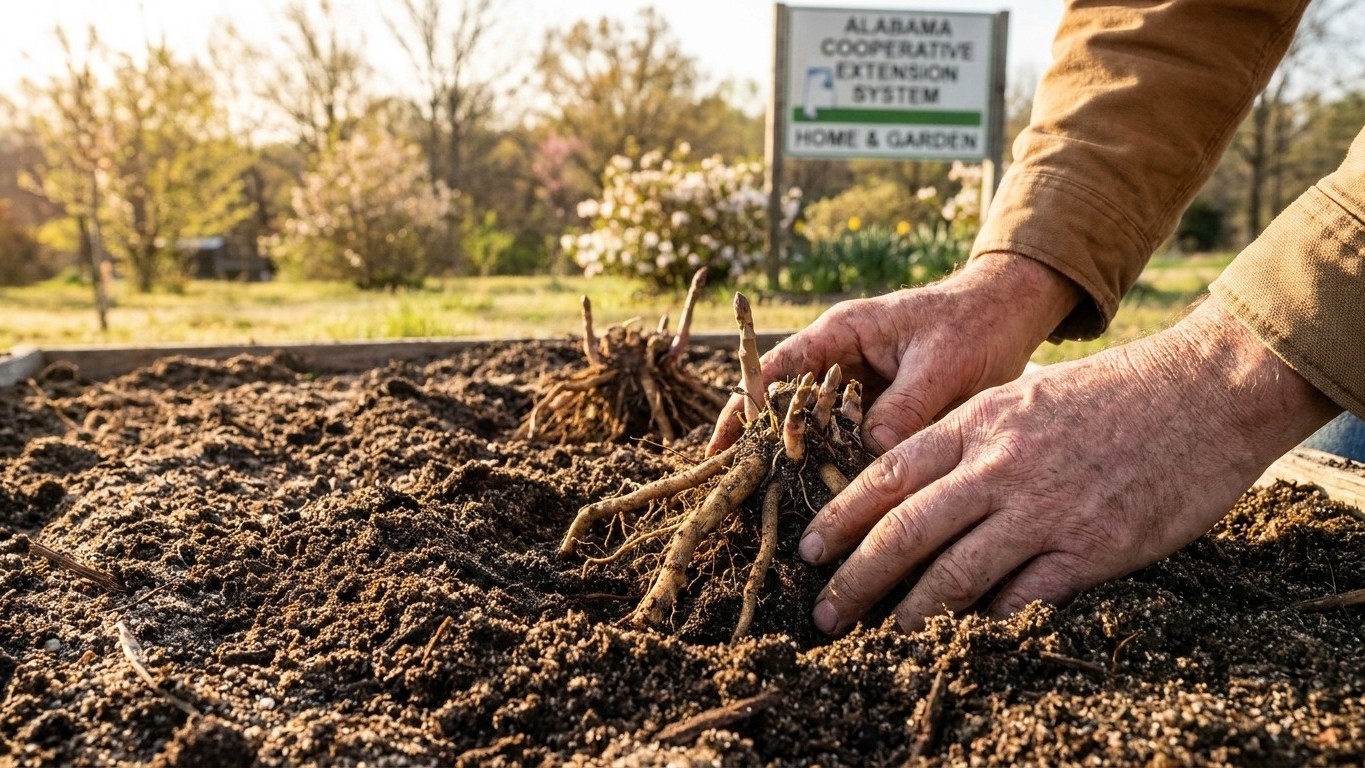

In South Carolina, asparagus crowns go into the ground in early spring, timed around the region’s last frost window rather than a fixed calendar date. Set them in furrows about 8 inches deep, in soil that drains well, since a properly sited bed goes on producing for 10 to 15 years. The reference station near Charleston puts that spring window between February 28 and March 17. Get the timing and the drainage right at the outset, because this is one crop in the garden where there’s no do-over once the crowns are down.
The short answer
Before anything else, asparagus asks one question of a piece of ground: does it drain? Utah State University Extension is blunt about it, most soils will grow asparagus fine, provided they’re well drained. That single condition matters more here than the planting date does, because a bed you dig this spring is still supposed to be feeding you in a decade or more. Get the site wrong and you’re not fixing it next season, you’re digging up a mature stand.
The soil USDA lists as representative of South Carolina, the Bohicket series, does not pass that test. It’s an Entisol, meaning a young soil with almost no profile development, and the surface horizon runs heavy: 17 percent sand, 35 percent clay, 48 percent silt, with organic matter around 15.0 percent and a surface pH near neutral at about 7.3. USDA classes it as very poorly drained. That’s a soil built to hold water, not shed it, which is close to the opposite of what a 10-to-15-year asparagus bed wants underneath it.
That figure describes a representative soil series for the state, not the dirt in any one backyard. South Carolina’s ground runs from sandy coastal ridges to heavy river-bottom clay to whatever a builder left behind after grading a lot, and none of that shows up in a single statewide number. What the Bohicket data does usefully signal is a regional tendency, low country and river-adjacent ground in this state leans wet and slow to drain, and a gardener sitting on similar soil needs to plan around it rather than hope for the best.
If a soil test or just watching a spot after rain shows standing water or slow percolation, the fix isn’t to skip asparagus, it’s to change the bed. Raised rows or a mounded berm lift the crowns above the wettest layer. Working in organic matter loosens heavy clay over a season or two. Choosing higher, sandier ground elsewhere on the property, even a few feet of elevation change, can be the difference between a bed that thrives for fifteen years and one that rots out in its third. Whatever the fix, it has to happen before the crowns go in, not after.
Will the summer here water it for you?
Asparagus has a fairly specific thirst. In its first two growing seasons the bed wants 1 to 2 inches of water every other week; once it’s established, that eases back to roughly the same amount every three weeks. The question for a South Carolina gardener is how much of that the sky actually supplies, and how much has to come from a hose.
- What the bed asks for: young plants need 1-2 inches every two weeks through their first two years, then an established stand needs about the same amount every three weeks.
- What summer here delivers: the reference station’s 1991-2020 normals show June at 6.21 inches, July at 6.6 inches, and August at 6.97 inches, for a three-month total near 19.8 inches, out of roughly 52.5 inches a year.
- Averaged out, that’s plenty on paper: spread evenly, 6 to 7 inches a month works out to well over an inch a week, comfortably ahead of what a young bed needs on its every-other-week schedule.
- But summer rain here rarely arrives evenly: a good share of it lands as a single thunderstorm that dumps quickly and runs off, especially on the state’s heavier clay soils, rather than soaking down to root depth the way a slow, steady rain would.
- Heat complicates the math further: hot summer days push evaporation hard, so a downpour that looks generous on a rain gauge can leave the top few inches of soil dry again within days.
- The practical takeaway: don’t take the monthly total at face value. A rain gauge on the actual bed, checked weekly through the growing season, is what tells a gardener whether nature covered that week’s 1 to 2 inches or whether supplemental watering is needed to close the gap.
When to put the crowns in
Crowns go into South Carolina soil in early spring, and the timing hangs on frost rather than a set week. The reference station’s 1991-2020 data puts the last spring freeze around February 28 to March 17, a range built from freeze-probability normals rather than a single guaranteed date. That “around” matters, because a mean frost date is an average of thirty years of weather, not a promise about any one spring. Gardeners near the coast, including peninsular Charleston, tend to run milder than that airport-station figure, while the Upstate runs several weeks tighter on both ends of the frost season. Whichever part of the state a garden sits in, the safer move is to plant once the soil has warmed and the worst of the freeze risk has passed, rather than racing to hit a calendar day.
Crowns are set into furrows roughly 8 inches deep. The furrow isn’t filled in all at once, it’s backfilled gradually, adding about 2 inches of soil every other month over the course of the year as the young shoots grow up through the loose fill. That slow backfill gives roots room to establish without smothering new growth, and it’s part of why this crop rewards patience over speed.
Seed is the alternative route, though it adds a season to an already long timeline, since seed-grown plants need a year in a nursery bed before they’re ready to move to their permanent spot as crowns. Most home gardeners skip that step and buy crowns directly, which is also the route the early-spring furrow method above assumes.
On variety, the published guidance from Utah State University Extension names four options and nothing more: Jersey Giant and Jersey Knight are all-male varieties, while UC 157 F1 and Purple Passion are male/female. That’s the extent of what’s documented, sex of the plant, nothing on flavor, yield, or disease resistance is published alongside those names, so choosing between them isn’t a matter of one being objectively better, just a matter of which type a grower wants in the bed.
Whichever variety goes in, the harvest clock doesn’t start moving until year three. There’s no cutting spears in year one or two, full stop, no matter how tempting the first shoots look. In year three, harvest runs about 4 weeks; the following year, about 6 weeks; after that, about 8 weeks. The rule for when to stop each season isn’t a date on the calendar, it’s a visual cue: stop cutting once most of the spears coming up are thinner than a pencil, and let the plant put its energy back into building next year’s crown.
Common questions
Can I harvest any spears in the first two years?
No. The bed needs those two years to build root reserves, and cutting spears early weakens the crown for the long run. Harvest doesn’t begin until year three.
What if my soil doesn’t drain well?
Raise the bed, mound it into a berm, or work organic matter into heavy clay before planting. Since asparagus stays in place for 10 to 15 years, fixing drainage after the fact isn’t practical.
Is there a soil pH asparagus needs in South Carolina?
That figure isn’t published in the source guidance used here, so it isn’t stated as a target. What is published is the single requirement that the soil drains well.
Should I plant from seed or from crowns?
Crowns are the faster, more common route and the one the early-spring furrow timing above is built around. Seed works too, but it adds a full extra year in a nursery bed before the plants are ready to move to their permanent spot.
If you follow the almanac, here is when to plant asparagus by the moon. It is a tradition, not a proven method.