
Sow autumn spinach in South Dakota once the soil has cooled below 80°F, roughly 50 to 75 days before your target harvest date. With the reference-city first fall frost falling between September 24 and October 4, that math points to a sowing window running from about mid-July through mid-August, depending on how quickly the ground shakes off summer heat and how close to frost you’re willing to harvest.
The short answer
At the reference city, the longest day of the year holds 15 hours and 15 minutes of daylight. For a leaf crop like spinach, that number works against you. Long days push spinach toward flowering, a process gardeners call bolting, and once a plant bolts the leaves turn bitter and the harvest is over. This is the opposite of what long days do for a crop like onions, where extended daylight builds the bulb. Spinach gets no such benefit. A long day is simply a long day, and in South Dakota’s summer, there are a lot of them in a row.
That matters because it means a cool summer here would not buy extra growing weeks even if one existed. Spinach responds to day length on its own, independent of temperature, so the calendar itself is working against a mid-summer crop regardless of how mild or wild the weather turns. Add the heat on top of that timing problem and the case for summer sowing collapses further: South Dakota averages 13.8 days a year at 90°F or hotter. Spinach grows best where temperatures stay under 75°F, and that same 75°F line marks where flavor turns bitter, not just where growth slows. Cross it, and you’re not just slowing the plant down, you’re ruining what’s left of the crop.
So which is it, day length or heat? Here, it’s both, and they arrive together. The long days of June and July coincide with the hottest stretch of the year, the very weeks when the days-above-90 count runs highest. There’s no summer loophole where cooler air offsets long daylight, because the two problems peak at the same time. That’s precisely why autumn sowing exists as a separate strategy: it waits for daylight to shorten and heat to fade, rather than trying to outlast either one in mid-summer.
How long the spring window really is
Before autumn planting makes sense, it helps to see why spring sowing is such a narrow strip of calendar in South Dakota. The math runs like this:
- Spinach seed goes in the ground 2 to 3 weeks before the last spring frost. With the reference city’s last frost falling between April 29 and May 9, that puts the earliest realistic sowing somewhere around early-to-mid April.
- Frost risk tapers off through late April into the first week of May, which is also roughly when spring soil finally warms enough for reliable germination without slowing the crop down.
- Good spinach growth stops once temperatures push consistently above 75°F. Given that South Dakota racks up 13.8 days a year at 90°F or higher, and that heat builds quickly once it arrives, the days below that 75°F ceiling run out fast, typically well before summer solstice.
- Put those two edges together and the usable spring window comes out to somewhere around five to six weeks, start to finish, from early April sowing to a late-May cutoff before quality drops.
Six weeks is workable for a fast leaf crop, but it’s tight. It leaves little room for a slow start, a late cold snap, or a warm spike that arrives early. That’s the practical argument for treating autumn as the second, often more forgiving, spinach season in this state rather than an afterthought.
The autumn crop, and when the soil lets you sow
Autumn sowing flips the spring problem around. In spring, cold soil and lingering frost are the obstacles. In fall, the obstacle at the start of the season is heat, and the obstacle at the end is frost, with a narrower target window sitting between them.
Soil still too warm to germinate
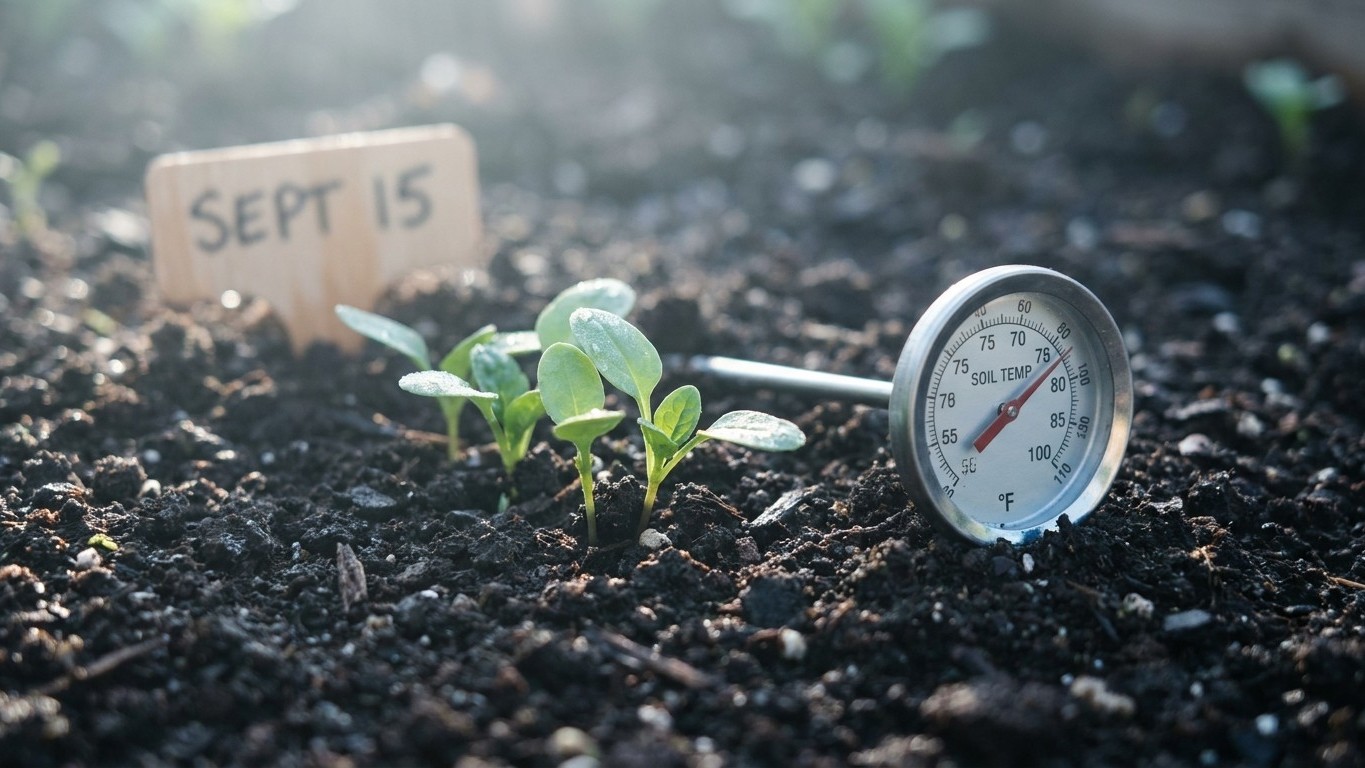
Spinach seed germinates poorly once soil temperature climbs above 80°F, according to Utah State University Extension. South Dakota’s summer soil holds that heat well into July, especially in a year with a high count of 90°F-plus days. Sowing too early, while the ground is still cooking from midsummer sun, means poor or spotty germination even with good seed. The practical move is to wait until soil temperatures have started their seasonal decline, which for most South Dakota gardens lands sometime between late July and mid-August. Testing the actual soil with a simple thermometer beats guessing off the calendar, since a sandy, south-facing bed and a shaded, clay-heavy one can differ by several degrees on the same day.
Counting back from the first frost
The other edge of the window is the first fall frost, which at the reference city falls between September 24 and October 4. Utah State University Extension’s guidance for a fall crop is to sow 50 to 75 days before the date you want to harvest, not before the frost itself. If you’re aiming to bring in a harvest right around that September 24 to October 4 stretch, counting back 50 to 75 days lands sowing somewhere between mid-July and mid-August.
Overlap those two limits, warm soil on one side and frost on the other, and the realistic sowing target for most South Dakota gardens sits in early-to-mid August: late enough that soil has cooled past the 80°F germination barrier, early enough that the crop still has 50 to 75 days to mature before frost shuts it down. Gardeners outside the reference city should nudge that window earlier rather than later. Suburban and rural sites typically see their first fall frost arrive one to two weeks sooner than the airport station’s recorded average, and colder pockets or higher elevations can see it earlier still, so checking local frost history rather than relying only on the reference-city dates is worth the extra few minutes.
Spinach varieties commonly grown for fall include Bloomsdale, Melody, Teton, and Olympia. No days-to-maturity figures for any of these are published in the sourced data here, so rather than guess, treat the 50-to-75-day window as the planning tool and adjust sowing date based on how your own soil and frost timing behave, not on a specific variety’s supposed speed.
Common questions
Can I sow spinach in July if I water it well?
Watering doesn’t lower soil temperature enough to fix the core problem. Germination drops above 80°F soil regardless of moisture, so a well-watered July bed can still fail to sprout if the ground itself is too warm.
Why does fall spinach often taste better than spring spinach?
Shortening days and cooling temperatures in autumn keep the crop under the 75°F threshold that triggers both slowed growth and bitterness, whereas a spring crop is racing against rising heat and lengthening days as it matures.
What happens if I sow too late in August?
The plants may not reach the 50-to-75-day maturity window before the first fall frost arrives, especially in colder counties where frost lands earlier than the reference-city average. A shortened harvest or an unfinished crop is the usual result.
Does the reference city’s frost date apply to my whole county?
No. It reflects one weather station. Suburban and rural gardens commonly see the last spring frost later and the first fall frost earlier than that station records, sometimes by one to two weeks, so use it as a starting reference and confirm against local conditions.