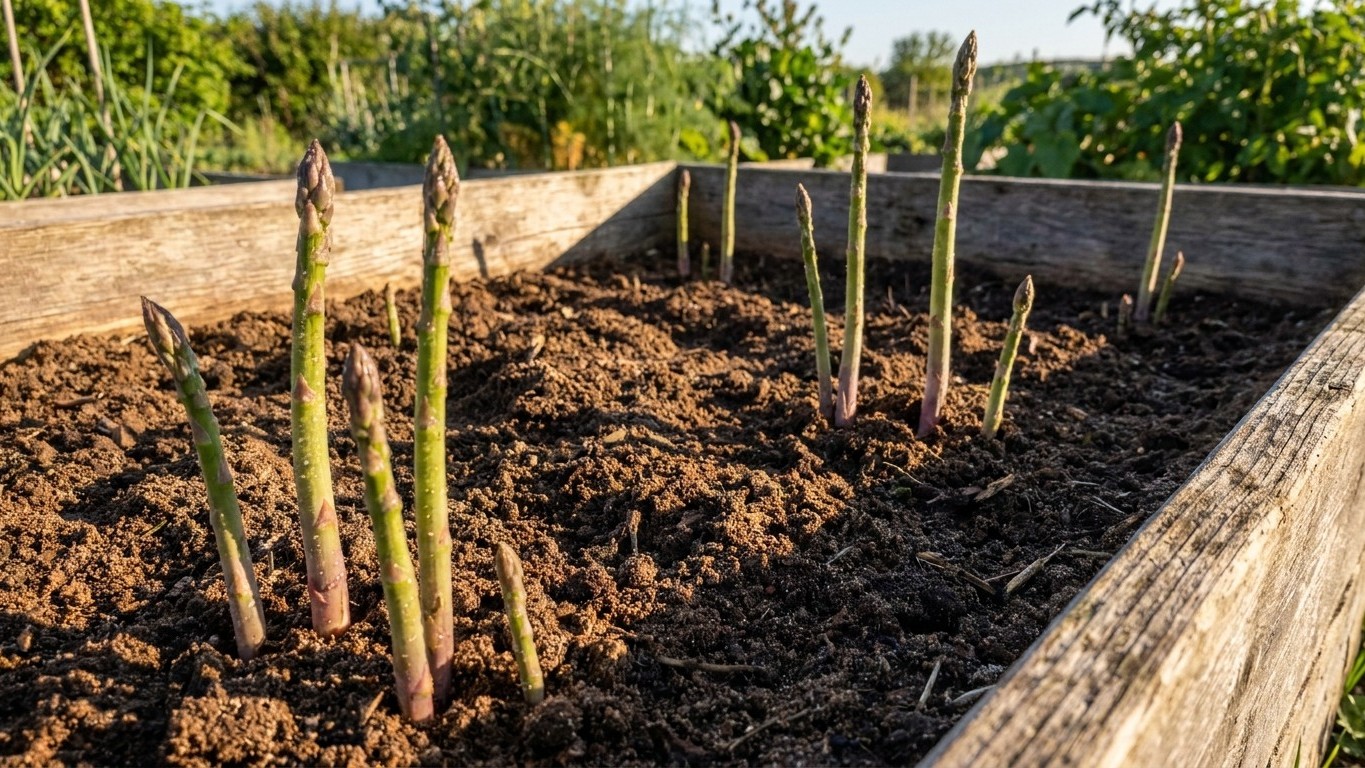

Yes, in most cases, but the answer hinges on one variable: does the ground drain. Asparagus asks nothing else of a soil for a fifteen-year run except that water not sit in it, and the clay that represents Texas can go either way depending on how it was worked before the crowns went in.
The short answer
Start with what the crop actually needs. Utah State University Extension notes that asparagus crowns, once settled, keep producing for 10 to 15 years, and that “most soils will do provided they are well drained.” That’s the whole soil requirement published for this crop, no pH range, no fertility threshold, just drainage. Everything else about siting the bed follows from that single condition.
The soil USDA lists as representative of Texas is the Houston Black series, a Vertisol, the shrink-swell clay that famously cracks open in a dry August and turns to something close to glue after a hard rain. Surface pH runs about 7.9, on the alkaline side. The texture is heavy: 20 percent sand, 54 percent clay, 26 percent silt, with organic matter around 3.0 percent in the surface horizon. USDA classifies it as moderately well drained, which is a real classification, not a euphemism, but it sits closer to the “watch it” end of the drainage scale than to a sandy loam.
That shrink-swell behavior is the detail that matters for a bed meant to stay put for a decade and a half. Clay that swells shut in wet weather can hold water around a crown’s root zone long enough to rot it, especially in a low spot or a yard where a builder compacted the subsoil during construction. A Vertisol can still support asparagus, but usually only where the surface has been loosened and raised, not left as flat, undisturbed clay.
The Houston Black series is a starting point, not a diagnosis of any one yard. Texas spans hundreds of mapped soil series, and a river-bottom garden, a Hill Country slope, or a lot filled in during a subdivision build can differ completely from the state’s representative clay. The one practical move that settles the drainage question for an actual bed is watching how long standing water lingers after a heavy rain, or digging a foot-deep hole, filling it, and timing how fast it empties. If the water is gone in a few hours, the ground is a candidate. If it sits overnight, the fix is a raised bed, 8 to 12 inches of amended soil above grade, rather than fighting the native clay for fifteen years.
Once drainage is settled, the crop’s own timeline is patient by design. There’s no harvest at all in year one or two. Year three brings a short 4-week cutting window, year four stretches to 6 weeks, year five to 8 weeks, and every season after that the rule for when to stop is the same: stop cutting once most of the spears coming up are thinner than a pencil, not on a fixed date.
Will the summer here water it for you?
The bed’s water demand is spelled out plainly: 1 to 2 inches every other week for the first two years while roots establish, then a lighter 1 to 2 inches every three weeks once the planting matures. Line that against what a Texas summer, per the 1991-2020 normals from station USW00012960, actually delivers.
- June brings about 6.0 inches of rain for the month. Against a young bed’s every-other-week schedule (roughly two waterings a month at 1-2 inches each, or 2-4 inches total), June rainfall alone covers it and then some, assuming it falls in usable doses rather than one runoff-heavy storm.
- July is the driest month of the three, at 3.77 inches. That’s still inside the 2-4 inch monthly target for a first- or second-year bed, but it’s the tightest month of the summer and the one where a gap between rain events is most likely to leave a young crown dry for a stretch.
- August averages 4.84 inches, back above the young-bed target and comfortably above the mature-bed need.
- Add the three months together and summer delivers about 14.6 inches, against 51.8 inches for the full year, meaning summer alone is not a drought season on paper, but it’s also not evenly spread.
- For a mature bed watering every three weeks (roughly 1.3 waterings a month at 1-2 inches, or 1.3-2.6 inches monthly), every summer month on the normals list clears that bar without help.
- The practical takeaway: a first- or second-year bed in a low-rainfall July, or in any year running below normal, likely still needs a supplemental soak or two, while an established bed can usually ride out an average Texas summer on rainfall alone. A rain gauge on the actual plot, not the regional average, is what tells a gardener whether this year is one of those dry stretches.
When to put the crowns in
Crowns go into the ground in early spring, set into furrows about 8 inches deep. For the Houston area, station USW00012960 puts the window with a 30 to 70 percent chance of a 32°F freeze somewhere between around February 4 and around March 1, and that band is a useful marker for when the last hard freeze risk is easing, not a guarantee tied to a calendar date. Texas runs across four USDA hardiness zones, and this window belongs to the mild Gulf Coast end of the state; the Panhandle freezes later into spring and earlier into fall, and North Texas and Hill Country sit somewhere between the two. A frost date from one Houston-area station, even Hobby versus IAH, can shift by roughly two weeks, so “around” is doing real work in that sentence.
Once the crowns are in the furrow, the soil doesn’t all go back at once. The furrow is backfilled gradually across the year, about 2 inches at a time every other month, rather than filled level on planting day. That staged backfill is part of why a Vertisol’s shrink-swell behavior matters early on: a furrow left partly open for months gives clay more surface exposed to a wet-dry cycle than a bed filled and settled all at once.
Crown selection comes down to sex, and that’s the only distinguishing detail Utah State University Extension publishes on the named varieties. Jersey Giant and Jersey Knight are all-male selections; UC 157 F1 and Purple Passion are male/female mixes. No flavor comparison, no yield figure, and no stated reason to prefer one over another appears in that source, so any claim about which tastes better or produces more is not something this research backs up.
Seed is the alternative route to crowns, typically started earlier and transplanted once seedlings are established, but it adds a season or more before a planting reaches the size a purchased crown already represents at planting time. For a bed meant to produce for a decade and a half, that head start from crowns is usually the reason gardeners choose crowns over seed, though the source doesn’t rank the two methods against each other beyond noting crowns as the planting method it describes.
Common questions
Can asparagus grow in heavy clay at all?
Yes, provided the clay drains at a reasonable pace. A Vertisol like Houston Black is classed as moderately well drained, which works for asparagus in many spots, but a low-lying or compacted patch of the same soil series can hold water long enough to rot crowns, so a drainage check on the actual site matters more than the series name.
Is Texas soil too alkaline for asparagus?
The Houston Black series runs about pH 7.9 at the surface, but the source on asparagus’s soil needs is silent on any pH requirement or preference. No published figure here supports either recommending or ruling out an alkaline soil for this crop.
How long until the first harvest?
There’s no harvest at all in the first two years. Cutting starts in year three with a short 4-week window, and the window widens gradually in following years, always ending for the season once most of the emerging spears run thinner than a pencil.
Does the whole furrow get filled in on planting day?
No. The 8-inch furrow is backfilled gradually, about 2 inches every other month across the year, rather than all at once, which lets the crown settle in stages as it grows.