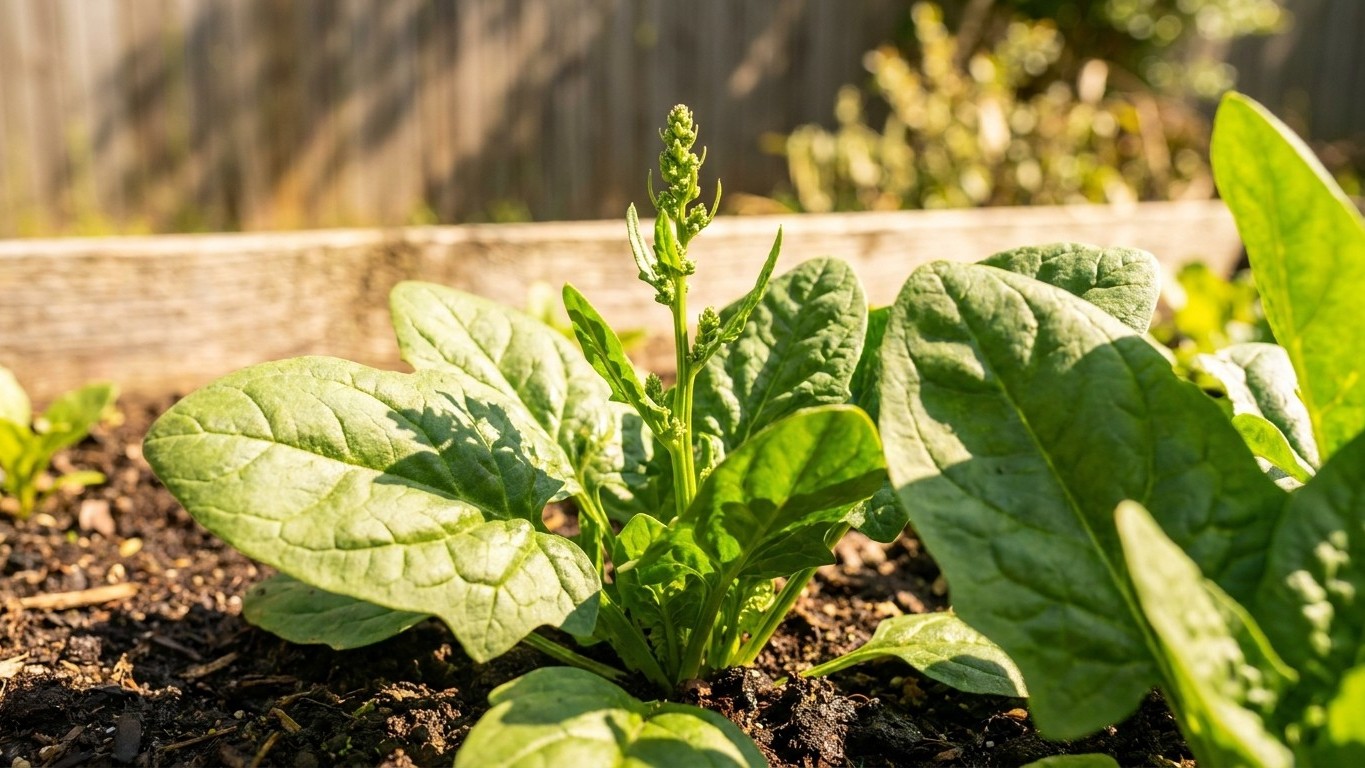

Yes, Spinach in Vermont bolts early, and the reason is day length, not heat. On the summer solstice, Burlington sees 15 hours and 22 minutes of daylight, far past the point where spinach starts flowering no matter how cool the air stays. Vermont summers are genuinely mild, with only 5.4 days a year reaching 90°F, but that mildness doesn’t rescue the crop. The trick isn’t fighting the bolt — it’s dodging the long-day window with tight spring and fall timing.
The short answer
Fifteen hours and twenty-two minutes of daylight on the longest day of the year is the number that decides everything for spinach here. Spinach flowers, or bolts, when days stretch long and temperatures climb, and Vermont’s early summer delivers the first condition in full even when it withholds the second. A gardener who assumes that a cool June buys extra weeks of harvest is making a reasonable guess that turns out to be wrong. Day length alone can trigger the shift from leaf production to flower stalk, and once the plant crosses that threshold, no amount of shade or watering pulls it back.
Heat plays a supporting role, not the lead. Vermont averages just 5.4 days a year above 90°F, which is a small heat load compared to states farther south or west. That’s good news for almost every other summer vegetable, but it doesn’t change spinach’s calendar. The plant’s growth ceiling sits at 75°F, and plenty of ordinary Vermont days in late May and June creep past that mark even without qualifying as a heat wave. So while extreme heat isn’t Vermont’s problem, ordinary warm-season temperatures still push spinach past its comfort zone at the same time daylight is doing its own damage.
The two pressures arrive together, which is what makes the window so narrow. By early June, days are approaching their longest stretch of the year and afternoon temperatures are regularly clearing 75°F. Spinach sown too late in spring runs straight into both triggers at once. The practical answer, then, is that Vermont’s limit is day length first, with heat arriving as a secondary accelerant during the exact weeks when the day-length trigger is already active. Neither factor waits for the other; they overlap by design, since both are tied to the same turn of the calendar toward midsummer.
This is also why a mild Vermont summer feels deceptive. Gardeners in hotter states watch a thermometer and know when trouble is coming. In Vermont, the trigger is invisible: the sun climbing higher and staying up longer, with no heat wave required to set off bolting. Understanding that distinction is the difference between blaming a warm afternoon and recognizing that the calendar itself is the constraint.
How long the spring window really is
- Start from the last spring frost. At the Burlington reference station, the last spring freeze typically falls between April 30 and May 10. Gardens in the Green Mountains or the Northeast Kingdom should expect this date to arrive later, since Burlington’s position on Lake Champlain gives it the mildest spring in the state.
- Back up two to three weeks for sowing. Spinach seed goes into the ground before the last frost, not after it, so sowing typically lands somewhere between April 9 and April 26 at the reference station, adjusted earlier or later depending on how quickly a given garden’s soil thaws and dries enough to work.
- Track the rising day length through May. Every week after sowing adds daylight, moving the garden closer to the point where day length alone starts nudging spinach toward flowering, regardless of how the thermometer behaves.
- Watch for the 75°F ceiling arriving alongside longer days. By late May and into June, afternoon temperatures in much of Vermont begin exceeding that ceiling on a regular basis, right as day length approaches its yearly peak of 15 hours and 22 minutes.
- Add it up. From a sowing date in mid-April to the point in early-to-mid June when both triggers are firing together, Vermont gardeners get roughly eight to nine weeks of usable spring growth before bolting becomes the dominant risk.
That’s a workable stretch, but it’s not a forgiving one. A week lost to a late cold snap, delayed soil drying, or a poor germination batch eats directly into the harvest window rather than simply shifting it later, since the calendar’s day-length trigger doesn’t move to accommodate a slow start.
The autumn crop, and when the soil lets you sow
Fall spinach avoids the long-day problem entirely, since daylight is shrinking rather than growing through late summer and into autumn. The obstacles here are different: warm soil at the start, and an early frost at the end.
Soil too warm for germination
Spinach seed germinates poorly once soil temperatures climb above 80°F, and in mid-to-late summer that’s exactly the condition many gardens face, even in a state with Vermont’s modest heat load. The state’s low count of days above 90°F suggests soil rarely holds extreme heat for long, which works in a fall grower’s favor compared to hotter regions, but it doesn’t eliminate the obstacle. Waiting until the hottest stretch of summer has passed, typically once August settles into cooler nights, gives seed a better shot at germinating instead of sitting dormant or rotting in soil that’s still too warm.
Racing the first fall frost
The first fall frost at the reference station arrives between October 3 and October 13, and that date sets the outer boundary for a fall harvest. Utah State University Extension recommends sowing 50 to 75 days before the date a gardener wants to harvest, and no maturity figure beyond that range is published for spinach. Counting back from an early October harvest target puts sowing somewhere between late July and late August, depending on exactly how close to frost the harvest is planned and which end of the 50-to-75-day range a given garden falls into.
That leaves a narrow but real overlap: soil needs to have cooled enough to germinate reliably, and sowing still needs to happen early enough to clear 50 to 75 days of growth before frost shuts things down. In practice, that overlap lands mostly in August across most of Vermont, with gardens in the Green Mountains or the Northeast Kingdom needing to sow earlier in that window, since their frost date arrives sooner than Burlington’s.
Four spinach varieties commonly named in growing guides are Bloomsdale, Melody, Teton, and Olympia.
Common questions
Does shade cloth delay bolting in Vermont?
Shade cloth can lower the temperature spinach experiences, which addresses the heat side of the equation, but it does nothing about day length. Since day length alone can trigger bolting in Vermont’s long summer days, shade cloth alone won’t fully prevent the shift to flowering.
Can spinach be grown through a Vermont summer?
Not reliably. Once daylight approaches its June peak of 15 hours 22 minutes and afternoon temperatures start clearing the 75°F growth ceiling, spinach shifts toward flowering rather than leaf production. Most Vermont gardeners plan around a spring crop and a separate fall crop instead of a continuous summer planting.
What’s the best time to sow fall spinach in Vermont?
Based on counting back 50 to 75 days from an early-October harvest target and waiting for soil to drop below the 80°F germination threshold, most of August is the practical sowing window, shifting earlier for gardens in colder parts of the state.
Is Vermont’s mild summer heat an advantage for spinach?
Only partly. With just 5.4 days a year above 90°F, Vermont avoids the harshest heat stress other regions face. But since bolting is triggered by long days as much as by heat, that mild summer doesn’t extend the harvest window the way it might for a heat-sensitive crop that isn’t also day-length sensitive.