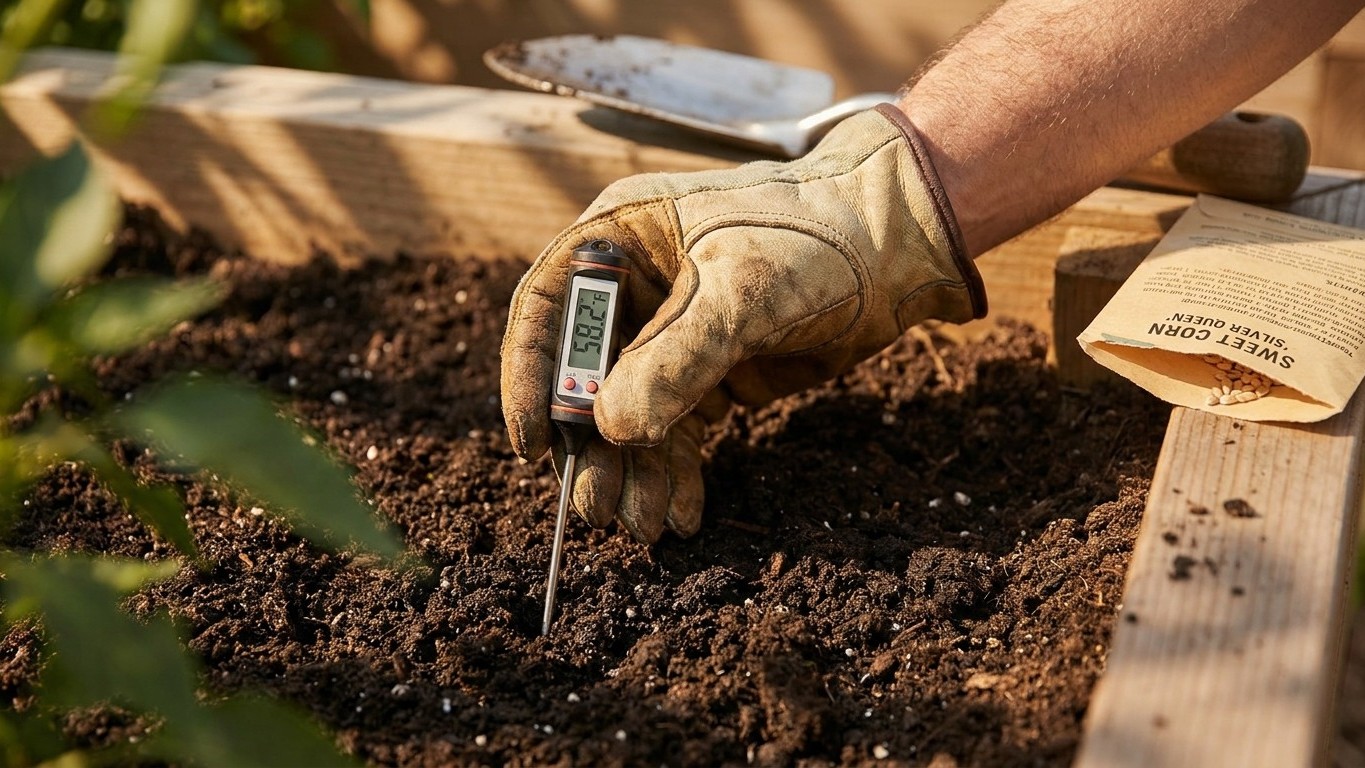

Sweet corn in Vermont goes into the ground once soil temperature holds above 60°F, not on the date of the last frost. That threshold typically arrives weeks after frost has cleared, and from that point growers need 60 to 90 days before the first fall frost, which lands between October 3 and October 13 in the Burlington area. Colder pockets of the state compress that window further, so the safe planting date shifts with both a soil reading and a location on the map.
The short answer
The gap between the last frost and a soil reading of 60°F is the detail most planting calendars skip over. Air warms first. Soil, especially in a clay-heavy bed or a shaded corner of the yard, lags well behind it. NOAA’s 1991-2020 climate normals put the last spring frost for the Burlington reference station (USW00014742) between April 30 and May 10. That date marks only when the air stops freezing. It says nothing about whether the ground underneath is warm enough for a corn seed to break dormancy, and Utah State University Extension is clear that sweet corn needs soil above 60°F to germinate reliably.
That’s why a calendar alone will mislead a Vermont gardener. Two people planting on the same frost date, one on sandy loam in full sun and one on heavy clay under a maple, can see germination weeks apart. The only fix is a soil thermometer pushed a couple of inches into the row, checked on a few consecutive mornings, rather than a guess tied to the frost date printed on a seed packet.
Once soil clears 60°F, the clock that matters is the 60 to 90 days sweet corn needs to reach harvest. Vermont’s first fall frost, again from the Burlington station, falls between October 3 and October 13. Counting backward from that range gives a rough planting deadline: a 90-day variety needs to be in the ground by roughly early-to-mid July, a 60-day variety by roughly early-to-mid August. Both figures leave a cushion, since most Vermont gardeners plant far earlier than either deadline once the soil allows it.
Burlington’s lake-effect corridor is the mildest ground in the state, both frost dates in that range lean toward the late-spring and late-fall end. The Green Mountains and the Northeast Kingdom run substantially shorter: frost lingers later in spring and returns earlier in fall, which squeezes the usable window from both directions at once. Vermont also averages only 5.4 days a year at 90°F or hotter, a modest heat load that means soil warms gradually rather than in a quick jump, another reason to trust a thermometer over a date on paper.
| Milestone | Date range (Burlington reference station) |
|---|---|
| Last spring frost | April 30 to May 10 |
| First fall frost | October 3 to October 13 |
| Calculated latest sowing, 60-day variety | roughly early-to-mid August |
| Calculated latest sowing, 90-day variety | roughly early-to-mid July |
Does a late variety fit here?
Maturity length is what decides whether a given variety has any business in a Vermont garden, and the answer changes sharply depending on which corner of the state a gardener is working.
A 60-day variety
This is the safe choice almost everywhere in Vermont. Even accounting for a soil that doesn’t clear 60°F until well into late spring, and even in a garden that plants cautiously late, the calculated backward deadline of early-to-mid August leaves a wide buffer before the October 3-13 frost window. A 60-day type fits comfortably in the Burlington corridor and holds up in the Green Mountains and the Northeast Kingdom too, where both ends of the season arrive on a tighter schedule. For anyone gardening above the valley floor, this length is the one to lean on.
A 90-day variety
Here the math gets tight. Working backward from the first fall frost puts the latest sensible sowing date at roughly early-to-mid July, which only works if soil reached 60°F comfortably ahead of that point. That’s plausible along the milder, lake-warmed ground near Burlington. It’s a much harder case in the Green Mountains or the Northeast Kingdom, where a later soil warm-up and an earlier first frost can close the gap almost entirely. Said plainly: a 90-day variety often does not fit those higher, colder parts of the state, and a gardener there is better off treating the 60-day range as the practical ceiling rather than gambling a full season on a slow variety.
What goes wrong here
- Soil sown too cold. Seeds go in on the calendar frost date instead of a measured 60°F soil reading, and germination is patchy or seeds simply rot in cold, wet ground. The remedy is a soil thermometer checked over several mornings rather than a date circled on a seed packet, particularly in clay soil or a shaded bed that stays cool longer than the rest of the yard.
- A variety too late for the season. A 90-day type gets planted in a short-season pocket, the Green Mountains or the Northeast Kingdom, and the ears never finish ripening before the first fall frost arrives. The fix is matching maturity length to the local frost window: favor 60-day varieties in those colder regions, and reserve longer varieties for the mildest, lake-influenced ground near Burlington.
- Sweetness lost because two types tasselled together. This one has nothing to do with Vermont’s climate. Utah State University Extension notes that su, se, and sh2 sweet corn types cross-pollinate when their tassels shed pollen during the same window, and the result is a starchy, disappointing ear instead of a sweet one. No isolation distance is published for this; the rule is about timing, not feet or rows. The remedy is staggering sowing dates so the tasseling periods of different types don’t overlap, or growing only one type in a season, while still planting each type in blocks of three or more rows so pollination within that block stays reliable.
Common questions
Can I sow sweet corn on Vermont’s last frost date?
Not reliably. The frost date only marks when the air stops freezing; soil usually needs additional time to hold above 60°F, the threshold sweet corn actually requires to germinate. Planting on the frost date alone often means the ground is still too cold.
How many days of growing season does Vermont give sweet corn?
Counting from a 60°F soil reading to the first fall frost (October 3 to October 13 at the Burlington reference station), most Vermont gardens can fit the full 60 to 90 day range in milder valley ground, while shorter-season regions do better sticking to the lower end of that range.
Does elevation or region change the sowing date?
Yes. The Green Mountains and the Northeast Kingdom run a substantially shorter season than the Burlington corridor, with a later last frost in spring and an earlier first frost in fall, which narrows the usable planting window from both ends.
Can I grow two types of sweet corn in the same garden without losing sweetness?
Yes, as long as their tasseling periods don’t overlap. Utah State University Extension’s guidance centers on timing, not a set distance, so staggering sowing dates or choosing varieties with different maturity lengths keeps the pollen shed from coinciding.