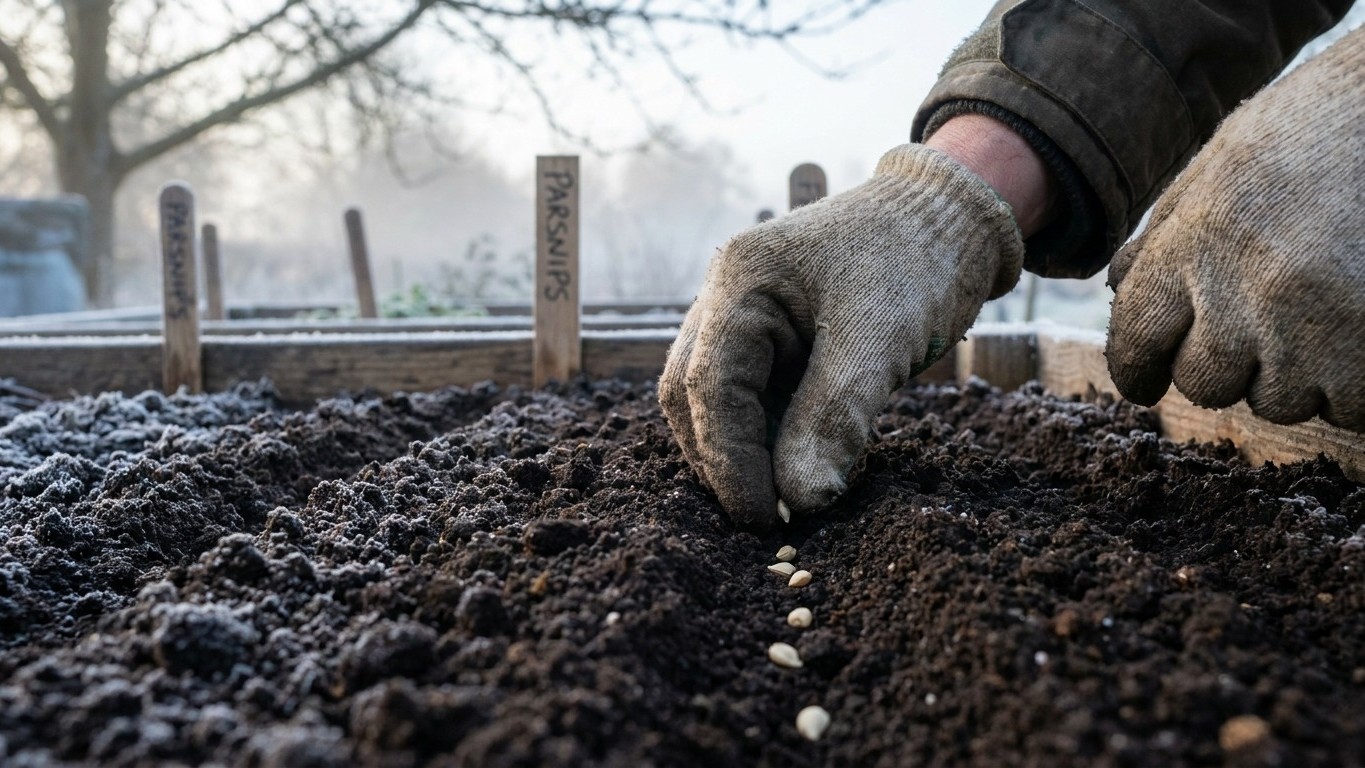

Sow parsnips directly in the ground in Wyoming about two to three weeks before your local last spring frost, which falls between May 7 and May 18 at the Cheyenne reference station. That puts most seeding windows in mid-to-late April at lower elevations, later wherever the ground sits higher and colder. Left in place through several fall frosts, the roots convert stored starch to sugar and reward the wait.
The short answer
Everything about growing a sweet parsnip instead of a merely edible one comes down to one question: does this territory deliver several frosty weeks before harvest? In Wyoming, at the Cheyenne reference station, the mean daily minimum of the coldest month sits at 18.1°F. That’s not a record low and not a seasonal average. It’s the typical low temperature the coldest month produces, day after day, and it tells you this ground gets genuinely cold, repeatedly, not just a brief dip once a winter.
That figure matters more than any hardiness zone number could. A zone rating tells a gardener whether a perennial plant survives winter dormant in the ground. It says nothing about whether a biennial root crop like parsnip gets enough sustained frost exposure to trigger the starch-to-sugar conversion that makes it worth growing in the first place. Two locations can share the same zone and differ wildly in how many frosty weeks they actually deliver. Wyoming, with a mean coldest-month minimum well below freezing, is not a marginal case. This is a place where cold arrives reliably and stays.
So the plain answer: a parsnip grown here will sweeten, not merely grow. The frost exposure is there in quantity, not just as a token frost or two before the ground closes up. Gardeners in milder-winter states sometimes end up with a fine-looking parsnip that never develops that characteristic sweetness because the cold simply doesn’t linger long enough or arrive early enough. That’s not Wyoming’s problem. The challenge here runs the other direction: making sure the growing season is long enough, and the seedbed forgiving enough, to get a mature root into the ground before that cold shows up.
Keep in mind the reference figure comes from one station, Cheyenne, and Wyoming’s elevation swings from roughly 3,100 feet along the eastern plains to well over 10,000 feet in the mountains. Gardens at 6,000 feet or higher will see colder minimums and a shorter window than the reference number implies, which strengthens the sweetening case even further but tightens the calendar considerably.
Does the season fit?
Parsnips need 100 to 120 days from seeding to maturity, sown two to three weeks before the last spring frost, according to Utah State University Extension. Laid against Wyoming’s frost dates, here’s how the arithmetic works out.
- Start with the last spring frost window. At the Cheyenne reference station, that’s May 7 to May 18. Sowing two to three weeks earlier puts seed in the ground roughly mid-to-late April, while the soil is still cool but workable.
- Add germination time. Parsnip seed is notoriously slow to sprout, 14 to 21 days is typical. Sown in mid-to-late April, seedlings won’t actually break the surface until early-to-mid May. Patience here is not optional; digging up the bed and re-sowing because nothing seems to be happening is the single most common mistake with this crop.
- Count forward 100 to 120 days from the seeding date, not from emergence. From a mid-to-late April sowing, 100 days lands in late July, 120 days in mid-August. Both fall comfortably before Wyoming’s first fall frost.
- Check that against the first fall frost window. At the reference station, first frost arrives September 24 to October 5. Compared to a mid-August maturity date, that leaves roughly five to seven additional weeks of growing time in reserve, plus the early frosty weeks themselves once they arrive.
- Weigh in elevation. The reference station sits at roughly 6,000 feet with about 130 frost-free days, and frost is possible in any month at higher elevations across the state. Gardens well above that elevation should treat the sowing window as earlier and the fall frost as arriving sooner, tightening the fit considerably.
At or near the reference elevation, the season fits comfortably, with real margin left over for the frosty weeks that sweeten the crop. Higher up, the same arithmetic gets tight fast, and the margin for a late seeding or a slow germination shrinks toward zero.
What goes wrong here
- Forked, split, or twisted roots from heavy or stony ground. Parsnip roots push straight down through loose soil; anything that blocks that path, rocks, clay clumps, compacted subsoil, forces the root to fork around the obstruction. Wyoming’s clay-heavy prairie soils are a common culprit. Utah State University Extension recommends deep sandy soil for this crop, and where the native ground is heavy, double digging the bed before sowing is the remedy, working the soil loose to a full spade’s depth or more so the taproot has nowhere to catch.
- Forked roots from overwatering, a separate cause entirely. Even in loose, stone-free soil, roots that sit in consistently soggy ground can split or fork as they grow. The fix here isn’t soil structure but watering discipline: keep the bed evenly moist while seedlings establish, then ease off rather than keeping it saturated through the growing season.
- A season that runs out at higher elevations. Gardens well above the Cheyenne reference elevation see a shorter frost-free window and a fall frost that can arrive well before September 24. Sowing at the earliest safe date, and considering row cover to buy an extra week or two on either end, protects against a maturity date that slides past first frost before the root has filled out.
- Pulling the crop too soon, before it’s had its frosty weeks. Because Wyoming reliably delivers sustained cold, the temptation is to harvest as soon as the calendar says the root should be mature. Digging as soon as the 100 to 120 days are up skips the conversion of starch to sugar that only happens with real frost exposure. Leaving roots in the ground through several fall frosts, rather than harvesting the moment they reach size, is what actually produces the sweetness this crop is grown for.
Common questions
Can I start parsnip seeds indoors in Wyoming to get ahead of a short season?
No. Parsnips are sown directly in place; the long taproot doesn’t transplant well once it starts forming, and disturbing it usually produces a stunted or forked root. The season math above already builds in sowing two to three weeks before last frost, which is the closest this crop gets to a head start.
Why hasn’t anything come up three weeks after I sowed?
That’s normal. Parsnip germination runs 14 to 21 days, slower than most garden seed, and cool spring soil can push it toward the longer end of that range. Resist the urge to dig up the row and re-sow; give it the full three weeks before assuming a failure.
Should I harvest parsnips before winter or leave them in the ground?
Leave them through several fall frosts if you can. That sustained cold is what converts stored starch to sugar, and it’s the whole reason this crop is worth growing in a place with a genuinely cold coldest month. Exactly how late roots can safely stay before the ground becomes too frozen to dig isn’t a figure covered by the data used here, so check local conditions as the season deepens.
What kind of soil do parsnips need in Wyoming?
Deep, sandy soil is what Utah State University Extension recommends. Where the native ground runs heavier, as much of Wyoming’s clay-based soil does, double digging the bed before sowing loosens it enough for the taproot to grow straight rather than forking around compacted layers.
The Moon calendar is a separate, older custom: see when to plant parsnips by the moon, written as tradition rather than fact.