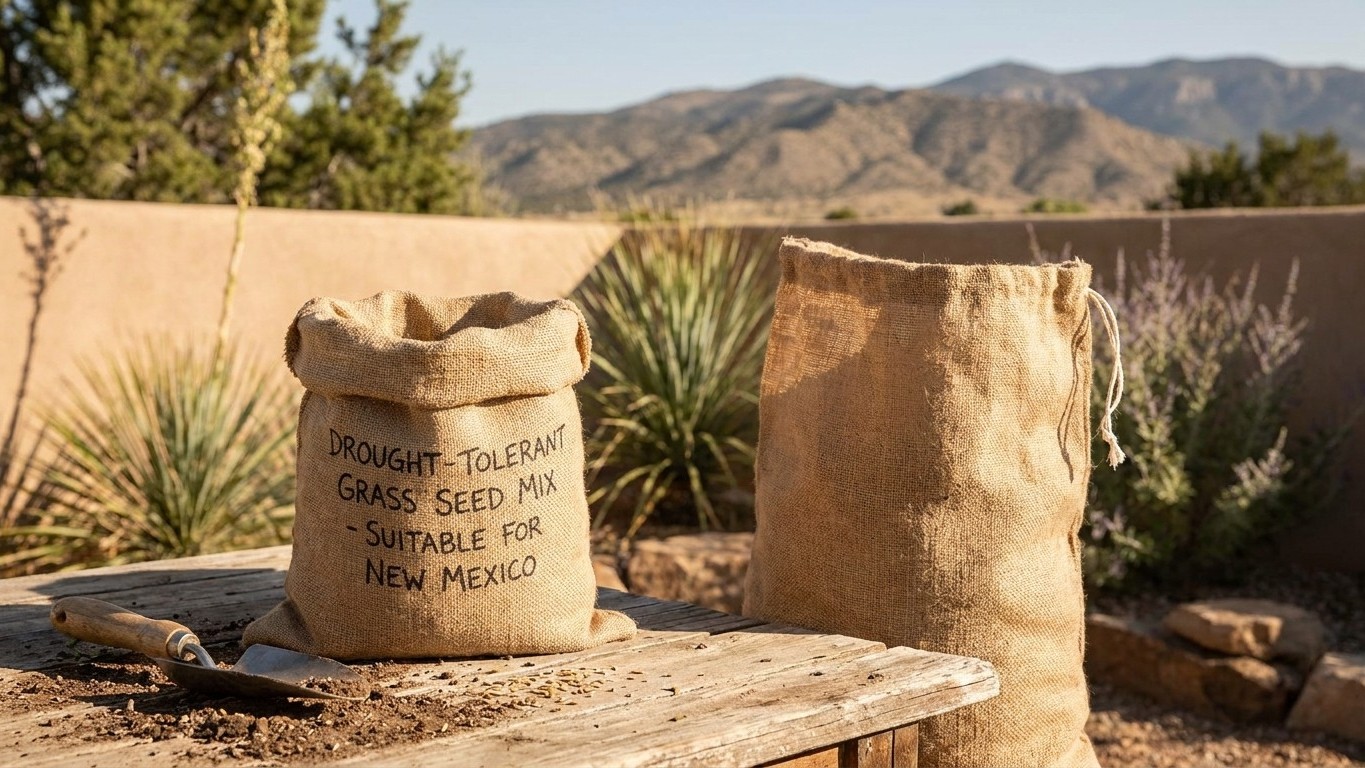

New Mexico’s growing regions fall mostly in what turf specialists call a transition zone, a climate too hot for cool-season grass to stay green all summer and too cold for warm-season grass to stay green all winter. Clemson Cooperative Extension (HGIC 1214) lists five species suited to this middle ground: Tall Fescue, Kentucky Bluegrass and Perennial Ryegrass for the cool months, Zoysiagrass and Bermudagrass for the hot ones. Decide first whether you want a lawn that’s green in January or one that’s green in July, because nothing on that list gives you both.
The short answer for New Mexico
Albuquerque’s airport weather station puts the first fall freeze somewhere between October 29 and November 9, and that single window splits New Mexico’s lawn choices in two. Tall Fescue stays green right through that freeze and on into spring, then goes rough and thin by midsummer. Bermudagrass and Zoysiagrass shrug off July heat but brown off the moment that freeze arrives, staying that way for months. The grass list doesn’t change from county to county — only which trade-off you can live with does.
Pick a cool-season lawn built around Tall Fescue and you get green grass from fall through spring, with a rough, thinned-out look during the hottest weeks of summer. Pick a warm-season lawn built around Bermudagrass or Zoysiagrass and you get turf that shrugs off summer heat but turns brown from the first hard freeze until it greens up again in spring.
At the Albuquerque airport weather station, NOAA’s 1991-2020 climate normals put the first fall freeze of 32°F somewhere between October 29 and November 9. A warm-season lawn anywhere near that reference point should be expected to start browning off within that window, though a yard in a low spot, or one at higher elevation nearby, can see frost arrive earlier than that range suggests.
The choice comes down to what you’re willing to give up: a fescue lawn that needs supplemental water and looks tired in July, or a Bermuda or Zoysia lawn that looks dead for roughly five months of the year even though it isn’t. The species list doesn’t change as you move around the state, but which end of that trade-off makes sense usually does.
Working through the year

Sorting out this trade-off is the first real decision in New Mexico lawn care. Everything else, from mowing height to fertilizer timing, follows from which side you pick. Each of the five species below trades summer performance for winter color, or the reverse, in a different ratio.
Tall Fescue

Tall Fescue is the backbone of most cool-season lawns in this zone. It’s a coarse-bladed, bunch-type grass that doesn’t spread by rhizomes, so a thin patch fills in only by tillering or reseeding, not by creeping in from the sides. Its root system runs deeper than the other two cool-season species, which is exactly why turf-type Tall Fescue survives a New Mexico summer that would knock out Kentucky Bluegrass. The trade-off shows up in July and August: expect it to slow down and look ragged during the hottest stretch, and know that deep, infrequent watering during that stretch matters more than how often you mow.
Kentucky Bluegrass

Kentucky Bluegrass forms the densest, most self-repairing sod of any cool-season grass, spreading by underground rhizomes to knit bare spots shut on its own. That same trait makes it the most water-hungry of the three cool-season species, and its shallow roots mean it’s usually the first grass in a fescue lawn to go off-color when summer irrigation lapses. Most seed blends sold for this climate use it as a minority partner mixed with Tall Fescue rather than as a lawn on its own, because it can’t carry a New Mexico summer by itself.
Perennial Ryegrass

Perennial Ryegrass germinates faster than either other cool-season grass, often showing green blades within a couple of weeks, which is why it shows up in seed blends as a nurse grass to hold soil while slower Tall Fescue gets established. It’s also the grass used to overseed a dormant Bermudagrass or Zoysiagrass lawn for winter color, since it germinates in cool soil and thins out on its own once summer heat returns. On its own, without a warm-season grass underneath it, it has the weakest heat and drought tolerance of the five and isn’t a realistic stand-alone lawn here.
Zoysiagrass

Zoysiagrass builds a dense turf that resists foot traffic and weed pressure once it’s filled in, and it tends to hold color slightly later into fall than Bermudagrass does. The cost is speed: Zoysiagrass is the slowest of the five species to establish from seed and the slowest to green up again in spring, so a newly seeded Zoysia lawn can take more than one full season to look complete. Clemson’s Zoysiagrass Maintenance Calendar (HGIC 1217) lays out the mowing and feeding schedule once the grass is established.
Bermudagrass

Bermudagrass has the best heat and drought tolerance on this list and spreads fastest, filling in bare or worn patches through stolons that run along the soil surface. That aggressive habit is also its main downside in a home lawn, since it will cross into flower beds and gravel paths if it isn’t edged, and it has the poorest cold tolerance of the two warm-season options, browning off earliest in fall. Clemson’s Bermudagrass Maintenance Calendar (HGIC 1216) covers mowing height and feeding windows for an established lawn.
What changes across New Mexico
The Homestead Post’s transition-zone label for New Mexico is built on climate data from Albuquerque, and that reference point sits in the middle of a state with a huge range in elevation. Higher ground pushes the picture toward cool-season grass and away from warm-season grass, because the frost-free season shortens and winter cold deepens as elevation climbs.
Santa Fe, Taos and Los Alamos all sit well above Albuquerque’s elevation. A Bermudagrass or Zoysiagrass lawn planted at that altitude has a shorter window to establish before cold weather returns, and a harder time surviving winter in the coldest years. A cool-season lawn built around Tall Fescue is the safer bet the higher you go, and it’s the grass most likely already growing on an established lawn in one of those towns.
Drop down into the Rio Grande valley around Las Cruces and the southern part of the state, and the balance tips the other way. A longer, hotter growing season there favors Bermudagrass and Zoysiagrass, and a cool-season lawn in that part of the state spends more of the year fighting heat than one in Albuquerque does.
The fall frost window NOAA’s climate normals give for the Albuquerque airport, October 29 to November 9, applies to that station specifically. A garden in a low-lying valley or a shaded northern exposure nearby can see frost arrive earlier, and higher, more open ground elsewhere in the state should expect it earlier still. There’s no single frost date for New Mexico as a whole, only a reference figure from one city that other locations run ahead of or behind depending on elevation and terrain.
The mistakes this climate punishes
A handful of timing mistakes account for most of the transition-zone lawn failures we hear about, and each one shows its damage on a different schedule.
- Feeding a warm-season lawn late in the fall. Nitrogen applied to Bermudagrass or Zoysiagrass close to the first freeze pushes soft new growth that has no time to harden off, and that growth is what dies back hardest over winter.
- Seeding a cool-season lawn in late spring. Tall Fescue or Kentucky Bluegrass seeded once the weather has already turned warm produces seedlings that face summer heat stress before their roots are established, and most of that seeding fails by midsummer.
- Mowing cool-season grass too short in summer. A close-cut fescue lawn loses the leaf area it needs to shade its own soil and roots, and the damage shows up as thinning and weed encroachment within a few weeks rather than all at once.
- Treating winter brown as dead. A dormant Bermudagrass or Zoysiagrass lawn looks the same as a dead one from October through the following spring, and pulling it out or reseeding over it wastes money on a lawn that would have recovered on its own.
The nitrogen-timing mistake is usually the costliest of the four, because a bag of fertilizer applied at the wrong end of the season doesn’t just fail to help. It actively works against the grass’s own hardening process going into winter.
Checking this against your county
Albuquerque’s frost dates and the transition-zone call above are reference points, not a substitute for local knowledge. New Mexico State University’s Cooperative Extension Service, at aces.nmsu.edu, runs county offices across the state that can tell you what’s actually thriving nearby and where your local frost window really falls. Once you’ve settled on a species, your county extension office is also the place to confirm any local seeding or fertilizing timing before you commit a whole yard to it.
If you already know which grass you’re growing and just need the schedule mapped onto the calendar year, that’s laid out in The New Mexico Lawn Care Calendar, Month by Month.
Common questions
Will Bermuda grass survive winter in Albuquerque?
An established stand generally does, going fully brown and dormant rather than dying. A lawn seeded the same year, or one that’s still thin going into its first winter, is more vulnerable and can suffer real dieback in a harder-than-usual freeze.
Can I mix tall fescue and Bermuda grass seed in the same lawn?
Not as a permanent mix. The two grow on opposite halves of the year, so instead of blending them, most transition-zone growers overseed a dormant Bermudagrass lawn with Perennial Ryegrass for winter color and let the ryegrass fade out on its own once the Bermuda wakes up in late spring.
When is the right time to plant grass seed here?
It depends entirely on which species you’re planting. Cool-season grasses like Tall Fescue establish best when seeded ahead of the fall frost window or in early spring, while warm-season grasses like Bermudagrass need warm soil and go in later in spring. The month-by-month calendar linked above breaks this down further.
My zoysia grass is still brown while everything else has greened up. Is it dead?
Probably not. Zoysiagrass is slower than Bermudagrass and slower than any cool-season grass to break dormancy in spring, sometimes lagging by weeks. Scratch a stem near the soil line: if it’s still pliable and shows green or white underneath, the grass is alive and just running behind.