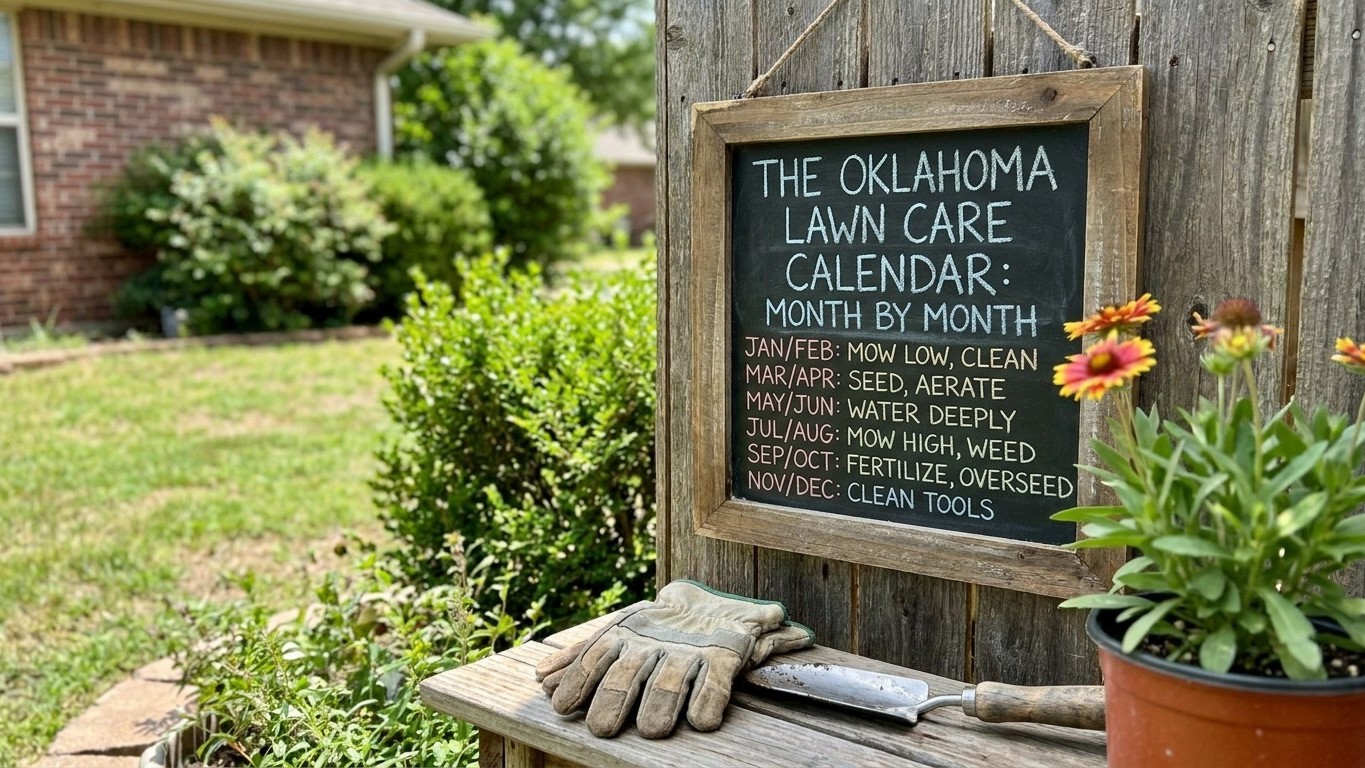

What should you be doing to your lawn right now? It depends on which grass is out there, because Oklahoma splits the year in half: warm-season grass grows hard from late spring through summer, cool-season grass takes over in fall and spring, and the whole schedule hinges on one date, the first fall freeze. Before you mow, feed, or seed anything this week, walk out and identify whether you’re standing on fescue or bermuda — everything else below depends on that answer.
The short answer for Oklahoma
Oklahoma falls in the transition zone, the band of the country where neither cool-season nor warm-season turf performs at its best. The Homestead Post places the state here using the season-tolerance thresholds published in Clemson Cooperative Extension’s HGIC 1214, and near Oklahoma City that means a lawn of tall fescue, Kentucky bluegrass or perennial ryegrass will thin and brown under summer heat, while a lawn of bermudagrass or zoysiagrass will sit brown from the first fall freeze until spring green-up. Both are normal. Brown is not dead, it is dormant, in either direction.
That first fall freeze, measured at Oklahoma City by NOAA’s 1991-2020 climate normals, arrives between October 29 and November 8. It matters because it is the point past which a warm-season lawn stops actively growing and a cool-season lawn can still be mowed and fed for weeks. Everything else on this calendar, mowing height, feeding windows, seeding dates, is built around that one freeze range and the spring green-up on the other side of winter.
Which grass is right for a given yard depends on what the owner is trading off. A reader who wants a lawn that stays green through a mild Oklahoma winter should lean toward tall fescue or perennial ryegrass and accept summer stress. A reader who wants a lawn that shrugs off July heat and does not need weekly watering should lean toward bermudagrass or zoysiagrass and accept a brown yard from fall through early spring. If you have not yet chosen, The Best Grass Seed for Oklahoma Lawns lays out the seed options side by side before you commit a season to one type.
Working through the year

The two grass groups are never on the same task in the same month. Clemson’s species calendars, HGIC 1219 for tall fescue, HGIC 1216 for bermudagrass and HGIC 1217 for zoysiagrass, lay out separate schedules, and a yard with the wrong one applied loses a season.
Late winter into early spring
This is pre-emergent season for warm-season lawns. HGIC 1216 times the bermudagrass pre-emergent application to soil temperature rather than a calendar date, applied before crabgrass germinates as the ground warms. Fescue lawns need little attention here beyond a first light mowing once growth resumes; HGIC 1219 does not call for nitrogen at this point in the tall fescue calendar.
Spring
Bermudagrass and zoysiagrass green up and begin their main growing season, mowed low, roughly 1 to 2 inches, per HGIC 1216 and HGIC 1217. Nitrogen for both starts once green-up is complete and continues into summer. Fescue keeps mowing higher, in the 2.5 to 3.5 inch range that HGIC 1219 sets for the species, and gets at most a light feeding, since Clemson’s tall fescue calendar reserves the heavy nitrogen for fall.
Summer
Bermudagrass and zoysiagrass are at peak growth and take the season’s main nitrogen applications and most of the mowing. Fescue is under the most stress of its year here. Raising the mower, not lowering it, and holding irrigation around 1 inch of water per week during dry stretches is what carries a fescue lawn through July and August without losing the stand.
Fall
This is fescue’s season. HGIC 1219 puts the bulk of the year’s nitrogen and the overseeding window in September and October, ahead of that October 29 to November 8 freeze range at Oklahoma City, and pairs it with core aeration while the soil is still warm enough for new roots to establish. Warm-season lawns wind down: feeding stops well before the freeze, since new growth pushed late into fall has no time to harden off.
Winter
Bermudagrass and zoysiagrass sit dormant and brown until spring green-up. Fescue keeps growing through mild spells and gets mowed as needed until true winter cold sets in for good.
| Grass | Season type | Mowing height | Active growth |
|---|---|---|---|
| Tall Fescue | Cool-season | 2.5-3.5 in (HGIC 1219) | Spring and fall |
| Kentucky Bluegrass | Cool-season | 2-3 in (Penn State Extension) | Spring and fall |
| Perennial Ryegrass | Cool-season | 1.5-2.5 in (Penn State Extension) | Spring and fall |
| Zoysiagrass | Warm-season | 1-2 in (HGIC 1217) | Late spring through summer |
| Bermudagrass | Warm-season | 1-2 in (HGIC 1216) | Late spring through summer |
What changes across Oklahoma
Every date and range above is measured at Oklahoma City, and Oklahoma is a big state with a lot of ground between the panhandle and the pine woods of the southeast. The panhandle, around Guymon, sits at noticeably higher elevation and further north, so both the last spring freeze and the first fall freeze there run earlier than the Oklahoma City range, and the growing season for either grass type is shorter by real weeks, not days.
The southeastern corner of the state, toward Idabel and the Ouachita foothills, sits lower in elevation and further south, with a milder winter and more rainfall than Oklahoma City sees. Bermudagrass and zoysiagrass hold their green longer into fall there, and fescue faces less brutal summer stress because the humidity, while higher, comes with somewhat less extreme heat than the state’s western half.
Large water bodies moderate their immediate surroundings too. Yards close to Grand Lake in the northeast or Lake Texoma on the southern border tend to see slightly softer frosts on the shoulder seasons than open ground a few miles away, because the water holds heat overnight. None of this replaces a local reading. NOAA’s Oklahoma City figures are a starting point, and a county extension office is the way to adjust them for your own ground.
The mistakes this climate punishes
Oklahoma’s split calendar makes it easy to apply the wrong season’s task to the wrong grass, and the damage rarely shows up right away.
- Feeding a warm-season lawn in fall. Nitrogen pushed into bermudagrass or zoysiagrass close to the first freeze forces soft new growth that has no time to harden off, and that tissue is what dies back hardest at the next cold snap, showing up as dead patches rather than the clean dormancy the rest of the lawn goes through.
- Seeding cool-season grass in late spring or summer. Tall fescue and perennial ryegrass seed sown as the weather warms germinates poorly and the seedlings that do come up rarely survive summer heat, wasting the seed and the season. Fall, ahead of the first freeze, is when fescue seed actually establishes.
- Cutting fescue too short in summer. A lower mowing height exposes more soil to heat and moisture loss, and a fescue lawn scalped in July often does not recover fully until the following fall’s overseeding.
- Watering a dormant warm-season lawn heavily in winter. Bermudagrass and zoysiagrass are brown but alive through winter, and heavy watering does not green them up early, it just wastes water and can invite fungal problems once temperatures rise.
Most of these mistakes come from treating Oklahoma Lawn Care as one calendar instead of two. The fix is simple to state and easy to forget in practice: know which grass is in the ground before touching a bag of fertilizer or a spreader of seed.
Checking this against your county
The Oklahoma City figures in this calendar are a reference point, not a guarantee for every county. Oklahoma State University Extension maintains county offices across the state that can confirm local frost timing, soil temperature for pre-emergent applications, and any pest or disease pressure specific to your area. Start at OSU Extension and look up the office for your county before locking in a seeding or feeding date.
Common questions
Can I have bermuda and fescue in the same yard?
You can, but they will not look uniform. A common pattern is bermudagrass in full sun and fescue in shadier corners where bermuda thins out, and the two will be green at different times of year, which some owners like and others find patchy.
Why is my bermuda lawn still brown in April when my neighbor’s is green?
Green-up timing varies by sun exposure, soil temperature and even mowing history, not just by calendar date. A slope facing south warms faster than a shaded, flat yard a few doors down, so a week or two of difference between two bermuda lawns close together is normal.
Do I need to dethatch every year?
Not necessarily. Dethatch when you can feel a spongy layer thicker than about half an inch between the soil and the green blades, which usually builds up faster under bermudagrass and zoysiagrass than under fescue.
Can I use one fertilizer bag for both my fescue and my neighbor’s bermuda advice?
No, because the nitrogen timing runs opposite for the two groups. A fescue lawn wants its heaviest feeding in fall and a warm-season lawn wants its heaviest feeding in late spring through summer, so following one bag’s schedule on the wrong grass type either starves it or feeds it at the worst possible time.