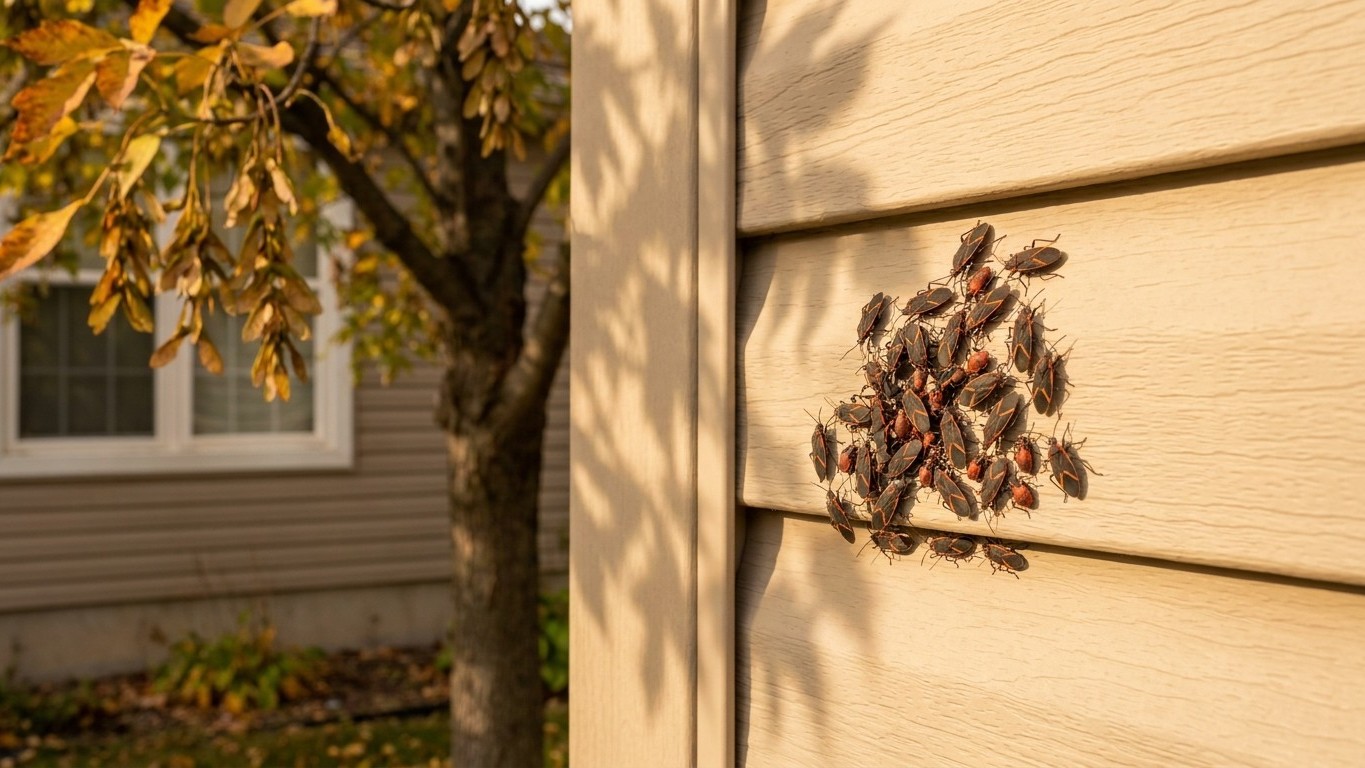

Boxelder bugs show up twice a year in Manitoba: a brief nuisance swarm in spring as they leave winter hiding spots, then a much bigger push in September and October when they cluster on warm walls before the cold sets in. Sealing entry points before that fall swarm, combined with removing seed-bearing female boxelder maples near the house, is what actually keeps them out. Insecticide sprays offer only short-term relief.
When Boxelder Bugs Appear in Manitoba

Winnipeg’s river valleys, along the Red and Assiniboine, are lined with Manitoba maple trees, known locally as boxelder maples. That’s not a coincidence. The bug takes its name from this exact tree, and wherever the tree grows thick, the bug follows. Females lay eggs on the bark and in seed pods each spring, and by midsummer, nymphs are crawling all over trunks and sidewalks near mature trees.
Two windows matter for homeowners. The first is late April through May, when adults that spent winter tucked into wall cavities, attics, and woodpiles start moving again. They’re sluggish, slow to fly, and mostly just want to get back outside to feed on fresh maple growth. The second window, and the one that generates most of the calls to pest control companies across southern Manitoba, runs from early September through late October. As daytime temperatures drop and nights turn cold, adult bugs abandon the trees in large numbers and look for something warm to cling to. That “something warm” is very often the south or west-facing wall of a house, where afternoon sun heats the siding.
Manitoba’s early frost pattern actually compresses this fall swarm into a shorter, more intense period than what’s typical farther south in places like Minnesota or the Dakotas. A hard frost in mid-September can trigger a mass movement toward buildings within days, which is why some homeowners describe the infestation as sudden even though the bugs have been feeding in nearby trees all summer.
Why They Cluster on Certain Walls
Boxelder bugs are drawn to heat and light-colored surfaces. A white or pale-gray stucco wall that faces west will pull in far more bugs than a shaded, dark-brick wall on the north side of the same house. This matters for anyone trying to figure out where to focus sealing efforts, since the bugs concentrate their search for cracks exactly where they’re already gathered in the largest numbers.
Why Manitoba’s Landscape Favors This Bug
Boxelder maple (Acer negundo) is one of the most widely planted shade trees in Winnipeg’s older neighborhoods and along riverbank parks. It grows fast, tolerates the prairie’s extreme temperature swings, and seeds prolifically, which is exactly the combination that keeps boxelder bug populations high year after year. The female trees produce the winged seed pairs (samaras) that boxelder bug nymphs feed on almost exclusively during their development.
Male boxelder maples don’t produce seeds, so a property near male trees only will host far fewer bugs than one near a fruiting female. This is a detail most homeowners never think to check, but it explains why two houses on the same block can have wildly different experiences with the pest.
The bug also feeds opportunistically on other maples and on ash trees, though at much lower rates. In parts of rural Manitoba where boxelder maples line shelterbelts and farmyard windbreaks, the insect can build up in large numbers with essentially no natural predators keeping pace. Manitoba’s cold winters don’t eliminate the population either. Adults are remarkably tolerant of cold once they’ve tucked into a sheltered space, and survival rates in insulated wall voids or attics are high enough that a bad year can repeat itself the following fall.
What Actually Stops Boxelder Bugs
Spraying the bugs where you see them, on a sunny wall or a windowsill, kills the ones present at that moment and nothing more. New bugs keep arriving from the source tree for weeks. Real control means addressing three things: the entry points into the structure, the immediate landscape, and the timing of any treatment.
Seal Before the Fall Swarm, Not During It
The single most effective step is exterior sealing done in August, ahead of the swarm rather than in the middle of it. Boxelder bugs get inside through the same gaps that let in cold air: gaps around window and door trim, unsealed weep holes in brick veneer, torn screens, loose vent covers, and cracks where siding meets the foundation. A tube of exterior-grade caulk and a few hours spent walking the perimeter of the house, especially the sun-facing walls identified earlier, closes off the routes bugs use to slip into wall voids and attics.
Weatherstripping on exterior doors and repairing torn window screens matters just as much. Once bugs are inside a wall cavity for the winter, they’re essentially impossible to remove without opening the wall, and they’ll often find their way into living spaces through electrical outlets and light fixtures during warm spells in late winter.
Manage the Host Tree, Carefully
Removing a mature boxelder maple purely to control bugs is rarely worth it. These trees provide real shade value and removal is expensive. A more practical approach for homeowners with a female boxelder maple close to the house is trimming back branches that overhang the roof or touch the siding, since bugs move from tree to wall most easily when there’s direct branch contact. Raking up and disposing of seed pods in fall also reduces the food source available to nymphs the following spring.
For anyone planting new shade trees in a yard already prone to boxelder bug problems, choosing a male boxelder maple, a different maple species, or another shade tree entirely avoids restarting the cycle.
Exterior Insecticide Treatment, Timed Right
A residual insecticide labeled for boxelder bugs, applied to the exterior siding and foundation in late August or early September, before bugs begin massing, can meaningfully cut down on how many make it inside. Timing is the whole game here. Applying the same product in October, after bugs have already clustered and started probing for entry points, is far less effective because many bugs are already inside wall cavities by then. Manitoba homeowners who’ve dealt with repeat infestations often find that a single well-timed perimeter treatment in late summer, combined with sealing, outperforms multiple reactive sprays later in the season.
Indoor Cleanup Without Making a Mess
Bugs that do get inside are best removed with a vacuum rather than crushed. Boxelder bugs release a foul-smelling compound when squashed, and that odor can stain light-colored fabric or wallpaper. A shop vacuum with a bit of soapy water in the canister, or a simple dustpan-and-broom sweep followed by disposal outside, handles small numbers without the smell or the stain.
A Seasonal Checklist for Manitoba Properties
Because the bug’s behavior is so tied to Manitoba’s temperature swings, timing beats intensity. A short list of tasks, done at the right point in the calendar, covers most of what matters:
- Late July to mid-August: inspect and seal cracks, gaps, and weep holes on south- and west-facing walls before bugs start moving.
- Late August to early September: apply a labeled exterior residual insecticide if past infestations have been severe, and trim tree branches touching the roofline or siding.
- September through October: vacuum clusters as they appear rather than spraying indoors, and keep checking that sealed gaps are holding up in cooler, wetter weather.
- Following spring: rake and dispose of fallen seed pods around host trees to limit the food supply for the next generation of nymphs.
None of this requires professional-grade equipment, though a persistent infestation tied to a large mature boxelder maple close to a foundation is one of the few cases where calling in a local pest control company for a proper perimeter treatment pays off, since they can access higher branches and apply product more evenly than a homeowner with a garden sprayer.
One detail that surprises a lot of people: boxelder bugs don’t bite, don’t spread disease, and don’t damage the structure of a home the way carpenter ants or termites do. The entire nuisance is behavioral, driven by their instinct to find warmth before winter. That’s good news for anyone weighing how aggressive to get with chemical treatment. The problem is annoyance and smell, not structural risk, which means sealing and cleanup will always do more long-term good than reaching for a spray can every time a cluster shows up on the porch.