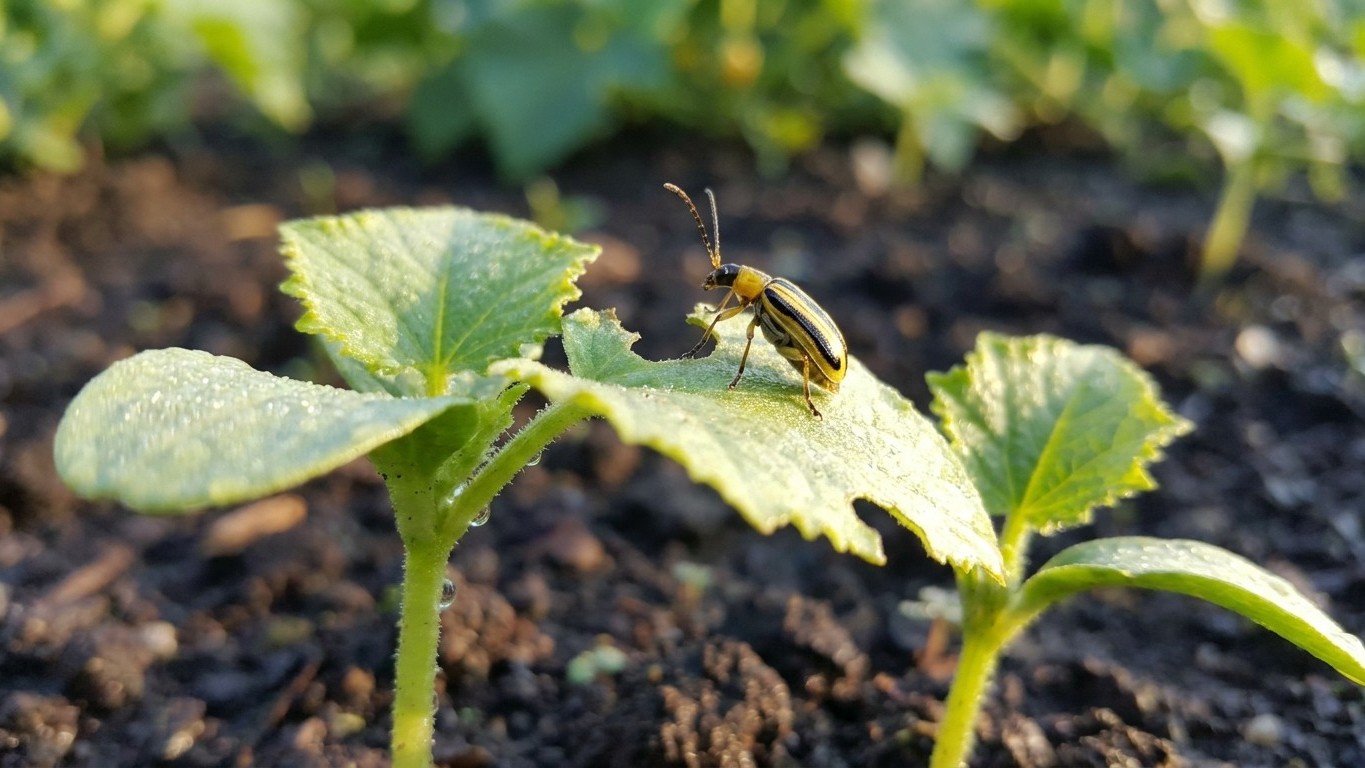

Striped cucumber beetles wake up in Manitoba as soon as soil temperatures climb past roughly 55°F, which typically lands in late May to early June across the southern grain belt and a week or two later up around Dauphin or The Pas. That timing puts them right on top of newly transplanted cucumbers, squash, and melons, when seedlings have just two or three true leaves and almost no defense against a hungry beetle chewing through the stem.
Gardeners in Winnipeg, Brandon, and Portage la Prairie tend to spot the first adults during the same week they’re hardening off transplants outdoors. That overlap is not a coincidence. The beetle’s biology is timed almost perfectly to Manitoba’s short growing season, and understanding that overlap is the single biggest advantage a home gardener has.
When Striped Cucumber Beetles Actually Show Up in Manitoba

Adult beetles overwinter in leaf litter, tall grass edges, and wooded shelterbelts, not in your garden soil itself. They tuck into debris the previous fall and stay dormant through Manitoba’s brutal winter, which routinely drops below -22°F. Come spring, they emerge in a fairly narrow window tied to soil warmth rather than the calendar date. A cold, wet spring pushes emergence into mid-June; an early warm-up can bring them out by the last week of May.
Once active, they head straight for the nearest cucurbit patch. In a province where the frost-free season often runs from late May to mid-September, barely 110 to 120 days in many zones, that early feeding pressure lands during the most fragile stage of the plant’s life. A seedling that loses its growing tip in June has little time to recover before the season closes again in September.
One Generation, Not Two
South of the border, in states with longer summers, striped cucumber beetle can push out two generations a year. Manitoba’s shorter, cooler season generally limits the insect to a single generation. Adults feed and lay eggs in June, larvae develop in the soil around cucurbit roots through July, and the new adult generation emerges in August to feed heavily before seeking overwintering sites in September. That August wave is often mistaken for a “second wave of the same beetles,” but it’s really the next generation, and it can hit late-planted squash and pumpkins hard just as they’re trying to size up fruit before frost.
How to Identify the Beetle and the Damage It Leaves Behind
The adult is small, about a quarter inch long, with a yellow-to-greenish-yellow body and three bold black stripes running down the wing covers. It’s easy to confuse at a glance with the spotted cucumber beetle, which carries black dots instead of stripes and behaves a bit differently in the garden. The striped version is the more aggressive early-season feeder in Manitoba’s cucurbit patches.
Look for these signs when scouting:
- Ragged holes in cotyledons and young leaves, sometimes stripping seedlings down to bare stems
- Adults clustered at the base of stems or hiding in blossoms during the heat of the day
- Scarring on the surface of young fruit where beetles have fed on the rind
- Wilting vines that don’t recover overnight, a red flag for bacterial infection rather than simple drought stress
That last point matters more than the chewing damage itself. The beetle carries Erwinia tracheiphila, the bacterium responsible for cucurbit bacterial wilt, in its gut and mouthparts. When it feeds, it can inoculate the plant’s vascular tissue directly. A vine that looked fine on Tuesday can be collapsed and dead by the weekend. Cucumbers and muskmelons are especially vulnerable to this disease; squash and pumpkins have more natural resistance, though they’re not immune.
Why Manitoba’s Climate Both Helps and Hurts
The long, harsh winters actually work in the gardener’s favor to some degree. Overwintering survival rates for striped cucumber beetle drop in years with little snow cover and deep soil freezes, since snow insulates the leaf litter where adults hide. A winter with thin snowpack and repeated deep freeze-thaw cycles, common across the Red River Valley, can knock back the following spring’s population before a single trap crop goes in the ground.
On the other hand, Manitoba’s compressed growing season means there’s no room for delay once beetles appear. A grower in a longer-season state might tolerate early feeding and still get a full harvest. In Manitoba, losing three weeks of seedling growth to beetle damage can mean the difference between ripe melons in August and green ones still on the vine at first frost.
What Actually Stops Striped Cucumber Beetle in a Manitoba Garden
Timing the Planting Window
Because emergence is tied to soil temperature rather than the beetle’s own schedule, gardeners have a real tool here: delay direct seeding of cucumbers and squash by even a week or two past the earliest safe planting date, and seedlings emerge with slightly tougher tissue right as the first beetle wave tapers off. Starting seedlings indoors under lights and transplanting larger, more established plants outdoors, rather than direct-seeding, also gives the crop a head start the beetles can’t easily undo.
Row Covers, Used Correctly
Floating row covers remain the single most reliable physical barrier for home gardeners. Laid over hoops immediately after transplanting or seeding, they block adult beetles from reaching the plants during the vulnerable seedling stage. The catch is pollination. Cucurbits need bees to set fruit, so covers need to come off once flowering begins, typically four to six weeks after planting depending on the variety. Removing covers too early defeats the purpose; leaving them on too long means no fruit at all.
Trap Cropping
Beetles show a strong preference for certain cucurbit varieties, particularly Blue Hubbard squash, over the crop a gardener actually wants to harvest. Planting a border of Hubbard squash around the perimeter of a cucumber or melon patch draws beetles away from the main crop. Those trap plants can then be treated more aggressively, including hand removal or targeted insecticide application, without worrying about residue on food crops meant for the table.
Mulch and Soil Management
Reflective mulch, whether silver plastic or aluminum foil strips laid between rows, disorients beetles and reduces landing rates on young plants. Straw mulch, common in Manitoba gardens for moisture retention through dry prairie summers, has a secondary benefit of making it harder for beetles to locate host plants by scent and sight. Deep fall tillage that exposes overwintering sites to freezing temperatures can also reduce the local population, though this only helps if neighboring properties or shelterbelts aren’t providing a steady source of new adults each spring.
Targeted Treatments
For gardeners who need more than physical barriers, kaolin clay sprayed on foliage creates a particle film that beetles find irritating to walk and feed on, without harming beneficial pollinators the way broader insecticides can. Diatomaceous earth dusted around the base of plants works on the same principle, though it needs reapplication after rain. Insecticidal soap can knock back adult populations on contact but has no residual effect, so it works best as a spot treatment during heavy scouting weeks rather than a blanket weekly spray.
For larger vegetable plots or anyone dealing with a persistent infestation, targeted approved insecticides applied at dusk, when bees are less active but beetles are still feeding, reduce collateral damage to pollinators while still hitting the pest population. Rotating cucurbit crops to a different part of the garden each year, ideally with at least a two-year gap before returning cucurbits to the same bed, also disrupts the beetle’s ability to find host plants immediately after emergence.
Watching for Bacterial Wilt, Not Just Beetles
Because the disease connection is often the more damaging part of a beetle problem, scouting shouldn’t stop once the chewing damage looks minor. A simple field test many Manitoba extension guides recommend: cut a wilting stem near the base and slowly pull the two halves apart. If a milky, sticky strand of sap stretches between them, that’s a strong indicator of bacterial wilt, and the plant should be removed rather than left in place as a reservoir for more beetle-to-plant transmission.
Squash and pumpkin varieties bred for wilt resistance exist and are worth considering for gardeners who’ve had repeated losses. Cucumber varieties, by contrast, generally lack strong resistance, which puts more weight on prevention through row covers and early-season vigilance rather than hoping a resistant variety will carry the crop through.
Cucurbit growers across the prairies deal with a fairly predictable pest calendar year after year, which means the real advantage isn’t a single product or trick. It’s tracking soil temperature in spring, watching for that first beetle sighting, and having row covers or trap crops already in place before the insects arrive rather than scrambling once the seedlings are already chewed down to stubs.
Related guides
- Striped cucumber beetle in Ontario: When It Shows Up and What Stops It
- Striped cucumber beetle in Massachusetts: When It Shows Up and What Stops It
- Striped cucumber beetle in Michigan: When It Shows Up and What Stops It
- Striped cucumber beetle in Newfoundland and Labrador: When It Shows Up and What Stops It
- Striped cucumber beetle in Nova Scotia: When It Shows Up and What Stops It