
Alabama Cooperative Extension System documents ten garden pests for home vegetable growers in the state, but only two of them have any real business on a carrot plant: aphids and spider mites. Both feed on the ferny top growth, not the root, and both show up while the root is still building underground, long before harvest.
Which pests attack carrot in Alabama

Alabama Cooperative Extension System lists ten pests for vegetable gardens across the state: Aphids, Corn earworm (tomato fruitworm), Cowpea curculio, Imported cabbageworm, Leaffooted bug, Mexican bean beetle, Spider mites, Spotted cucumber beetle, Squash vine borer, and Stink bugs. That is a wide net, cast across Everything from beans to squash to corn, and most of it has nothing to do with a carrot bed.
Corn earworm bores into corn ears and tomato fruit; a carrot never grows anything for it to tunnel into. Cowpea curculio and Mexican bean beetle are legume specialists, tied to peas and beans, not root vegetables. Imported cabbageworm needs the cole crops, cabbage, broccoli, kale, for its larvae to chew. Leaffooted bug and stink bugs are piercing-sucking feeders that go after developing fruit and seed pods, and a carrot grown for its root is usually pulled before it ever flowers. Squash vine borer and spotted cucumber beetle stay with cucurbits, squash and cucumber vines mostly, occasionally corn. None of the seven belong on this page, and naming them as carrot pests would be a mistake a good extension agent would catch immediately.
That leaves aphids and spider mites, both generalist feeders that will settle on almost any tender foliage, carrot included, when conditions favor them. The root spends 70 to 100 days developing underground after seeding, and that whole stretch is when the foliage above it has to stay functional enough to feed it. A pest that damages the leaves early doesn’t just look bad, it can throttle how big the root gets to grow.
Alabama Cooperative Extension System documents a short list here, and that’s the honest answer: two pests, not ten, actually target carrot in this state.
When each one shows up, and what it does first
Because carrots are sown directly into the bed, there is no transplant date to count from, only the seeding date. Everything about a carrot’s pest exposure runs on that 70 to 100 day window from seed in the ground to root in the kitchen, and both aphids and spider mites tend to show up at different ends of it.
Aphids are usually the first sign of trouble, arriving on young, soft foliage not long after the seedlings have thinned themselves out and started putting on real leaf growth. What a gardener notices first isn’t the insect itself, aphids are tiny and easy to miss, but the leaf curling inward, a yellowish cast to the new growth, and a faint sticky film on the foliage that draws ants. Left alone through a few weeks of mild, humid weather, the colony builds fast because aphids reproduce without needing to mate.
Spider mites tend to turn up later in the carrot’s underground development, and they favor a different set of conditions entirely: hot, dry stretches with no rain to knock populations back. The first sign is rarely the mite, which is barely visible without a hand lens, but a stippled, dusty-looking bronze or yellow speckling across the foliage, sometimes with fine webbing between the leaf stems if the infestation has been building a while. Carrot tops that suddenly look scorched or dried out in the middle of an otherwise well-watered bed are worth a close look for mites before blaming the weather.
Both pests act on the same principle: they weaken the top growth during the exact stretch when the root underneath needs that foliage working at full capacity. A mild aphid presence early in the season matters less than a heavy mite infestation late, closer to when the root is finishing its bulk.
Telling the damage apart from everything else
Carrot foliage gets blamed for insect damage more often than insects actually cause it. Alabama’s representative state soil, the Bama series, is naturally acid, sandy (67 percent sand, 14 percent clay, 19 percent silt), low in organic matter (about 0.8 percent), and well drained. That combination shapes a lot of what looks like pest trouble but isn’t. The figures describe the state soil as mapped, not any individual garden, so treat them as a starting point and confirm with a soil test rather than assuming your own bed matches.
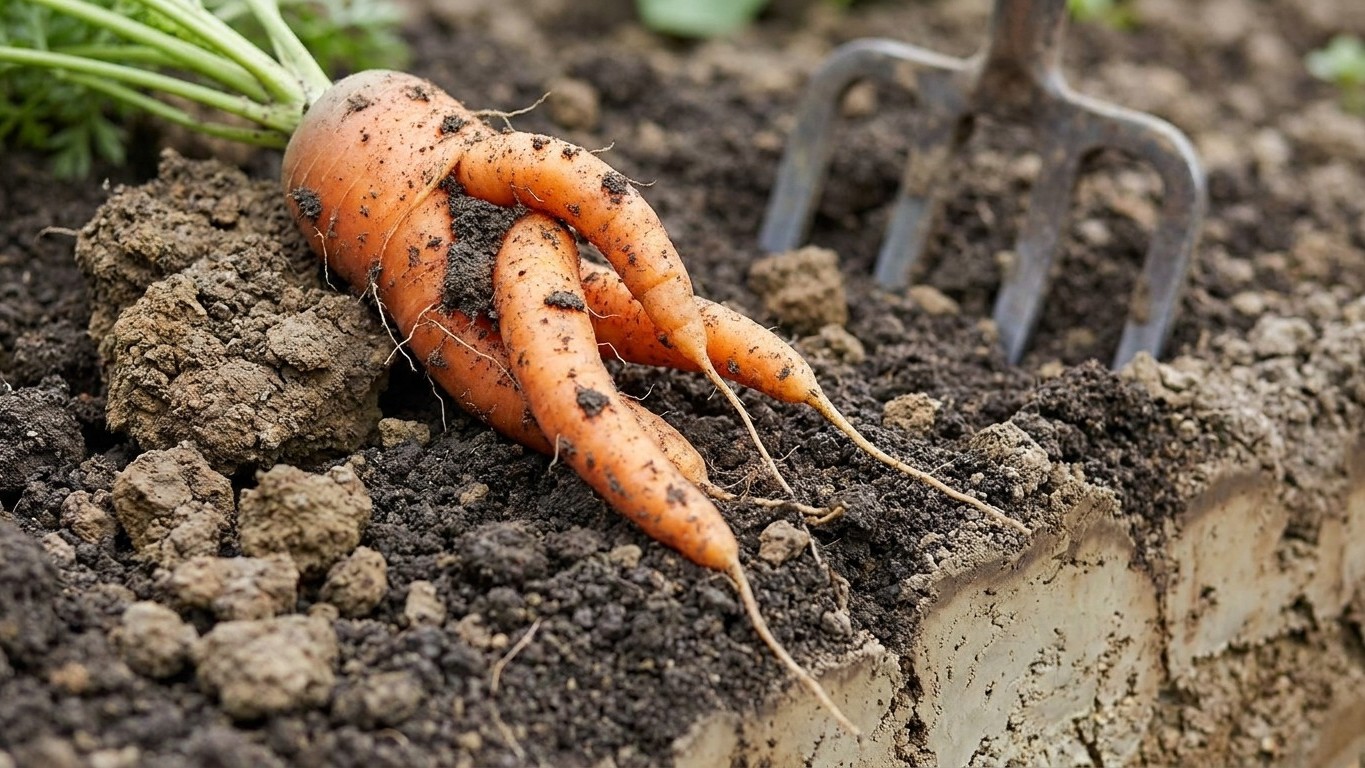
Carrots specifically want deep, sandy, well-drained soil rich in organic matter, according to Utah State University Extension. Heavy or rocky ground makes the root fork instead of growing straight down, and the fix for that is compost and double digging, not an insecticide.
| What you see | Likely cause | What tells it apart |
|---|---|---|
| Curled, yellowing new leaves, sticky residue | Aphids | Check leaf undersides with a hand lens for small soft-bodied insects clustered together |
| Stippled, bronzed foliage, fine webbing | Spider mites | Tap a leaf over white paper; mites show as moving specks |
| Forked or stubby root, straight tops otherwise healthy | Heavy, rocky, or compacted soil | No foliage damage at all; problem is only visible once the root is pulled |
| Pale, stunted foliage across the whole bed | Low organic matter or nutrient deficiency | Even, uniform pattern rather than patchy insect feeding |
| Wilting despite normal watering | Drought stress or disease | No insects present on close inspection; roots may show rot instead |
A county extension office can run a soil test and confirm which of these is actually at work in a given bed, something no article written for the whole state can do.
What actually works here, and what is a waste of time
A short growing season doesn’t leave room for guessing. Spraying before confirming which pest is actually present wastes the limited weeks a carrot has to bulk its root, and it can knock back the natural predators, ladybugs and lacewings, that would otherwise keep aphid numbers in check on their own.
A floating row cover laid down at seeding, before aphids or mites ever find the bed, is one of the more reliable non-chemical tactics available, since it physically blocks both pests from reaching the foliage in the first place. It has to come off before flowering isn’t a concern for a root crop harvested young, but it does need to stay ventilated enough that it doesn’t trap excess heat during hot spells, which would only invite spider mites in faster.
A strong jet of water directed at the undersides of leaves knocks aphid colonies down and disrupts spider mite webbing, and it costs nothing but a garden hose. Keeping the bed watered evenly through dry stretches matters too, since mites build up fastest on plants already stressed by drought.
What doesn’t work: treating the whole bed for a pest that hasn’t actually been confirmed, or assuming a forked root means an insect got to it, when the real cause sits in the soil texture underneath. Any decision about a specific product or treatment threshold belongs with the county extension office, which knows what’s labeled for use in Alabama gardens this season.
Where to check this for your own county
Alabama Cooperative Extension System is the authority behind every pest named on this page, and it operates through county offices that see what’s actually showing up in local gardens, not just what’s documented statewide. A pest list for the whole state doesn’t mean every county sees the same pressure, or on the same schedule.
A garden three counties over can have a heavy aphid year while another sits nearly untouched, depending on local weather, what’s planted nearby, and how much natural predator activity is already established. That variation is exactly why a statewide list is a starting point, not a diagnosis for any one backyard bed.
The most useful next step is a call or visit to the county extension office, sample in hand if something looks off. They can confirm whether it’s aphids, spider mites, a soil issue, or something else entirely, and they’ll know what, if anything, is worth doing about it this season.
Common questions
Do carrots get corn earworm? No. Corn earworm targets corn ears and tomato fruit; a carrot has no fruiting structure for it to attack, and Alabama Cooperative Extension System does not list it as a carrot pest.
What does aphid damage on carrot look like? Curled or cupped new leaves, a yellowish tint, and a sticky film on the foliage that often attracts ants, usually appearing on tender growth soon after the seedlings establish.
Can spider mites kill a whole carrot crop? A heavy, unchecked infestation during a hot, dry stretch can severely stunt the foliage and limit root size, though most home gardens catch it before it goes that far if the leaves are checked during dry weeks.
Why did my carrot root fork instead of growing straight? Forking is almost always a soil problem, heavy, rocky, or compacted ground, rather than insect feeding. Compost and looser, deeper soil preparation address it; a county soil test can confirm what’s actually in the bed.