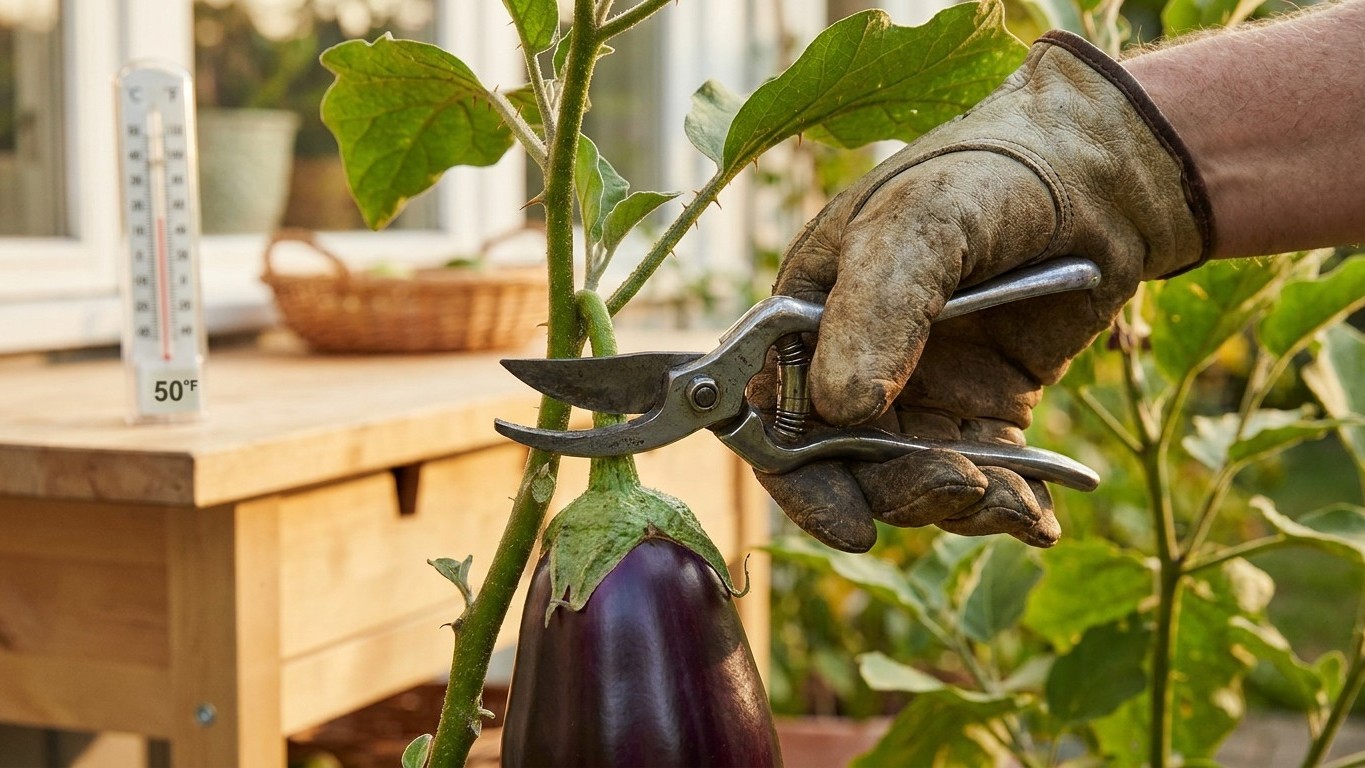

The Utah State University Extension answers this in two lines: cut the stem with a knife or pruning shears rather than twisting the fruit off, wear gloves because eggplant stems and leaf undersides carry small prickly thorns, and once you’ve harvested, keep the fruit on the counter at 50-55°F instead of tucking it into the refrigerator. Cold air does more damage than warm air here.
The short answer
Utah State University Extension’s guide to growing eggplant in the garden is blunt about both halves of this question. On the harvest side, the instruction is to use a knife or pruning shears to cut the stem when picking, rather than twisting the fruit free. The reason given is practical, not aesthetic: eggplant has small prickly thorns on its stems and under its leaves, and the Extension specifically recommends wearing gloves while you work.
On the storage side, the numbers are just as direct. Mature eggplant will hold for 7 days if kept at 50-55°F. That’s a narrow band, warmer than a refrigerator crisper drawer and cooler than a kitchen counter in most homes, but it’s the range the source gives, and it’s worth taking literally. The same source adds a warning that runs against instinct: fruits are subject to chilling injury if refrigerated. Put an eggplant in a standard fridge, which typically runs somewhere in the high 30s to low 40s, and you’re pushing it well below the Temperature it can tolerate.
This is a genuine reversal from how this site treats other vegetables. Lettuce and cabbage both want the cold of a refrigerator to hold their texture and slow decay. Eggplant doesn’t. It’s a warm-season fruit at heart, and its tissue reacts to cold the way a house plant reacts to a drafty window. The skin can pit, the flesh can turn brown internally, and none of that damage announces itself right away. It shows up a day or two later, after the fruit has already been put away and forgotten.
There’s also a quality test built into the harvest recommendation. USU Extension describes ripe eggplant as full size, with a glossy sheen, typically 6 to 8 inches long, firm, plump, and fully colored, with smooth skin. That gloss is the signal to watch for. Once a fruit goes dull, it has usually gone too far. Over-mature eggplant is described as dull colored, soft, seedy, and bitter tasting, which means the visual cue you’re looking for at harvest time doubles as an early warning sign that you waited too long.
So the short answer holds up under scrutiny: cut the stem, don’t twist the fruit, and store what you pick somewhere cool but not cold. The rest of this comes down to understanding why those two rules exist and what breaks down when they’re ignored.
What actually decides it

Why twisting damages more than the fruit
Eggplant stems are woody and fairly rigid near the point where the fruit attaches. Twisting puts a rotational stress on that junction that a simple downward or sideways pull doesn’t. The stem can tear rather than separate cleanly, and that tear doesn’t stop at the fruit. It can pull at the branch itself, splitting bark or snapping a stem that was otherwise still producing. A plant that loses a branch to a bad twist stops producing fruit from that point on for the rest of the season. Cutting with a knife or pruning shears avoids that chain reaction entirely. The blade does the separating instead of the plant’s own fibers, and the wound left behind is clean rather than ragged, which also matters for how quickly it seals over and stops being an entry point for rot organisms.
The thorn detail folds into this same mechanism. Because the stems and leaf undersides carry small prickly spines, a bare-handed twisting motion means gripping and wrenching against something that’s actively working against your hand. Gloves solve the immediate discomfort, but cutting instead of twisting reduces how much contact and force your hand needs to apply in the first place. Less force against a thorny stem means fewer scratches, and a cleaner cut on the plant.
Why cold causes damage that heat doesn’t
Chilling injury isn’t the same thing as freezing. Eggplant tissue evolved in warm climates and its cell membranes are built for a narrower, warmer temperature range than something like cabbage or kale. When the fruit sits below the temperature its cells tolerate, even well above freezing, those membranes start to break down at a cellular level. The damage doesn’t require ice crystals to form. It’s a slow leak, cell walls losing their integrity, and it produces the pitting, discoloration, and soft spots that show up after a day or two in the refrigerator, not immediately.
This is why 50-55°F functions as a real threshold rather than a rough guideline. It’s cool enough to slow the ripening and softening that would happen at room temperature, which is why the fruit holds for about 7 days instead of spoiling in a day or two. But it stays above the point where chilling injury begins. A refrigerator, built to protect foods that thrive in the high 30s, oversteps that threshold every time.
How to do it
- Wait until all frost danger has passed and the soil has warmed to 60°F before setting Transplants outside. Eggplant is a warm-season crop, and unlike cool-season vegetables that tolerate a light frost, eggplant does not. Check your own last frost date and plant only after it, once the soil itself, not just the air, has reached that 60°F mark.
- Watch the fruit for full size, a glossy sheen, and length in the 6 to 8 inch range. These are the visual markers the fruit is ready, and they’re worth checking together rather than relying on size alone.
- Confirm firmness and color before cutting. Fruits that are firm, plump, and fully colored with smooth skin carry the best flavor and quality. If the skin looks dull instead of glossy, the fruit has likely gone past its prime.
- Put on gloves. The thorns on the stems and leaf undersides are small but sharp enough to be worth avoiding.
- Cut the stem with a knife or pruning shears. Don’t twist. A clean cut protects both the fruit and the plant’s remaining branches.
- Move harvested fruit to storage at 50-55°F, not the refrigerator. At that range, mature eggplant holds for 7 days.
- Plan to use or freeze what you can’t eat within that window. Eggplant isn’t suitable for canning or drying, but it can be frozen, so freezing is the fallback once the 7-day storage window is closing.
What goes wrong

- Twisting the fruit off instead of cutting it. This tears the stem junction, can damage the branch itself, and cuts off future fruit production from that point on the plant. Use a knife or pruning shears every time.
- Refrigerating the harvest. Fruits are subject to chilling injury if refrigerated, and the damage shows up as pitting and soft spots a day or two later, not right away. Store at 50-55°F instead.
- Letting fruit go past its glossy stage. Over-mature eggplant turns dull colored, soft, seedy, and bitter. There’s no fixing this after the fact. Check for gloss and firmness regularly and harvest before the skin loses its shine.
- Trying to preserve a surplus by canning or drying. Eggplant isn’t suitable for either method. Freezing is the only preservation option the Extension supports, so plan harvest and use around that limit rather than around a canning schedule.
- Losing plants to verticillium wilt and expecting a resistant variety to solve it. There is no varietal resistance to this disease. The only measures available are crop rotation and soil solarization, applied before the problem starts, not after.
- Handling stems bare-handed. The thorns on stems and leaf undersides will scratch. Gloves are the straightforward fix, and there isn’t a good reason to skip them.
Common questions
Can I store eggplant in the refrigerator for just a day or two?
The Extension’s guidance doesn’t carve out an exception for short stays. Fruits are subject to chilling injury if refrigerated, and that injury can begin developing before it’s visible. The safer approach is a 50-55°F spot, which also happens to be where the fruit lasts longest, up to 7 days.
How do I know an eggplant is ripe without cutting into it?
Look for full size, a glossy sheen, and a length of roughly 6 to 8 inches, combined with firm, plump flesh and smooth, fully colored skin. The gloss is the single most reliable visual cue. A shift from glossy to dull is a sign the fruit has moved past peak quality.
What happens if I twist the fruit off by accident?
A twisted-off fruit may still be edible if the flesh itself wasn’t damaged, but the real cost is to the plant. Twisting can tear the stem junction and stress or split the branch, which can end fruit production at that spot for the rest of the season. Going forward, keep a knife or pruning shears on hand at harvest time.
Is there any way to make eggplant last longer than 7 days?
Within the 50-55°F storage window, 7 days is the figure the Extension gives for mature fruit. Beyond that, canning and drying aren’t viable options for eggplant, but freezing is, making it the practical route for anyone with more fruit than they can use in a week.