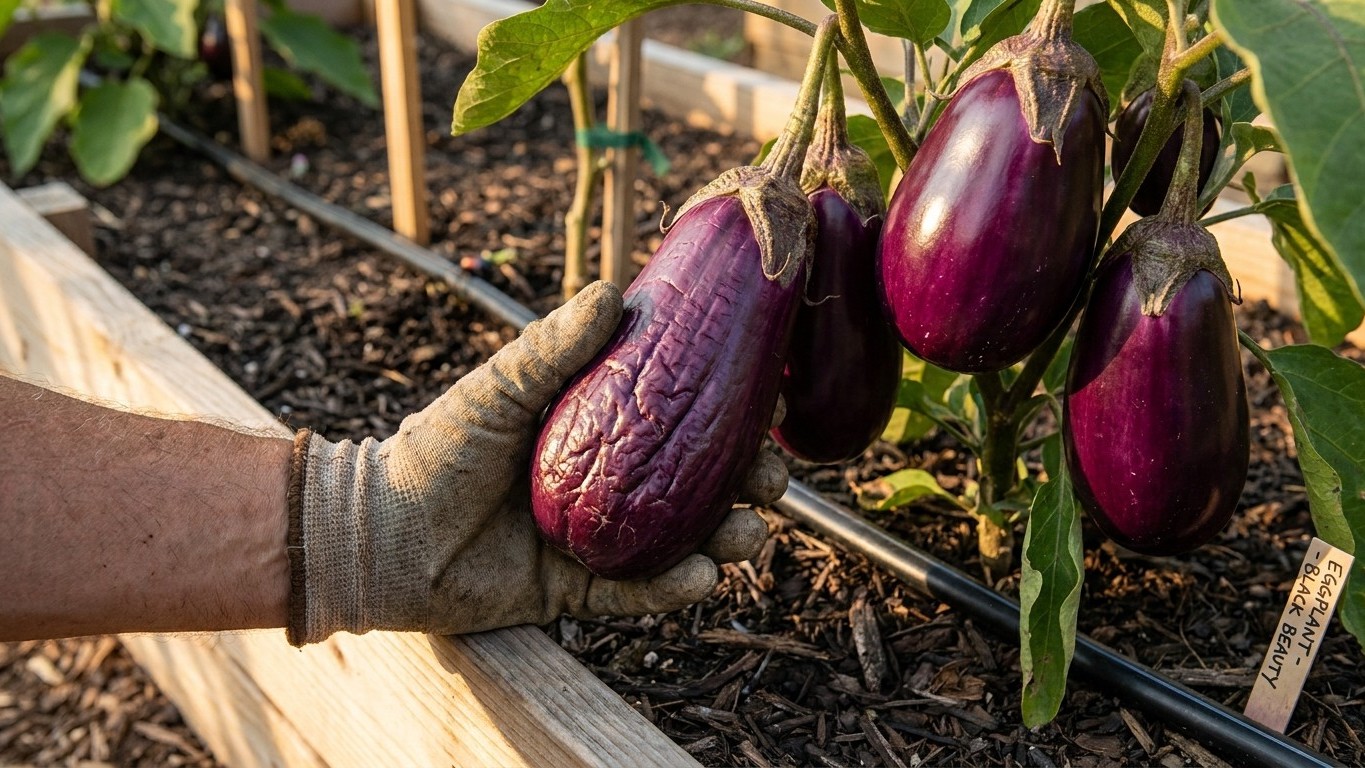

Eggplant skin turns tough and leathery for one of four reasons, and Utah State University Extension lays them out plainly: night temperatures below 55°F, day temperatures above 95°F, water stress, or fruit left to hang past maturity. Two of those causes are weather. The other two sit in the gardener’s hands, which is why the same variety can turn out tender in one yard and rubbery in the next.
The short answer
Utah State University Extension states the four triggers for tough skin without hedging: unfavorable weather (night temperatures lower than 55°F, or day temperatures above 95°F), water-stressed plants, or fruit that’s gotten over-mature. That’s the full list. No fifth cause, no soil pH angle, no fertilizer shortfall gets blamed for leathery skin in this source, and that matters because a lot of garden advice tries to pin skin texture on things the Extension simply doesn’t support.
Here’s the part that changes how you think about the problem: the source itself splits those four causes into what you can and can’t fix. Its own words are worth quoting directly, because they cut through a lot of guesswork: “Since you can’t do much about high temperatures, keep the plants well-watered and harvest the fruits when they are full size and mature.” That sentence is the whole strategy in one line. Temperature swings, hot or cold, are not something a home gardener bends to their will short of row cover or shade cloth. Watering consistency and harvest timing are.
The timing piece has a number attached to it that’s easy to overlook. Fruits reach full mature size in 10 to 20 days after flowering, according to the same Extension publication. That’s a two-to-three-week window, not a single date, and it means the plant is giving you a fairly narrow target for harvest before “mature” tips into “over-mature.” Miss that window on the late side and skin toughness starts creeping in even if watering has been flawless.
So the practical answer isn’t “water more” or “pick sooner” in isolation. It’s recognizing that weather stress and grower error often overlap on the same fruit. A plant already struggling with a cold snap or a heat spike is far less forgiving of inconsistent watering or a delayed harvest than a plant growing in mild, stable conditions. The two controllable factors don’t just add to the two uncontrollable ones, they compound with them.
What actually decides it

Tough skin rarely has a single cause. It’s usually the tail end of a chain that started somewhere else on the plant, and understanding that chain is more useful than memorizing a list of four bullet points.
How water stress becomes skin toughness
Irregular watering, whether the plant gets too little or too much, causes tough leathery fruit or root rot, per Utah State University Extension. Those two outcomes (leathery skin and rot) sound like opposites, but they share a root cause: inconsistency. A plant that dries out between waterings and then gets soaked pulls water unevenly into developing fruit. The skin, which forms and thickens during that same growth window, hardens as a defensive response to the stress. Root rot shows up on the other end of that same inconsistency, when soil stays saturated too long and roots suffocate. It’s the same irregular pattern producing two different symptoms depending on which direction the swing goes.
How a thin canopy causes sunscald, which mimics tough skin
Sunscald is caused when fruits are exposed to direct sunlight during hot, dry weather. Exposed areas over-heat, dry out, and do not color uniformly. Big plants with good leaf cover have less sunscald problems. The chain here starts earlier than most gardeners think. A plant that’s been stressed, by uneven watering, poor fertility, or crowding, produces less foliage. Less foliage means less shade over the fruit itself. That exposed fruit then bakes under direct sun and develops the same kind of dry, discolored, hardened patch that gets mistaken for ordinary tough skin from over-maturity. The two problems look similar on the fruit but start from different failures: one from delayed harvest, the other from an undersized plant that never grew enough leaf cover to shade its own crop.
How over-maturity closes the loop
Fruit left on the plant past the 10-to-20-day full-size window keeps developing internally even after size has maxed out. Seeds enlarge, flesh loses some of its tenderness, and the skin thickens as the fruit shifts from “ready to eat” toward “seed production mode.” A stressed plant that’s already producing tougher skin from water irregularity, combined with a grower who delays harvest waiting for fruit to get slightly bigger, stacks both controllable causes on the same piece of produce.
How to do it
- Wait until soil reaches 60°F and all frost danger has passed before transplanting. Eggplant is a Warm-Season Crop with no cold tolerance, so setting it out early doesn’t gain anything and only invites the kind of stress that shows up later as tough skin.
- Water on a consistent schedule from transplant onward, not a reactive one. Since irregular watering, whether under or over, is directly tied to tough leathery fruit and root rot, the goal is steady soil moisture rather than letting the plant dry out and then flooding it to compensate.
- Track flowering dates on individual fruit clusters. Because fruit reaches full mature size in 10 to 20 days after flowering, noting when a flower sets gives a real countdown rather than guessing by eye alone.
- Check fruit size and firmness starting around the two-week mark after flowering. This is the front edge of the 10-to-20-day maturity window, and checking early means you catch fruit at its best rather than finding out it slipped past prime a few days too late.
- Harvest at full size rather than waiting for “a little bigger.” Since you can’t do much about high temperatures, the Extension’s own guidance is to control what’s controllable: keep plants well-watered and harvest fruit when it’s full size and mature, not after.
- Maintain full leaf cover through the season instead of over-pruning. Big plants with good leaf cover have fewer sunscald problems, so a plant kept healthy and leafy through consistent watering ends up protecting its own fruit from direct sun exposure as a side effect.
What goes wrong

- Fruit left on the plant too long “to get bigger.” Once fruit passes the 10-to-20-day maturity window after flowering, it’s already headed toward tougher skin and enlarged seeds. The remedy is simply picking on schedule based on flowering date rather than waiting for a size that may never look “ready enough.”
- Inconsistent watering that swings between drought and flood. This is called out directly as a cause of both tough leathery fruit and root rot. The fix is a steady watering routine, not an occasional deep soak after the soil has already cracked dry.
- Sunscald from a thin, under-leafed plant. Fruit exposed to direct sun during hot, dry weather overheats, dries out, and colors unevenly. Since big plants with full leaf cover have fewer sunscald problems, the practical response is keeping the plant itself healthy and leafy rather than trying to shade individual fruit after the damage starts.
- Verticillium wilt in the soil. This one has no fix through variety selection. Utah State University Extension makes clear there’s no varietal resistance to verticillium wilt in eggplant. The only measures given are crop rotation and soil solarization, not a “resistant” seed choice, because that option doesn’t exist for this disease.
- Blaming temperature swings for tough skin and stopping there. Night temperatures below 55°F and day temperatures above 95°F are named causes, but treating them as unfixable and ignoring the other two factors wastes the half of the problem that actually responds to management. Watering consistency and harvest timing remain fully within reach even during a rough weather stretch.
Common questions
Can tough skin be fixed once it’s already formed on the fruit?
No. Tough or leathery skin is the result of conditions during fruit development, not something that reverses after the fact. The Extension’s guidance is entirely forward-looking: keep plants well-watered and harvest at full size and maturity to prevent it on the next fruit, not to correct it on the current one.
Does choosing a specific eggplant variety prevent tough skin?
The source names thirteen varieties but attaches no rating or resistance claim to any of them regarding skin toughness. The prevention strategy described is watering consistency and harvest timing, not variety selection.
Is sunscald the same thing as tough, over-mature skin?
They can look similar but come from different mechanisms. Sunscald results from direct sun exposure on fruit during hot, dry weather, tied to thin leaf cover on the plant. Tough over-mature skin results from fruit sitting past its 10-to-20-day maturity window after flowering. A plant can show either, or both, depending on which failure occurred.
What do I do if verticillium wilt shows up in my eggplant bed?
Utah State University Extension is specific here: there’s no varietal resistance to rely on. The measures listed are crop rotation and soil solarization, applied to the bed itself rather than to the plant choice for next season.