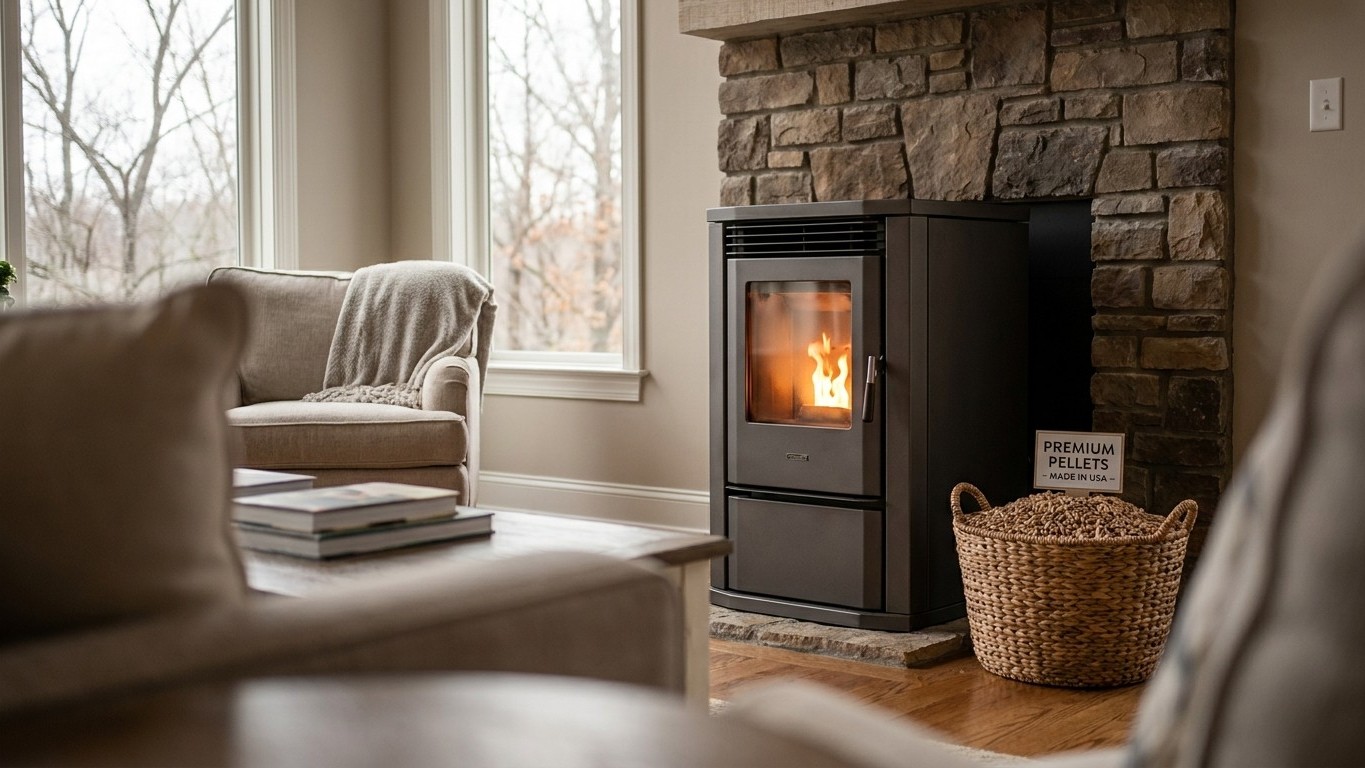

A pellet stove in South Dakota isn’t a decorative extra: with roughly 7,248 heating degree days a year at Sioux Falls, this is one of the harder heating climates in the Lower 48. The stove can carry real weight here, but it needs a fuel budget, a storage plan, and a backup plan built for a nine-month heating season, not a mild-climate afterthought.
How hard the winter works here

Sioux Falls averages about 7,248 heating degree days a year (base 65 F), according to NOAA’s 1991-2020 U.S. Climate Normals. That single number is the whole story for anyone budgeting pellets: heating degree days add up, day by day, how far the mean temperature falls below 65 F, and they translate almost directly into fuel burned. A house that needs 7,248 degree days’ worth of heat needs roughly twice the fuel of a house in a 3,600-degree-day climate, all else being equal. This is not a marginal, “supplemental warmth on chilly evenings” climate. It’s a genuine heating load, and a pellet stove sized and run correctly can serve as a primary heat source in a well-insulated home, not just a cozy accessory.
The length of the season matters as much as its depth, and the two aren’t the same thing. NOAA’s monthly normals for Sioux Falls show heating demand starting in September, the first month whose average temperature (63.8 F) dips below the 65 F threshold, and running roughly nine months until the mean climbs back above 65 F in June. January is the peak, racking up about 1,461 degree days on its own, more than double what October or November see. February (1,195) and December (1,317) aren’t far behind. That’s a long haul for a hopper and an auger: a stove here isn’t lighting for a few cold snaps, it’s running steadily from fall through spring.
All of this comes from one weather station: Sioux Falls, in the eastern part of the state. South Dakota is a big territory, and a station is not a state. Households near the Black Hills or in the higher, more exposed western counties should expect a colder, and sometimes longer, season than these numbers describe. Anyone budgeting fuel for a home outside the Sioux Falls area should treat this figure as a reasonable starting point, not a substitute for local data.
How many tons a winter takes here
Nobody can hand you a tons-per-winter number that fits your house, and any source claiming to publish one for “South Dakota” is guessing. What you can do is work the math yourself, using the degree-day figure above as the starting point, since that number is literally a measure of how much heat your house needs to replace.
The units are simple. A standard bag of pellets weighs 40 pounds. Fifty bags make a ton. From there, how many tons you burn depends entirely on how much heat your home actually loses, which is exactly what those 7,248 heating degree days are measuring at the Sioux Falls reference station. A tight, well-insulated 1,800-square-foot house and a drafty older farmhouse of the same size, sitting under the same degree-day total, can burn very different amounts of fuel.
Three variables move that number more than anything else:
- How well the house holds heat — insulation, air sealing, and window quality change fuel use dramatically even under identical outdoor conditions.
- Whether the stove is the only heat source or a supplement — a stove backing up a furnace burns far less than one carrying the whole load through a Sioux Falls January.
- The setting it runs at — a stove dialed up to hold 72 F through a stretch of single-digit nights consumes noticeably more than one set to take the edge off at 68 F.
Given all that variability, the most honest approach isn’t a published estimate at all. It’s counting your own bags. Track how many you burn through your first winter, note the setting you ran the stove at and whether it was your only heat, and you’ll have a baseline specific to your house and habits that no state-level or even city-level average can match. One measured season beats every estimate you’ll find online, including this one. For the general math behind bag counts and ton estimates, the national breakdown of how many pellets a winter takes walks through the calculation in more detail.
Buying and storing them in this climate
Timing matters here because the heating season starts in September at the Sioux Falls reference point, meaning demand for pellets climbs well before the coldest weather actually arrives. Buying ahead means buying during summer, before that seasonal window opens, both because pellets are typically cheapest when demand is low and because a regional cold snap in October or November can empty shelves fast in a state where furnaces and stoves alike are gearing up for a long season all at once.
Keeping bags dry through the year
Pellets are compressed sawdust, held together by the natural lignin in the wood rather than any glue or binder. That means moisture is the enemy, full stop: damp pellets swell, lose their shape, and crumble into sawdust that won’t feed properly through an auger. South Dakota’s continental climate brings humid summer stretches with real thunderstorm activity, and a garage or unheated shed floor can sweat with condensation on humid days even when nothing looks obviously wet. Winters, by contrast, tend to run dry and cold, which is actually easier on stored fuel, but the storage window that matters most is the humid months between delivery and first use.
Practical storage means bags off a bare concrete floor, ideally on a pallet or shelving, in the driest indoor space available, away from basement dampness or a garage corner prone to condensation. A single ruined pallet load is a real loss, and it’s avoidable with basic precautions. For a full rundown on stacking, moisture barriers, and how to judge whether a bag has already absorbed moisture, the national guides on pellet storage and pellet quality cover the details that apply regardless of state.
On cost, the only number worth comparing between suppliers is the price per ton, not the price per bag, since bag sizes and pallet configurations can make sticker prices misleading. Beyond that, no dealer names or price figures are reliable enough to print here, since both shift by season and by supplier.
What a winter outage means here
A pellet stove is not a wood stove, and the difference shows up the moment the power goes out. Feeding pellets from the hopper into the firebox and pushing warm air into the room both depend on electric motors and, usually, electronic controls. Cut the power, and the fire either stalls or the whole system shuts down for safety. No electricity, no heat, no matter how full the hopper is.
That constraint matters more in a climate like this one than it would somewhere mild. With Sioux Falls averaging 7,248 heating degree days a year and January alone carrying 1,461 of them, a power outage during a January cold snap is a genuine heating emergency, not a minor inconvenience. In a milder climate, losing stove power for an evening might mean a chilly living room and an extra blanket. Here, with outdoor temperatures regularly running well below freezing for weeks at a stretch, it can mean a house losing heat fast.
What most South Dakota households fall back on during an outage depends on what they’re already heating with. According to the U.S. Energy Information Administration’s 2020 Residential Energy Consumption Survey, 75% of South Dakota homes use a furnace as their main heating equipment, with natural gas as the leading fuel at 58% and electricity at 25%; another 7% run a steam or hot-water boiler, and 14% rely on propane. Furnaces themselves often need electricity to run their blowers and controls even when the fuel is gas or propane, so a whole-house outage can leave both the furnace and a pellet stove offline at the same time. The survey doesn’t publish reliable figures for central heat pumps or fuel oil in the state, which means those categories are too small or too uncertain to report, not necessarily zero.
None of this points to a specific generator size or battery capacity, because that depends entirely on the stove’s own power draw, listed on its appliance label, and on what else in the house needs to stay running during an outage. The national guide on what a power cut means for a pellet stove walks through how to size backup power around the appliance’s actual specs rather than a generic rule of thumb.