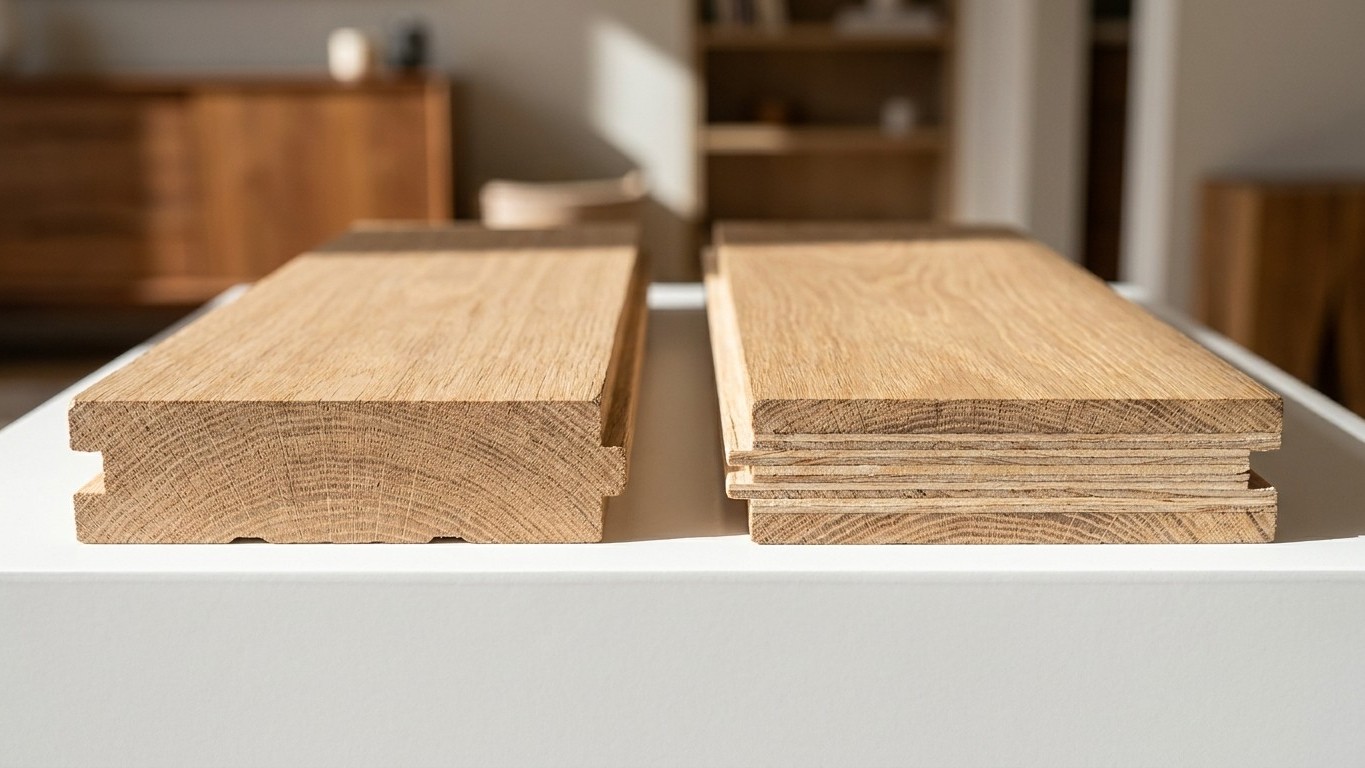

The honest answer: solid wood is milled from a single piece of timber, engineered wood is several thin layers bonded together with a real wood veneer on top. Both can look the same from across the room. What separates them is what happens underneath your feet over time, and where each one can actually go in a house without a callback six months later.
What is actually happening

Wood moves. That’s the fact every flooring decision comes back to. A tree grows in rings, and once that log becomes a board, it keeps trying to expand and contract with humidity the same way it did on the stump, just without bark to hide it. Solid wood is one piece of that log, cut straight through, and it moves as one piece. When the air gets humid, it swells across the grain. When the heating season dries the house out, it shrinks and gaps appear between boards. That’s not a defect. That’s the material doing exactly what wood has always done.
Engineered wood takes a different approach to the same problem. Instead of one solid piece, it’s built from several layers, usually a plywood or high-density fiberboard core, with a veneer of real hardwood bonded on top as the visible surface. The trick is in how those layers are oriented. Each layer typically runs with its grain turned relative to the one below it, the way plywood is built. That cross-lamination means when one layer wants to expand, the layer next to it is pulling in a different direction. The movement doesn’t disappear, but it fights itself into something much smaller and more stable at the surface.
That single difference in construction explains almost Everything downstream: why one type tolerates a Concrete Slab and the other doesn’t, why one can go over radiant heat with far less argument, and why a moisture problem that barely dents an engineered floor can cup or buckle a solid one within days.
It’s also why a flooring professional will run a moisture test on a subfloor or slab before installation, not out of caution for its own sake, but because that reading tells them which construction the space can actually support. The test itself is simple: a meter with pins or a sensor plate reads how much moisture is present in the material below, and that result, compared against what the flooring manufacturer specifies as acceptable, decides whether solid wood is even an option in that room. Skip that step and the wood, whichever kind it is, will eventually tell you the answer itself, usually with a gap, a crown, or a lift at the seams.
The covering, or what is under it
Choosing between the two isn’t really about looks. It’s about what’s happening one layer down, in the subfloor, the slab, or the crawlspace nobody looks at until something goes wrong. The floor you see is only ever reporting on conditions it can’t control.
| Situation | What’s really happening below the surface | Which one fits | Refinishing reality |
|---|---|---|---|
| Over a concrete slab, on or below grade | Slabs hold residual moisture for years and wick it upward, even when they look and feel dry | Engineered, in most cases | Can typically be sanded a limited number of times, sometimes not at all, depending on the veneer |
| Over a wood subfloor, upper level | Framing moves less, and there’s usually a crawlspace or conditioned space below adding stability | Either can work | Solid holds up to many refinishings over the life of the house |
| Over radiant heat | The floor is exposed to repeated, direct temperature swings, not just seasonal humidity | Engineered, built and rated for that use | Refinishing is possible but limited by the same thin veneer |
| Basement, below grade | Below-grade spaces run consistently damper, and the moisture source is often the surrounding soil, not the air | Engineered, and even then only after a subfloor moisture check | Limited, veneer-dependent |
| Climates with wide seasonal humidity swings | Wood is reacting to real changes in indoor moisture, not a manufacturing flaw | Engineered handles the swing with less visible movement | Solid can be refinished repeatedly, but may show more seasonal gapping in between |
Notice what that table is actually sorting: it’s rarely about which wood looks better and almost always about what the subfloor or slab is doing. A solid floor laid over a slab that was never tested for moisture isn’t a flooring failure so much as a foundation issue that showed up as a flooring symptom. The board is only the messenger.
The refinishing question follows the same logic. Solid wood can be sanded down and refinished repeatedly over decades, because there’s enough material in that single piece to remove and restore the surface again and again. Engineered wood’s veneer is real wood, but it’s a top layer bonded to a core, not a full-depth board, so how many times it can be sanded depends on how much of that veneer is actually there to begin with. Some can be refinished more than once. Some can’t be sanded at all without going straight through into the core. That’s not a flaw in the product, it’s a Structural tradeoff for the stability engineered wood is built to provide.
What to check, in order
Before assuming a floor is failing, work through what’s observable without tools or a contractor. Cheapest first, most revealing last.
- Look at the pattern across the room. Gaps between every board that open and close with the seasons point to normal wood movement. Cupping concentrated in one area, or boards lifting near a wall, points to a moisture source in that specific spot, not the material overall.
- Check where the floor sits relative to grade. A floor on a slab, below grade, or over a crawlspace carries a different baseline risk than one on an upper level over a ventilated subfloor. This rules out or rules in the slab and soil as suspects before anything else is tested.
- Run a simple surface test on the subfloor or slab, if it’s exposed anywhere. A small sheet of plastic taped down at the edges over bare subfloor or slab, left for a day or two, will show condensation underneath if moisture is moving through. It’s not a precise reading, but it rules out an obviously dry surface without needing any equipment.
- Look at an edge, if one is exposed. Near a closet, a vent, or a transition strip, the end grain of a board reveals whether the floor is solid wood all the way through or made of visible layers. That single glance answers the “which do I actually have” question definitively.
- Bring in a moisture meter reading from a flooring professional. This is the point where a precise number matters, and it’s still non-invasive, just pins or a sensor placed against the surface. If that reading comes back elevated, the next step is finding the source, and that’s where the job can stop being a flooring question.
Everything up to that last step can be done by anyone willing to get on their knees and look closely. None of it requires pulling up a board or opening a wall. That threshold matters, because past it, the diagnosis moves from the floor itself to whatever is happening beneath it.
When this stops being a flooring job
Three things end this page and hand the problem to someone else. The first is anything structural: joists that feel soft or bouncy underfoot, a beam that’s visibly sagging, posts in a crawlspace that look undersized or damaged. That’s framing, and no amount of choosing between solid and engineered wood fixes a floor that’s moving because what’s holding it up is failing. That call goes to a structural engineer or a licensed contractor, not a flooring installer.
The second is active water. A moisture reading that’s elevated and getting worse, a stain that’s spreading, water actually visible on a subfloor or slab: that’s a plumbing or drainage problem happening right now, and installing any type of wood flooring over it, solid or engineered, just buries the evidence temporarily. A plumber traces and stops the source. Only after that’s resolved and the area has had time to actually dry does a flooring question make sense again.
The third is a floor that’s been wet long enough to smell. A musty odor coming up through boards, especially in a basement or over a crawlspace, usually means moisture has been sitting there for a while, not just passing through. At that point the concern isn’t the wood species at all, it’s what’s been growing underneath it, and that’s a job for whoever handles remediation, not refinishing.
A flooring fitter can tell you whether a subfloor is flat, dry enough, and ready for either type of wood. A plumber traces where water is actually coming from. A structural engineer decides whether what’s under the floor can even carry it. Three different trades, three different scopes, and mixing them up is how a simple gap between boards turns into a much bigger repair. If the water is arriving from above, through a roof or a bathroom on the floor above, or from behind an exterior wall, that’s worth tracing at the source before any flooring decision gets made at all.