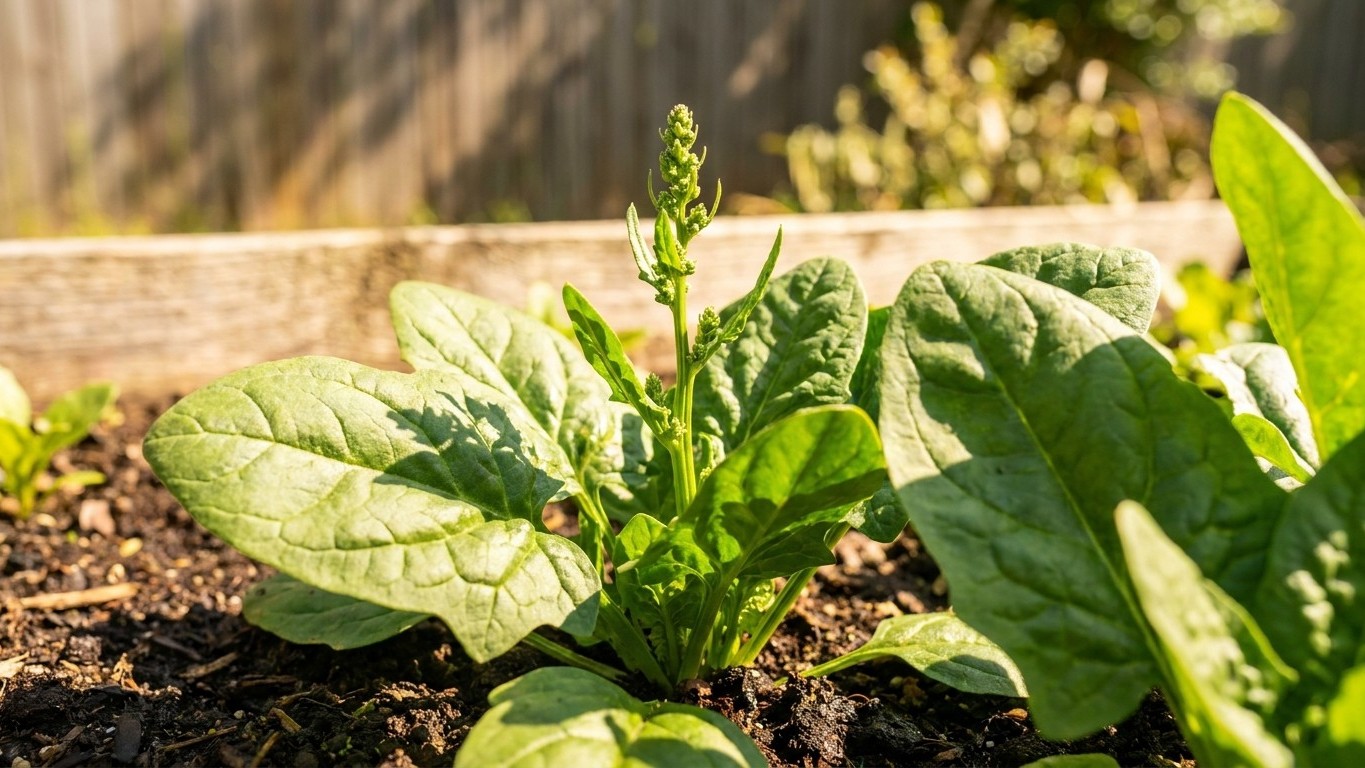

In California’s frost-free zones, spinach faces six documented pests rather than cold: aphids, snails and slugs, earwigs, spider mites, whiteflies, and root-knot nematodes. Timing depends less on a calendar month and more on soil temperature and day length, since the coastal and southern parts of the state never freeze and heat, not frost, sets the growing window.
Which pests attack spinach in California

UC Agriculture and Natural Resources documents eleven pests for this territory: Aphids including melon aphid, Brown garden snail and slugs (Cornu aspersum), Corn earworm (Helicoverpa zea), Cucumber beetles, Earwigs, Leaffooted bugs, Root-knot nematodes, Spider mites, Stink bugs, Tomato hornworm (Manduca sexta and quinquemaculata), and Whiteflies. Not all eleven belong on a spinach page.
Corn earworm feeds inside corn ears and tomato fruit, not on leafy greens with no fruiting body to bore into. Cucumber beetles are drawn to cucurbit foliage and flowers (cucumbers, squash, melons), a plant family spinach doesn’t belong to. Leaffooted bugs and stink bugs both target developing seed pods and fruit, piercing tomatoes, beans, and pomegranates for the juice inside, not the flat leaves spinach produces. Tomato hornworm is a specialist on the nightshade family, chewing tomato, pepper, and eggplant foliage almost exclusively. None of these five have a documented reason to land on a spinach bed.
That leaves six species worth watching: aphids (including melon aphid), brown garden snail and slugs, earwigs, spider mites, whiteflies, and root-knot nematodes. Aphids and whiteflies both feed by piercing leaf tissue and sucking sap, which stunts growth and leaves sticky residue behind. Snails and slugs chew ragged holes straight through leaf tissue, favoring the moist, low-growing habit of a spinach bed. Earwigs go after tender seedlings, often before a gardener even notices the plant has emerged. Spider mites thrive in dry, hot conditions and show up as the season warms. Root-knot nematodes work underground, attacking roots rather than leaves, so the damage shows up as a stunted, wilting plant long before anyone thinks to dig it up.
Six pests is not a long list, and that’s simply what this service documents for the territory. Padding it with anything else would be a guess, not a fact.
When each one shows up, and what it does first
California’s reference station shows no freeze in an average year, so the growing window for spinach isn’t bounded by frost dates the way it is elsewhere. It’s bounded by heat and day length instead. Spinach grows best where temperatures stay under 75 F, and that ceiling, more than any date on a calendar, decides when pest pressure builds.
Aphids tend to appear first, within the first few weeks after seedlings establish, clustering on the undersides of young leaves and along new growth. The first sign is usually curled, puckered leaf tips rather than visible insects. Snails and slugs work at night, and the first clue is often a silvery slime trail across chewed leaf edges rather than the pest itself, since both hide by day. Earwigs attack at the seedling stage almost exclusively, leaving small, ragged holes in the first true leaves, sometimes taking down an entire young plant before it has a chance to size up.
Spider mites and whiteflies both build as temperatures climb toward that 75 F ceiling, which is also the point at which spinach itself starts to suffer and turn bitter. Spider mite damage shows first as fine stippling, tiny pale dots across the leaf surface, that can be mistaken for dust until the leaf takes on a bronzed cast. Whiteflies show up as tiny insects that flutter up when a leaf is disturbed, followed by a sticky residue on the leaf surface. Root-knot nematodes give no early warning above ground at all. The first visible sign is usually a Plant That Wilts on a warm afternoon despite adequate water, a symptom easy to blame on the weather until the roots are checked.
Because the reference station records only 2.4 days a year at 90 F or above, extreme heat spikes are rare here, but the pests tied to warmth still build gradually as the days lengthen, regardless of how hot any single afternoon gets.
Telling the damage apart from Everything else
Spinach fails for reasons that have nothing to do with insects, and confusing the two leads to treating the wrong problem. The clearest example: **bolting** is not pest damage at all. When spinach sends up a tall central stalk and starts flowering, that’s a response to long days and warmth, the same 75 F threshold that governs growth also governs bitterness, and no pest treatment reverses it.
| What you see | Likely cause | What tells them apart |
|---|---|---|
| Ragged holes, slime trail on leaves | Brown garden snail or slugs | Slime trail present; damage worse near soil level |
| Curled, puckered new leaves | Aphids | Check leaf undersides for small clustered insects |
| Small holes in first true leaves | Earwigs | Damage concentrated on youngest seedlings only |
| Fine stippling, bronzed leaf surface | Spider mites | Worsens in hot, dry stretches; check for fine webbing |
| Sticky residue, insects fly up when disturbed | Whiteflies | Visible insects on disturbance, not just residue |
| Wilting despite watering, stunted plant | Root-knot nematodes | Roots show swollen galls when dug up and inspected |
| Tall central stalk, flowering | Bolting (not a pest) | Triggered by long days and heat, not insect feeding |
| Uniform pale yellowing, no holes | Nutrient deficiency | No chewing pattern, no insects present |
| Crispy leaf edges, wilting | Heat or water stress | Affects whole planting evenly, not patchy |
A gardener who spots any of these signs, especially the below-ground symptoms of nematodes, is better served by a local extension diagnosis than a guess from a photo. The pattern of damage across a bed, not a single leaf, is usually what settles the question.
What actually works here, and what is a waste of time
Physical exclusion beats almost everything else in this climate, mostly because there’s no winter to reset pest populations the way frost does elsewhere. A floating row cover placed over the bed **at seeding, before pests arrive**, blocks aphids, whiteflies, and earwigs from ever reaching the plant in the first place. Once a population is established underneath the leaves, the same cover does little good.
Snails and slugs respond well to handpicking at night, when they’re active, and to switching from overhead watering to drip irrigation, which removes the damp surface conditions both pests need to move around. Root-knot nematodes are the hardest of the six to manage directly once present in soil; crop rotation away from susceptible vegetables and choosing resistant varieties where available does more long-term good than any in-season fix.
Gardeners choosing among spinach varieties will find names like Bloomsdale, Melody, Teton, and Olympia offered by seed suppliers, though no yield, maturity, or pest-resistance data for any of these four is published by the source behind this page.
What wastes time: treating for cold protection in a territory with no measurable freeze, and spraying a plant that’s already bolting in hopes of saving the harvest. Once spinach has switched to flowering under long days, the leaves turn bitter regardless of pest control, and no treatment reverses that shift. The better move in a hot, frost-free climate is timing the crop to avoid the long-day window altogether, sowing again once soil temperatures drop below the 80 F mark where germination starts failing, rather than fighting the plant’s own chemistry in midsummer.
Where to check this for your own county
The six pests documented above come from UC Agriculture and Natural Resources, and that’s the authority to return to for anything more specific than what’s covered here. Pest pressure inside California varies enormously between a coastal garden, a Central Valley plot, and a desert lot, even though all three might share the same statewide pest list.
A county-level UC Cooperative Extension office is the next stop for anyone trying to confirm what’s actually in their own bed rather than what’s documented for the state as a whole. **State-level documentation says a pest is present somewhere in California; it does not say it’s present in any one garden.** Local offices track regional patterns, seasonal outbreaks, and sometimes even year-to-year shifts that a statewide list can’t capture.
For a plant showing symptoms that don’t clearly match any of the six pests above, particularly anything that looks like it might be root-knot nematode damage, digging up a plant and bringing it (or a photo of the roots) to a county extension office remains the most reliable next step, well ahead of guessing from a symptom list alone.
Common questions
Does spinach need cold weather to grow well in California?
No. Coastal and southern California see no measurable freeze in an average year, so the growing constraint is heat and day length, not cold. Spinach grows best under 75 F regardless of frost.
Can I grow spinach through summer in California?
Long days trigger bolting in spinach independent of temperature, so summer sowing generally fails to produce usable leaves before the plant flowers, even where summers stay relatively mild.
What’s the most common pest problem on backyard spinach in California?
Aphids and snails or slugs tend to appear earliest and most often, since both are active across a wide range of temperatures and don’t require the heat that spider mites or whiteflies need to build up.
How do I know if it’s root-knot nematodes and not just poor soil?
The clearest sign is swollen, gall-like bumps on the roots themselves, visible only by digging up an affected plant. Wilting alone, without checking the roots, can’t distinguish nematode damage from a watering or nutrient problem.