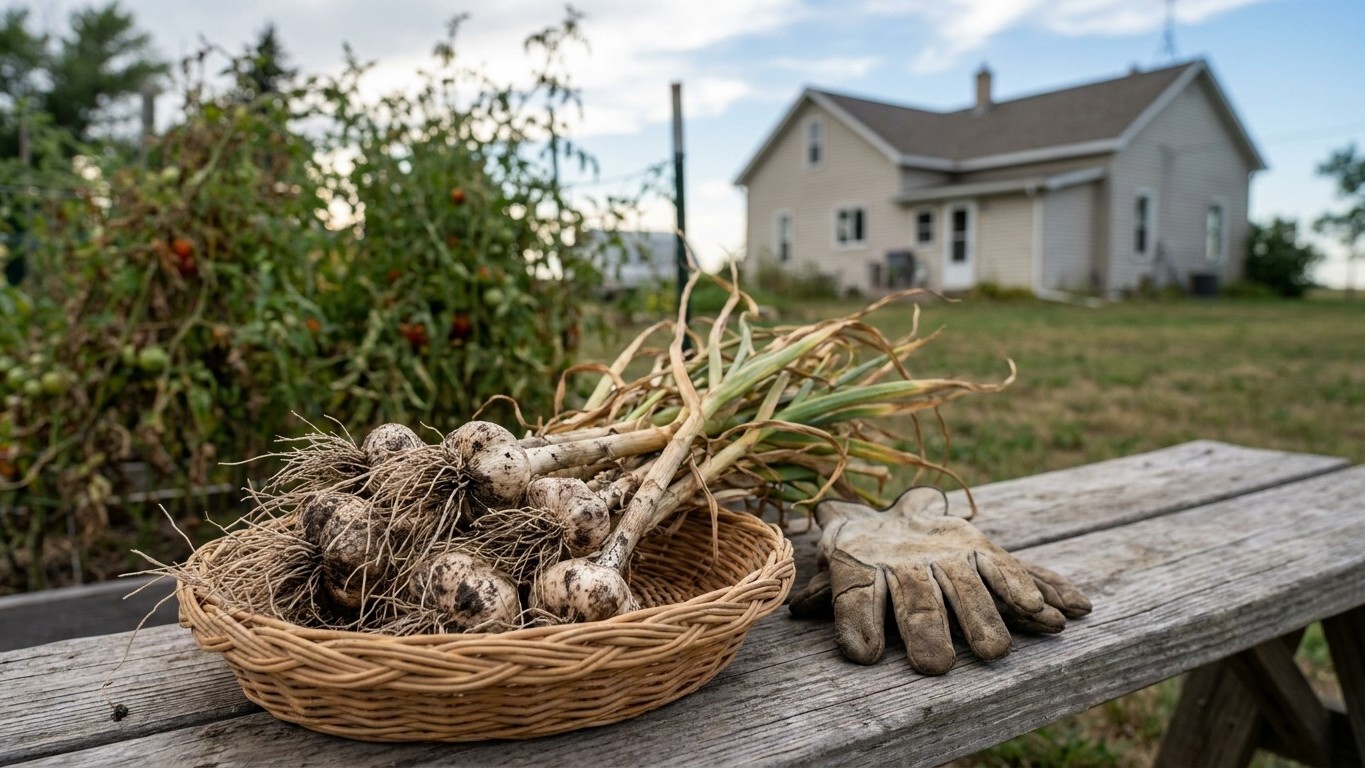

Maine growers plant garlic in September and then leave it alone for ten months, so the harvest window can feel sudden after all that waiting. Lift the bulbs when the lower leaves have browned off and four to six upper leaves are still green, which is usually earlier than a gardening book written for a milder state would have you guess. Pull one test bulb from the row, slice it open, and let what you see decide the day rather than a date circled on the calendar.
When garlic is ready to lift in Maine
Garlic set out according to Maine’s fall planting calendar spends the winter underground splitting into individual cloves, then pushes up leaves through spring and into early summer before bulbing up. Portland’s climate holds 30.4 weeks a year below 40°F, according to the University of Georgia Extension’s guide to garlic (publication C854), which comfortably clears the six to eight weeks of cold a planted clove needs to divide properly. Maine’s winter is never the limiting factor here, wherever in the state you planted. The variable that actually decides your harvest date is the weather from spring onward, and that shifts year to year and county to county.
Reading the plant instead of the calendar
The clearest signal is the leaves, not a number of days from planting. Garlic dies back from the bottom of the plant upward, and each green leaf roughly corresponds to a wrapper layer around the bulb underneath. A plant down to two or three green leaves is already shedding its protective coating and should come out soon. One still carrying seven or eight green leaves usually needs more time in the ground.
- Lower third to half of the leaves brown and dry
- Four to six upper leaves still green and upright
- Stem still firm at the base, not soft or collapsed
- Test bulb shows cloves separated cleanly under tight skins
Pull one bulb before you commit to digging the whole row. Slice it top to bottom. Cloves that fill the skin and pull apart cleanly mean the row is ready. A bulb that’s still a single undivided mass, or where the cloves are thin and loosely packed, earns another week or two before you touch the rest. Trust that cut bulb over a days-to-maturity figure printed on a seed order, since that number was counted from transplant in a trial planting somewhere else and drifts by a week or more with how the season actually runs here.
Curing it, and where to hang it here
Curing is the step that turns a fresh, wet bulb into something that will actually keep. It’s also the stage where growing garlic in a humid state like Maine parts ways with advice written for a drier climate, and it’s worth reading through Growing Garlic in Maine if you want the full season laid out before you get here.
Airflow matters more than heat
Hang the bulbs, or lay them out on screens, somewhere shaded, dry, and with air moving through it: a barn, an open shed, a covered porch with a fan running. Direct sun scalds the outer wrappers and can bake the cloves underneath before the inside has actually dried. Don’t wash the bulbs and don’t cure them in full sun. Leave the roots and stem attached and the soil brushed off but not scrubbed, and don’t trim anything until curing is finished.
Curing is done when the outer wrappers have gone papery and the neck, where the stem meets the bulb, feels dry and tight rather than fleshy when you squeeze it. Maine’s summer humidity slows this compared to a drier growing region, so give it more time than a catalog description written elsewhere would suggest, and check progress by feel rather than by a fixed number of days.
NOAA’s 1991-2020 climate normals put Portland’s first fall frost at October 9 to October 21, and that’s a midpoint, not a guarantee: in about half of all years frost arrives later than that window, and in the other half it comes sooner. Curing garlic usually wraps up well before that date range matters, but a cool, wet August can stretch the process, and gardeners inland or in northern Maine see their first frost earlier still, so build in some slack rather than cutting it close.
Storing it through a Maine winter
Where to actually put it
Once curing is finished, trim the roots close and cut the stem down to an inch or two above the bulb, or leave enough neck to braid if you’re working with a softneck type. Store the bulbs somewhere cool, dark, and dry with a little air movement, an unheated closet, a cellar corner well away from the furnace, or a mudroom that doesn’t freeze. Never store garlic in the refrigerator. The cold, damp air in there pushes cloves into early sprouting faster than a cool pantry shelf ever would, and by midwinter you’ll find green shoots forcing their way out through the wrapper.
Softneck versus hardneck in the pantry
Softneck types such as Early Red Italian and Inchelium Red generally hold up longer in storage than hardnecks do, a difference that traces back to their tighter, more numerous wrapper layers. Hardneck types like German White and Chesnok Red tend to soften and sprout sooner, so it makes sense to work through those first and hold the softnecks for later in the winter.
Check the stored bulbs every few weeks. Pull out anything that’s gone soft, moldy, or started sprouting before it can affect its neighbors. A single deteriorating bulb sitting in a bin of good ones speeds up spoilage in whatever it’s touching, so isolating the problem early matters more than any storage temperature you can hit exactly.
What goes wrong here
Storage rot traced back to the field
Most of what shows up in the storage bin actually started in the ground months earlier. White rot (Sclerotium cepivorum) and fusarium basal rot (Fusarium oxysporum f. sp. cepae) are the two soil-borne diseases most relevant here, according to the University of California’s UC IPM Pest Management Guidelines for Onion and Garlic (UC ANR Publication 3453). Using Portland’s monthly mean air temperatures as a rough stand-in for soil temperature, which the published thresholds are actually based on and which lags air by weeks and swings less, white rot’s published 50-75°F range overlaps four months of the growing season: September, May, June, and July, two of which sit within its narrower optimum band. Fusarium basal rot’s wider 59-90°F range overlaps three months: September, June, and July.
None of that means either disease is guaranteed, or that it’s ruled out in the months it misses. A single infected clove planted in fall carries the pathogen regardless of what the thermometer says that month. A monthly average also hides real swings, since a June averaging 65°F still includes days near 80. And one weather station near Portland doesn’t describe conditions in Aroostook County or Down East, where the growing season runs on a different schedule entirely.
Basal rot in particular tends to show up first in storage rather than the field, when a bulb that looked sound at curing turns soft and sour-smelling at the base weeks later. Pull those out on sight, since it spreads by contact with whatever else is in the same bin.
Pests documented for Maine gardens
University of Maine Cooperative Extension documents seedcorn maggot (Delia platura) as active in Maine vegetable plantings, and it’s the pest on that list most relevant to garlic, attacking cloves and young shoots underground soon after fall planting rather than at harvest time. See What Eats Garlic in Maine, and When for the specific windows when newly planted cloves are at risk, since by the time you’re lifting and curing bulbs that threat has largely passed. If something in your row or bin doesn’t match what’s covered here, University of Maine Cooperative Extension (extension.umaine.edu) is the right place to check before you assume the worst.
Common questions
How do I know it’s actually ready and not just stressed from dry weather?
Drought stress usually browns leaves all at once and unevenly across the row, while ripening garlic browns from the bottom up in a fairly even pattern plant to plant. When in doubt, pull the one test bulb and cut it open. A stressed but unripe bulb still shows a single undivided mass inside, not separated cloves under tight skins.
Should I wash the dirt off before curing?
No. Brush off loose soil by hand and leave the rest. Washing introduces moisture right where you’re trying to remove it, and wet bulbs cure slower and are more prone to the storage rots discussed above.
Can I store garlic in the fridge over winter?
You can, but it works against you. Refrigerator temperatures and humidity encourage cloves to sprout well before spring, faster than they would on a cool pantry or closet shelf. Save the fridge for cloves you’ve broken off to plant, not for bulbs meant to eat through winter.
What’s the real difference in curing hardneck versus softneck garlic here?
The process is the same for both, shade, airflow, and patience, but softneck bulbs generally cure a bit faster because their necks are thinner and dry down sooner. Hardneck bulbs, with their thicker stiff stem running through the center, can feel dry on the outside while the neck core is still holding moisture, so check the neck itself, not just the outer wrapper, before you call a hardneck done.