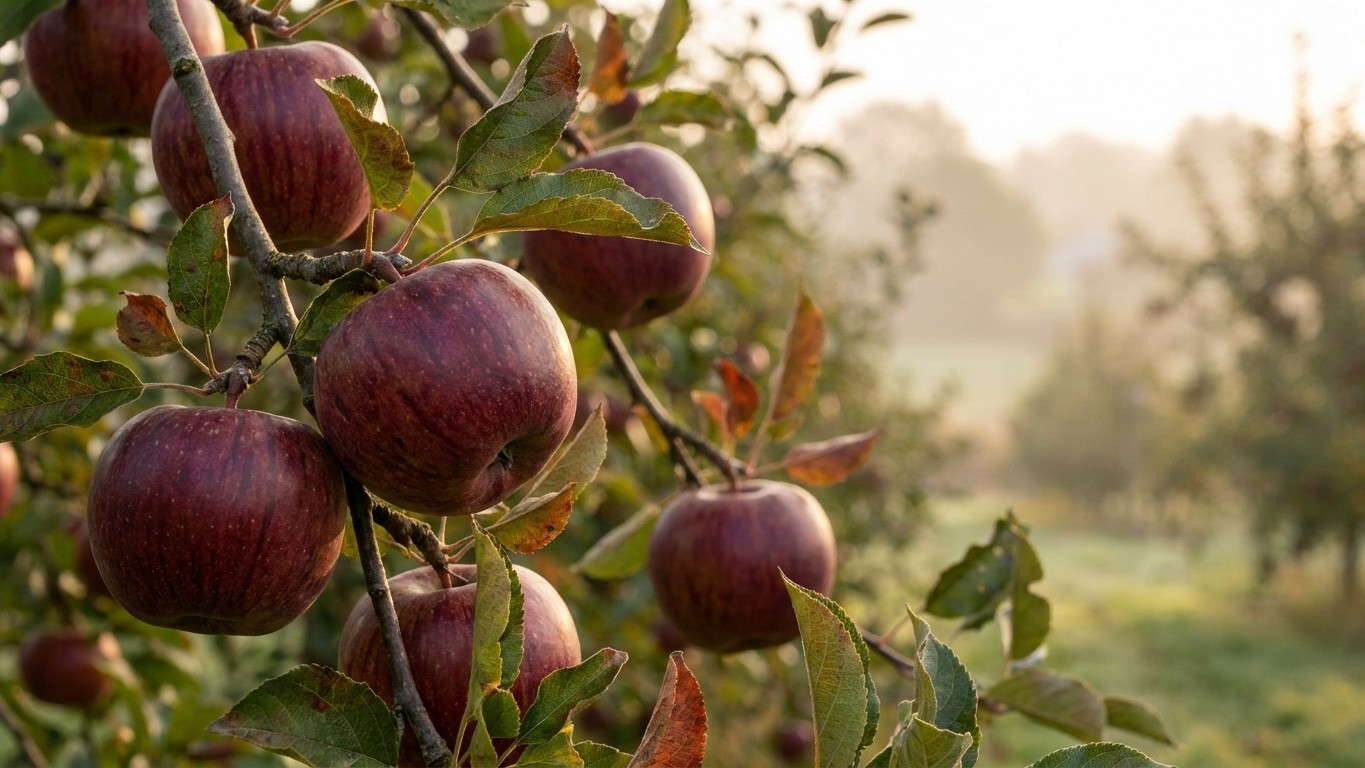

South Carolina apples are ready when the fruit’s background color shifts from green to yellow or cream and the flesh gives slightly under thumb pressure, not on a fixed date. In the Lowcountry near Charleston, that stage often arrives by midsummer for low-chill varieties. In the Upstate, at higher elevation, the same stage can wait until September or October. How long the fruit then keeps once picked depends almost entirely on which variety you’re holding.
When apples are ready to pick in South Carolina
The calendar is a poor guide here because two very different growing conditions sit inside one state line. Charleston’s coldest month averages a daily minimum of 38.9°F, according to NOAA NCEI Climate Normals for 1991-2020. That’s a mild winter by apple standards, and it means Lowcountry trees accumulate relatively little winter chill before spring. Apple varieties bred for low-chill climates respond to that shortage by breaking dormancy early, which pushes bloom forward on the calendar.
That early bloom runs straight into the region’s frost window. NOAA’s 1991-2020 Climate Normals put the last spring freeze at the Charleston-area airport station (USW00013880) somewhere between February 28 and March 17, the range where a 32°F freeze has a 30 to 70 percent chance of still happening. A low-chill tree that flowers into that window is gambling with its whole crop. Growers here should treat a late-February warm spell with suspicion rather than relief, because the trees that respond to it fastest are the ones most exposed if cold air returns.
Upstate South Carolina, at elevation and further from the coast, runs on a tighter, later frost calendar at both ends of the year, according to the same NOAA dataset’s regional pattern. No station-level figure for an Upstate town is published in the source used here, so exact local dates for places like Oconee County aren’t stated as fact in this article. What can be said is that colder Upstate winters accumulate more chill hours, which lets growers there plant familiar mid- and high-chill varieties without worrying about premature bloom the way Lowcountry growers do.
Reading the fruit, not the month
Once bloom has happened and fruit has set, ripeness shows up in the fruit itself. Background skin color moving from green toward yellow, seeds turning from white to brown, and the fruit separating from the spur with a gentle twist and lift are the three signs worth checking together. Early-season varieties typically finish ripening 60 to 100 days after petal fall; late-season types can run 140 to 160 days. Sampling one apple from the sunny, outer part of the canopy tells you more than staring at a calendar ever will.
Which ones keep, and which must be eaten
Storage life in South Carolina splits cleanly along the same line as chill requirement, and that’s not a coincidence. Low-chill varieties developed for the Deep South, the kind Lowcountry growers rely on because winters there don’t get cold enough to satisfy traditional apple types, tend to have softer flesh and a faster metabolic rate after harvest. They’re bred to fruit reliably in a mild climate, not to sit in a bin until March.
Firmer, later-maturing varieties built for cooler regions hold their texture and sugars far longer under refrigeration. These are the types more common in the Upstate, where enough winter cold accumulates to grow them without the early-bloom frost gamble that plagues low-chill trees near the coast.
| Variety type | Typical region grown | Storage character |
|---|---|---|
| Low-chill, early-blooming | Lowcountry, coastal plain | Softens quickly; best eaten within a few weeks of harvest |
| Mid-chill | Midlands, transition zones | Moderate storage life under refrigeration |
| High-chill, late-maturing | Upstate, higher elevation | Firm-fleshed; holds for several months when kept cold |
This is the trade-off worth stating plainly rather than dancing around: a low-chill variety flowers early because it needs less accumulated cold to break dormancy, and early flowering is exactly what puts it in the path of a late frost during that February 28 to March 17 window. Late-blooming, long-storing varieties simply aren’t an option on the same mild winters that make low-chill trees necessary. In the Lowcountry, growers are choosing the frost risk over no crop at all, and that’s the right trade to make there, since the alternative is a tree that may never flower reliably. Upstate growers, working with more chill and a later spring freeze pattern, get to have both hardier bloom timing and better-keeping fruit.
Storing them through a South Carolina winter
A root cellar or unheated garage is the traditional answer to long apple storage, and it works fine in genuinely cold climates. It’s a weaker plan across most of South Carolina. With Charleston’s coldest month averaging a daily minimum of 38.9°F, an unheated space near the coast rarely holds the steady 30 to 35°F that firm, late-keeping apples need for extended storage. Refrigeration, not a garage shelf, is the realistic tool for most of the state.
The basics don’t change by region: store apples at 30 to 35°F with high humidity, ideally in perforated plastic bags or a covered container that slows moisture loss without trapping condensation. Keep them away from onions, potatoes, and other ethylene-sensitive produce, since apples release ethylene gas that speeds ripening and rot in whatever sits near them. Check the batch every couple of weeks and pull any apple that’s gone soft or shows a bruise. One bad apple genuinely does affect its neighbors here, through the ethylene it gives off as it breaks down.
Upstate growers at higher elevation get colder nights through fall and into winter, which may extend the window when an unheated but insulated space stays cold enough for short-term storage. No specific temperature figures for an Upstate storage location are published in the sources used here, so treat that as a seasonal advantage rather than a guarantee, and check an actual thermometer in the space before trusting it with a winter’s worth of fruit.
Low-chill varieties common in the Lowcountry are the ones least suited to long storage regardless of temperature control. Their soft flesh and higher respiration rate mean even ideal refrigeration only buys a few extra weeks, not months. Planning to eat or process that fruit soon after harvest, rather than counting on it to last through winter, matches the variety to a realistic use.
What goes wrong here
The most common failure in the Lowcountry isn’t a pest or a disease. It’s planting a variety that needs more winter chill than the coastal climate provides. The tree grows, leafs out, and simply never flowers well, or flowers so lightly that fruit set is disappointing year after year. That’s not a growing mistake so much as a variety mismatch, and the fix is choosing rootstock and scion combinations suited to a mild-winter climate from the start.
The second failure runs the other direction: a low-chill variety blooms early during a warm February stretch, then a freeze inside the February 28 to March 17 window wipes out the flowers or young fruit. This isn’t rare in a Lowcountry orchard. It’s the built-in risk that comes with growing varieties suited to a place where the coldest month only averages 38.9°F at night. Watching short-range forecasts during bloom, rather than trusting the calendar, is the only real defense once a low-chill variety has started to flower.
The third mistake happens after harvest, not before. Growers assume a garage or shed will hold apples through winter the way it might in a colder state, then find the fruit soft and spotted by January. Given how mild South Carolina’s coldest month runs on average, that’s an easy assumption to make and a costly one to test with an entire harvest. Refrigerated storage, checked with an actual thermometer, is the more honest bet across most of the state.
For variety recommendations suited to a specific county or elevation, Clemson Extension is the land-grant service responsible for that kind of local guidance in South Carolina, and it’s a better source than a general planting chart for matching a tree to a specific site.
Common questions
What month do apples ripen in South Carolina?
There’s no single month for the whole state. Low-chill varieties in the Lowcountry can finish as early as midsummer, while high-chill varieties at Upstate elevation often aren’t ready until September or October. The fruit’s background color and seed color are better indicators than the date on a calendar.
Can you grow apples in the South Carolina Lowcountry?
Yes, with low-chill varieties specifically selected for mild winters, since Charleston’s coldest month averages only 38.9°F at night, well short of what traditional apple varieties need to flower well. Those low-chill trees bloom early and carry real frost risk during the region’s late-winter freeze window.
How long do South Carolina apples keep in the fridge?
It depends on the variety. Low-chill types common in the Lowcountry hold for only a few weeks even under good refrigeration, because they’re softer and metabolize faster after picking. Firmer, later-maturing types grown in the Upstate can hold for several months at 30 to 35°F with high humidity.
Does South Carolina’s Upstate have a different apple season than the coast?
It does. Higher elevation and cooler winters in the Upstate accumulate more winter chill, allowing hardier, later-blooming varieties that aren’t a good fit near the coast. No station-specific frost dates for Upstate towns are published in the sources behind this article, but the region is documented as running several weeks tighter at both ends of the frost season than the Charleston-area reference station.