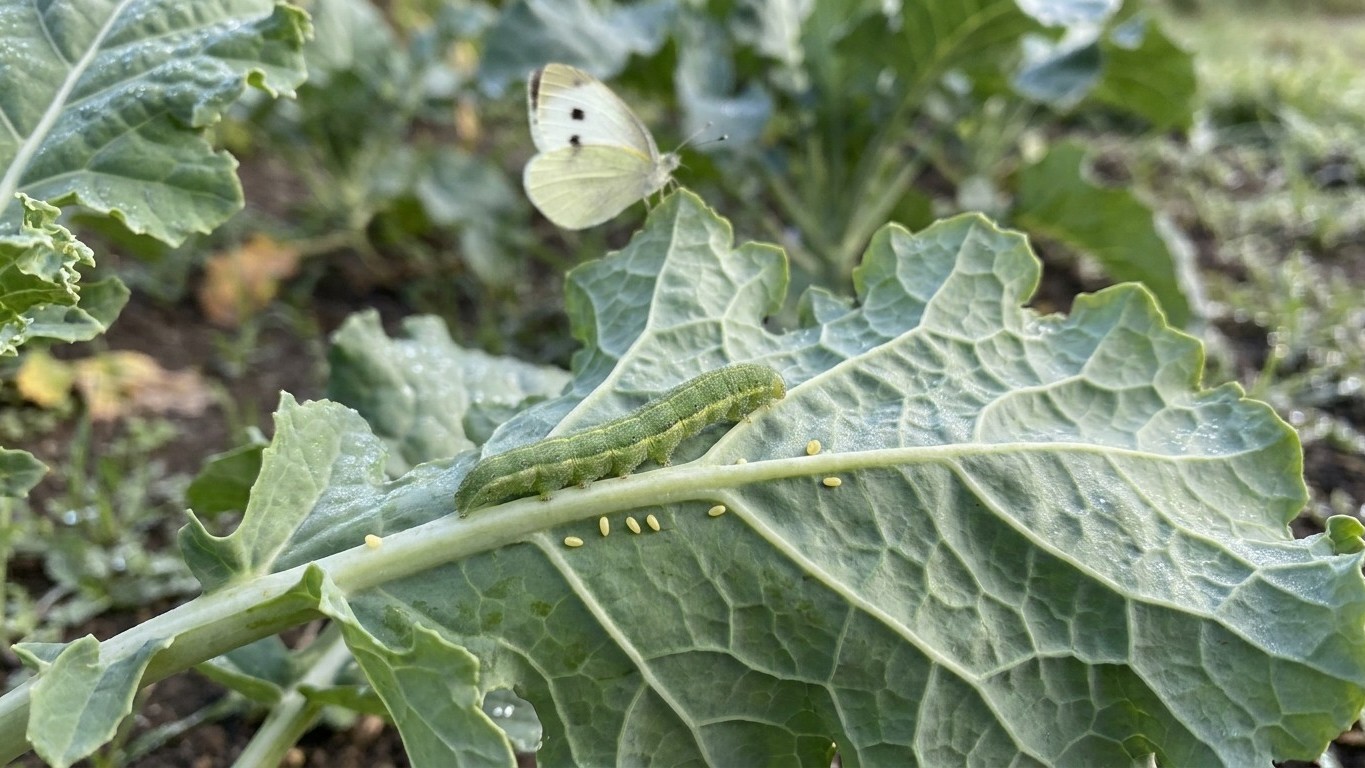

The imported cabbageworm starts showing up in British Columbia gardens as early as April on the South Coast and Vancouver Island, and as late as May or June in the Interior and northern valleys. It stops the way most cole-crop pests stop: floating row covers installed before the white butterflies arrive, weekly scouting for eggs and small larvae, and a targeted spray of Bacillus thuringiensis var. kurstaki (Btk) when caterpillars are found chewing holes in cabbage, kale, or broccoli leaves.
What the Imported Cabbageworm Looks Like in the Garden

The adult is a small white butterfly, roughly 1.5 to 2 inches across the wings, with one or two black spots on each forewing. Gardeners across the province often mistake it for the cabbage moth or the diamondback moth, but the imported cabbageworm butterfly flies during the day, drifting low over garden beds in a way that’s easy to spot while watering or weeding.
The larva is the stage that actually does the damage. It’s velvety green with a faint yellow stripe running down its back, growing to about an inch long before it pupates. Unlike the cabbage looper, which arches its body into a loop as it moves, the imported cabbageworm crawls in a straight line and tends to sit tight along leaf veins where its color blends in almost perfectly.
Eggs are the giveaway for gardeners who want to catch trouble early. They’re pale yellow, shaped like tiny bullets, and laid singly on the underside of leaves, usually along the midrib. A single female can lay several hundred eggs over her lifespan, which is one reason populations can spike fast once the first generation gets established in a bed of brassicas.
When It Shows Up Across British Columbia
Timing depends heavily on which part of the province a garden sits in, since BC’s climate swings from coastal rainforest to semi-arid valley within a few hours’ drive.
Coastal Regions: Lower Mainland, Vancouver Island, Sunshine Coast
Mild, wet winters along the coast mean pupae can survive in garden debris or nearby wild mustard plants and emerge earlier than almost anywhere else in Canada. First-generation adults often appear by mid-April, with caterpillar damage showing up on early-planted brassicas by late April or early May. Because the coastal growing season stretches long and frost-free, this region typically sees three to four overlapping generations before fall, which is why cabbageworm pressure on the coast tends to build steadily rather than arriving in one clean wave.
Interior Valleys and the Okanagan
Colder winters delay emergence in the Interior. Gardeners in the Okanagan, Thompson-Nicola, and Kootenay regions usually don’t see the first butterflies until mid-May, and damage on transplanted seedlings often doesn’t show until late May or early June. Hot, dry summers in these valleys can actually slow the pest down somewhat compared to the coast, but two to three generations are still common, with the second generation in July often causing the most visible feeding damage on late cabbage and broccoli plantings.
Northern BC, including the Peace River region, has a shorter window overall. A single generation, sometimes stretching into a partial second one, is typical there, tied to a compressed growing season that runs roughly June through August.
Life Cycle and Why Generations Matter
From egg to adult butterfly, the imported cabbageworm completes its cycle in three to six weeks depending on temperature. Warmer weeks speed things up, which is exactly why coastal gardens with mild spring temperatures start cycling through generations faster than Interior gardens still shaking off frost.
Each new generation means a fresh wave of egg-laying females looking for brassica leaves. This overlap is the real challenge for BC growers: by midsummer, a single cabbage plant can host eggs, tiny newly hatched larvae, and half-grown caterpillars all at once, making a single treatment pass far less effective than a repeated scouting-and-treatment routine every seven to ten days through the growing season.
The pest overwinters as a pupa, typically attached to plant debris, fence posts, or nearby structures near the original host plant. Clearing garden beds of old brassica stems and leaves in fall removes a meaningful chunk of the overwintering population before it gets a chance to emerge the following spring.
What Actually Stops Imported Cabbageworm
No single tactic wipes this pest out completely, but a few methods consistently work when used together and applied early.
Floating row covers installed at planting time, before the first butterflies appear, are the single most reliable physical barrier. Since the adult needs direct contact with leaves to lay eggs, a properly sealed cover (edges buried or weighted down) keeps females out entirely. The catch is timing: covers only work if they go on before eggs are already present, and they need to come off briefly during bloom if the crop requires pollination, which most brassicas don’t since they’re grown for leaves or heads rather than fruit.
Bacillus thuringiensis kurstaki remains the standard biological spray for active infestations. It’s a naturally occurring soil bacterium that targets caterpillars specifically, leaving bees, ladybugs, and other beneficial insects unharmed. Btk works best on young larvae, so spraying at the first sign of small feeding holes, rather than waiting until leaves are skeletonized, produces far better results. It needs to be reapplied after rain and generally holds up for five to seven days before losing effectiveness in sunlight.
Hand-picking sounds low-tech, but for small backyard plots it’s genuinely effective. Checking the undersides of leaves twice a week and crushing eggs or removing larvae by hand can keep populations under control on a handful of plants without any spray at all.
Natural predators and parasitoids already do a lot of the work in established BC gardens. Several parasitic wasp species, including Cotesia glomerata, lay their own eggs inside cabbageworm larvae, eventually killing the host. Gardens with diverse flowering plants nearby, especially dill, yarrow, and alyssum, tend to support higher populations of these wasps because the adult wasps need nectar sources to survive between egg-laying bouts. Birds and predatory ground beetles also pick off a share of eggs and small larvae, which is one argument against broad-spectrum insecticides that wipe out these allies along with the pest.
Crop rotation and companion planting round out the approach. Moving brassicas to a different bed each year makes it harder for emerging spring butterflies to find host plants immediately, buying a little time before populations build. Interplanting with strongly scented herbs like thyme or sage can also make it harder for egg-laying females to locate host leaves by scent, though this works better as a supplement to covers and scouting than as a standalone fix.
Crops at Highest Risk in BC Gardens
Any plant in the mustard family is fair game, but some crops take heavier hits than others. Cabbage, kale, and Brussels sprouts tend to suffer the most visible damage because their broad, dense leaves give larvae plenty of cover while they feed. Broccoli and cauliflower are also common targets, particularly when caterpillars work their way into developing heads, where they’re notoriously hard to spot and wash out before harvest.
Backyard growers in BC sometimes forget that ornamental flowering kale and stock (a common bedding plant) are brassicas too, and both can serve as unintentional breeding grounds that keep populations going near vegetable beds. Wild mustard and other weedy crucifers growing along fence lines or ditches do the same job in rural and semi-rural parts of the province, acting as a reservoir population even in years when a garden itself stays pest-free.
One detail that surprises a lot of gardeners: the imported cabbageworm isn’t native to North America at all. It was first documented in Quebec in the 1860s after arriving from Europe, and it spread west across the continent over the following decades, reaching British Columbia well before most of the pest-management tools gardeners rely on today were ever developed. More than 150 years later, it’s still one of the most consistently reported cole-crop pests in coastal and Interior gardens alike, which says less about any single control method failing and more about how well this insect adapted to a climate it was never originally built for.