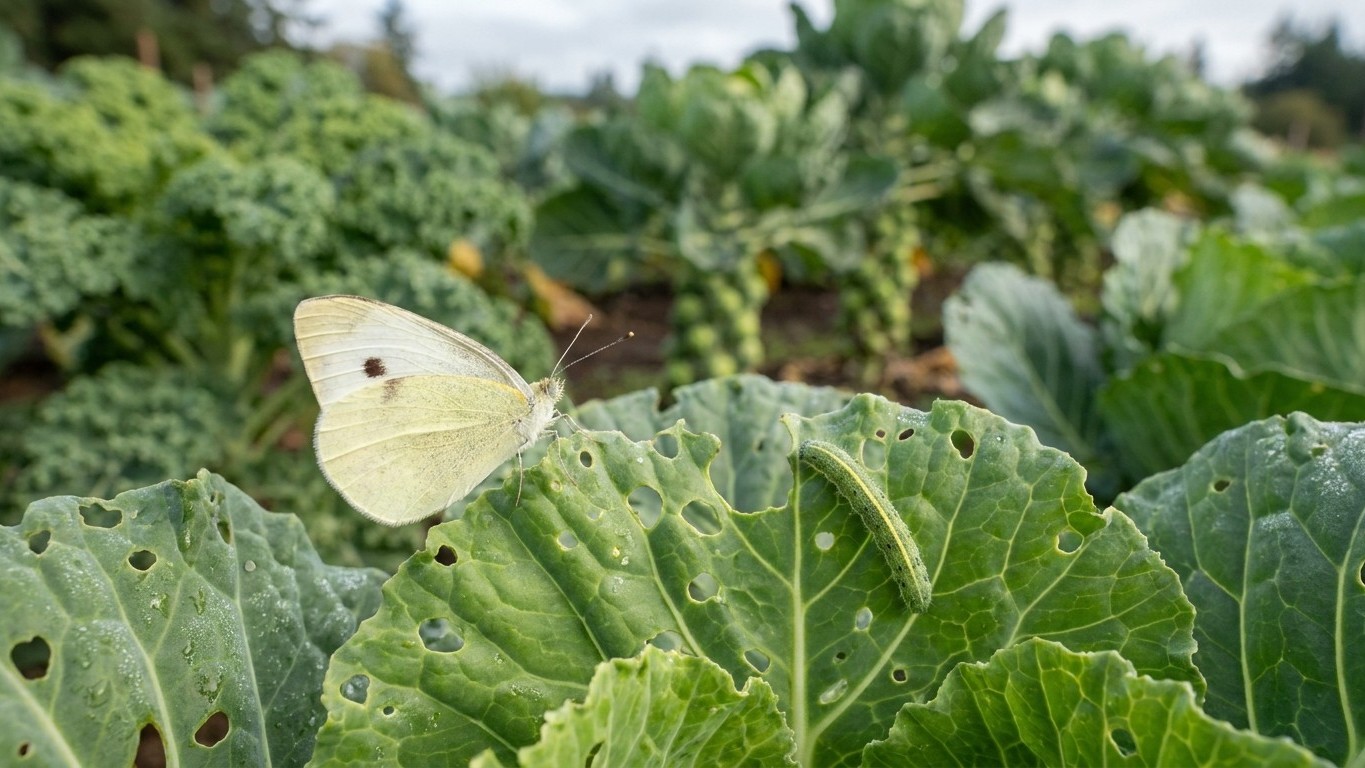

Small white butterflies fluttering over your broccoli patch in May aren’t just pretty garden visitors. They’re imported cabbageworm moths laying eggs, and within a week those eggs become velvety green caterpillars chewing ragged holes through your kale, cabbage, and Brussels sprouts. In Oregon, this pest shows up as early as April in the Willamette Valley and keeps producing new generations clear through October, making it one of the most persistent brassica pests west of the Cascades.
The good news: control is straightforward if you catch it early and understand the timing. The bad news: skip a week of monitoring during peak season and you can lose an entire planting of cole crops to caterpillar damage that looks worse than it sounds but adds up fast.
What Imported Cabbageworm Actually Looks Like

The adult is a white butterfly with a wingspan around 1.5 to 2 inches, distinguished by one or two black spots on each forewing (males have one, females typically have two). Gardeners often confuse it with cabbage moths or simply call it “the white butterfly problem,” but Pieris rapae is the specific species responsible for most brassica damage in Oregon gardens and commercial fields alike.
The larvae are the real culprits. They emerge pale and tiny, then grow into inch-long, velvety green caterpillars with a faint yellow stripe running down the back. That green coloring is excellent camouflage against cabbage and kale leaves, which is why infestations often go unnoticed until the damage is already extensive. Unlike cabbage loopers, which arch their backs when they move, imported cabbageworms crawl in a straight line, a small but useful identification detail if you’re trying to tell the two pests apart in the field.
Eggs and Frass: The Early Warning Signs
Before you see caterpillars, look for eggs. They’re tiny, yellowish, and bullet-shaped, laid singly on the undersides of leaves near the veins. A female can lay several hundred eggs over her lifetime, spreading them across multiple plants rather than clustering them in one spot. Once larvae hatch, they leave behind small dark green pellets of frass (caterpillar droppings) on leaf surfaces, often the first visible clue that feeding has started even before the holes become obvious.
When Imported Cabbageworm Shows Up in Oregon
Timing varies noticeably across the state’s growing regions, and that matters for anyone planning a monitoring schedule.
In the Willamette Valley, where most of Oregon’s vegetable gardening happens, overwintering pupae begin emerging as adults once daytime temperatures hold consistently above 60°F, usually mid to late April. That first generation lays eggs through May, and the resulting caterpillars do their damage through early June. Because the pest can complete a full generation in about three to four weeks under favorable conditions, the Willamette Valley typically sees three to five overlapping generations between April and October. This overlap is what makes the pest feel constant rather than seasonal. You’re rarely dealing with a single wave.
Coastal Oregon runs cooler and foggier, which slows larval development and pushes the pest’s active window slightly later and more compressed. Gardeners in Newport or Coos Bay often see peak pressure in July and August rather than the June surge common inland.
East of the Cascades, in the high desert around Bend or Pendleton, the shorter frost-free season and larger day-to-night temperature swings generally limit imported cabbageworm to two or three generations. Adults emerge later, often not until early May, and cold snaps in September tend to knock populations down faster than they do in the milder valley climate.
Oregon State University Extension notes that monitoring should begin as soon as brassica transplants go in the ground, since even a single generation of undetected caterpillars can strip young transplants before they establish. For details on regional pest timing and degree-day models, the OSU Extension imported cabbageworm profile is the most reliable Oregon-specific reference available.
Which Plants Are at Risk
Imported cabbageworm feeds almost exclusively on brassicas, but that category covers more of the garden than most people realize. Cabbage, broccoli, cauliflower, kale, collards, Brussels sprouts, and kohlrabi are all preferred hosts. Mustard greens and turnips get hit too, and even ornamental ones like flowering kale and stock aren’t immune. Nasturtiums, interestingly, are a secondary host and sometimes get planted deliberately as a trap crop, though results with that strategy are mixed and shouldn’t replace direct monitoring.
Damage shows up as irregular holes in leaves, starting small and expanding as larvae grow. Young transplants can be defoliated entirely within days if a generation hatches undetected, while mature plants tend to tolerate moderate feeding on outer leaves without major yield loss. The real economic damage happens when larvae bore into the heads of cabbage or the florets of broccoli and cauliflower, since contamination there makes the crop unmarketable even if the plant survives just fine.
What Actually Stops Imported Cabbageworm
No single method eliminates this pest for the whole season. Effective control in Oregon gardens usually combines physical exclusion, biological agents, and targeted intervention timed to the pest’s generation cycle.
Row Covers: The Simplest Fix for Home Gardens
Floating row covers placed over brassica beds at transplant time physically block adult butterflies from laying eggs in the first place. This is the single most effective tool for home gardeners because it prevents the problem rather than treating it after the fact. Covers need to go on before the first adults appear in spring, meaning mid-April in the Willamette Valley, and stay secured at the edges since female moths will find any gap. The tradeoff is that covers must come off for pollination if you’re growing brassicas for seed, though for crops harvested as leaves or heads, that’s rarely an issue.
Bacillus thuringiensis (Bt): The Go-To Biological Control
Bt kurstaki, a naturally occurring soil bacterium sold under various commercial names, is the standard treatment once caterpillars are present. It’s selective, meaning it targets caterpillars specifically without harming bees, beneficial insects, or people, which makes it a favorite for both organic growers and conventional home gardeners. Bt needs to be applied when larvae are young and actively feeding, since it works by disrupting the digestive system after ingestion. It breaks down quickly in sunlight, so reapplication every seven to ten days during active feeding periods is typically necessary, and coverage on the undersides of leaves matters as much as the tops since that’s where young larvae concentrate.
Parasitic Wasps: Nature’s Backup System
Several species of tiny parasitic wasps, particularly Cotesia glomerata, lay their own eggs inside cabbageworm larvae. The wasp larvae develop inside the caterpillar and eventually kill it, providing a natural check on populations that’s already present in most Oregon growing regions without any introduction needed. Avoiding broad-spectrum insecticides preserves these wasp populations, which is one more reason targeted Bt applications tend to outperform general-purpose sprays over a full season. Gardeners who see small yellow silk-like cocoons clustered near a dead or dying caterpillar are looking at evidence this biological control is already working in their favor.
Handpicking and Garden Hygiene
For small home plots, checking the undersides of leaves every few days and removing eggs and caterpillars by hand remains a legitimate strategy, especially early in the season when populations are still low. Clearing old brassica plant debris after harvest also matters, since it removes overwintering sites for pupae and reduces the size of the first spring generation. This single fall cleanup step is often skipped, yet it directly affects how many butterflies emerge the following April.
Putting the Timing and Control Together
The practical takeaway for Oregon gardeners is to treat late April through early June as the critical monitoring window in the valley, adjust that window later for coastal and high desert regions, and layer defenses rather than relying on one method. Row covers prevent the first wave. Bt handles what gets through. Parasitic wasps and reduced pesticide use keep pressure down across the rest of the season. Skipping any one of these doesn’t doom a crop, but combining all three is what separates a broccoli harvest full of holes from one that makes it to the kitchen intact.
One detail worth knowing: imported cabbageworm populations in the Pacific Northwest have shown some resistance to certain older insecticide classes after decades of agricultural use, which is part of why Bt and biological controls have become the preferred approach rather than a fallback. Chemical options still exist for severe commercial infestations, but for the scale of a backyard garden, they’re rarely necessary and often do more harm to beneficial insects than good.