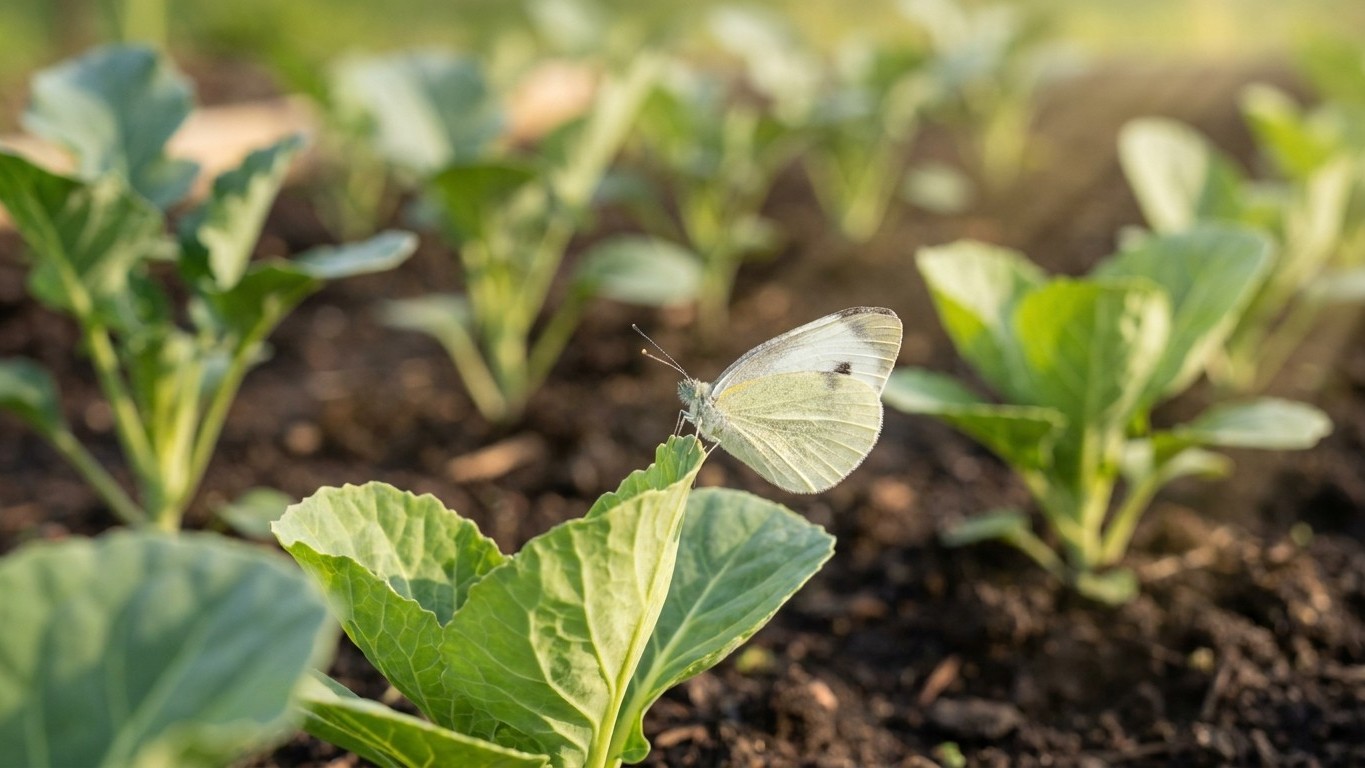

Imported cabbageworm shows up in Delaware as early as mid-April, when the first white butterflies emerge from overwintering pupae and start laying eggs on young cole crops. From there, the pest cycles through three to four overlapping generations before frost, with pressure peaking in June and again in September. The tools that actually stop it are timed Bacillus thuringiensis (Bt) sprays, floating row covers installed before the first flight, and a native parasitic wasp that many Delaware gardeners never realize is already working in their favor.
When Imported Cabbageworm Arrives in Delaware’s Growing Season

Delaware sits mostly in USDA hardiness zones 7a and 7b, which gives the state a long, humid growing season stretching from mid-April to late October. That window matters because imported cabbageworm (Pieris rapae) doesn’t survive winter as an adult. It overwinters as a pupa, often tucked into old crop debris, fence posts, or the undersides of greenhouse benches. Once daytime temperatures hold steady in the low 50s for a stretch, usually by the second or third week of April in Sussex County and a bit later inland, the adult butterfly emerges and starts hunting for cabbage-family plants to lay eggs on.
Each generation takes roughly three to five weeks from egg to adult, depending on heat. That means a grower in Georgetown or Milford can expect a first wave of larval feeding in early May, a second and often heavier wave in June, a lull during the hottest part of July when populations dip, then a resurgence in September as fall broccoli and kale get planted. Northern New Castle County runs slightly cooler, so timelines shift about a week later than the coastal plain.
Sussex County grows the bulk of Delaware’s commercial cole crops, and that concentration of host plants is exactly why cabbageworm pressure there tends to run higher than in the rest of the state. Backyard gardeners near those farms often see butterflies show up earlier simply because there’s more habitat feeding the local population.
Spotting Imported Cabbageworm Versus Its Look-Alikes
The larva is velvety green, about an inch long at maturity, with a faint yellow stripe running down its back and tiny yellow dashes along each side. It moves in a slow, straight crawl rather than the looping motion people associate with other cabbage pests. That distinction matters because Delaware gardens commonly host three caterpillars that all target the same plants but respond differently to control.
- Imported cabbageworm: solid green, single faint stripe, crawls normally, chews ragged holes anywhere on the leaf.
- Cabbage looper: pale green with two thin white lines, arches its back into a loop when it moves, feeds from the leaf edges inward.
- Diamondback moth larva: much smaller, tapered at both ends, tends to skeletonize leaves rather than chew full holes.
The adult butterfly is easy to confirm: white wings with one or two black spots, fluttering low over the garden bed rather than flying in a straight line. If you see that pattern of flight in mid-morning sun during late April, eggs are likely already on the undersides of your kale or cabbage leaves within a day or two.
Where the Damage Shows Up First
Larvae head straight for the plants Delaware home gardeners and small farms grow most: cabbage, broccoli, kale, collards, and Brussels sprouts. Young larvae start feeding on outer leaves, leaving small, irregular holes that look almost like they were punched with a nail. As they grow, they move toward the plant’s center, and on cabbage that means boring directly into the developing head. That’s the damage that actually costs a harvest, because a few chewed outer leaves are cosmetic, but a tunnel through the heart of a cabbage head makes the whole thing unsellable or unusable.
Frass, the small greenish-brown pellets larvae leave behind, is often the first clue something’s wrong, especially since the caterpillars themselves blend in so well with the leaf color. Check the underside of outer leaves and the crevices where leaves fold against the stem. That’s where both eggs and young larvae hide from birds and from casual inspection.
Kale and collards, both staples in Delaware home gardens and at farmers markets in Kent and Sussex counties, tend to show damage faster than cabbage simply because their leaves are more exposed and thinner. A single generation of larvae can strip a young kale planting down to lace-like remnants within two weeks if left unchecked.
What Actually Stops Imported Cabbageworm
The most reliable single tool remains Bacillus thuringiensis var. kurstaki, sold under several brand names as a biological insecticide. Bt works by disrupting the digestive lining of caterpillars after they eat treated leaves, and it’s selective enough that it doesn’t harm bees, birds, or beneficial predator insects. The catch is timing: Bt breaks down within a few days of UV exposure and needs to be reapplied after heavy rain. It also only works on larvae that are actively feeding, so spraying before eggs hatch does nothing. Scouting weekly starting in late April, then applying Bt as soon as small green caterpillars appear, keeps damage well below the threshold that ruins a crop.
Floating row covers, installed right after transplanting and sealed at the soil line, physically block the adult butterfly from laying eggs in the first place. This works especially well for spring plantings, since row covers can come off once temperatures climb into the 80s and the risk period narrows. For fall crops planted in August and September, covers again make sense because that’s exactly when the season’s second big flight of butterflies is active.
Biological control already does more work than most Delaware gardeners realize. Cotesia glomerata, a small parasitic wasp native to the region, lays its eggs inside cabbageworm larvae. The wasp larvae develop inside the caterpillar and eventually kill it, and a healthy population of this wasp can suppress an outbreak without any spraying at all. Avoiding broad-spectrum insecticides preserves this natural check, since those products kill the wasp along with the pest it controls.
Crop rotation and fall cleanup round out an effective approach. Removing old cole crop debris after harvest eliminates overwintering sites for pupae, and rotating cabbage-family plantings to a different bed each year reduces the concentration of host material that draws egg-laying females back to the same spot. None of these steps work in isolation as well as they work together: row covers reduce the initial egg load, Bt handles what gets through, and parasitic wasps clean up survivors.
A Practical Weekly Routine During Peak Flight
During the two heaviest flight periods, mid-May through June and again in September, a five-minute check of the underside of a few leaves per plant catches most infestations before they spread. Look for single, pale yellow eggs shaped like tiny bullets standing on end. One egg per leaf is common; a female cabbageworm rarely clusters eggs the way some other moths do, which makes early detection a bit more tedious but also means one missed egg won’t turn into a dozen larvae overnight.
Delaware’s coastal humidity actually works in the gardener’s favor here. Bt performs better in the region’s typical summer humidity than it would in a drier climate, since the product stays active on leaf surfaces slightly longer before breaking down.
Home gardeners in New Castle County sometimes report fewer cabbageworm problems overall compared to Sussex, and the reason likely has less to do with pest biology and more to do with planting density. Smaller, scattered backyard plots simply present less concentrated host material than the commercial cole crop fields further south, which means the butterflies have a harder time finding enough plants in one place to sustain multiple heavy generations.