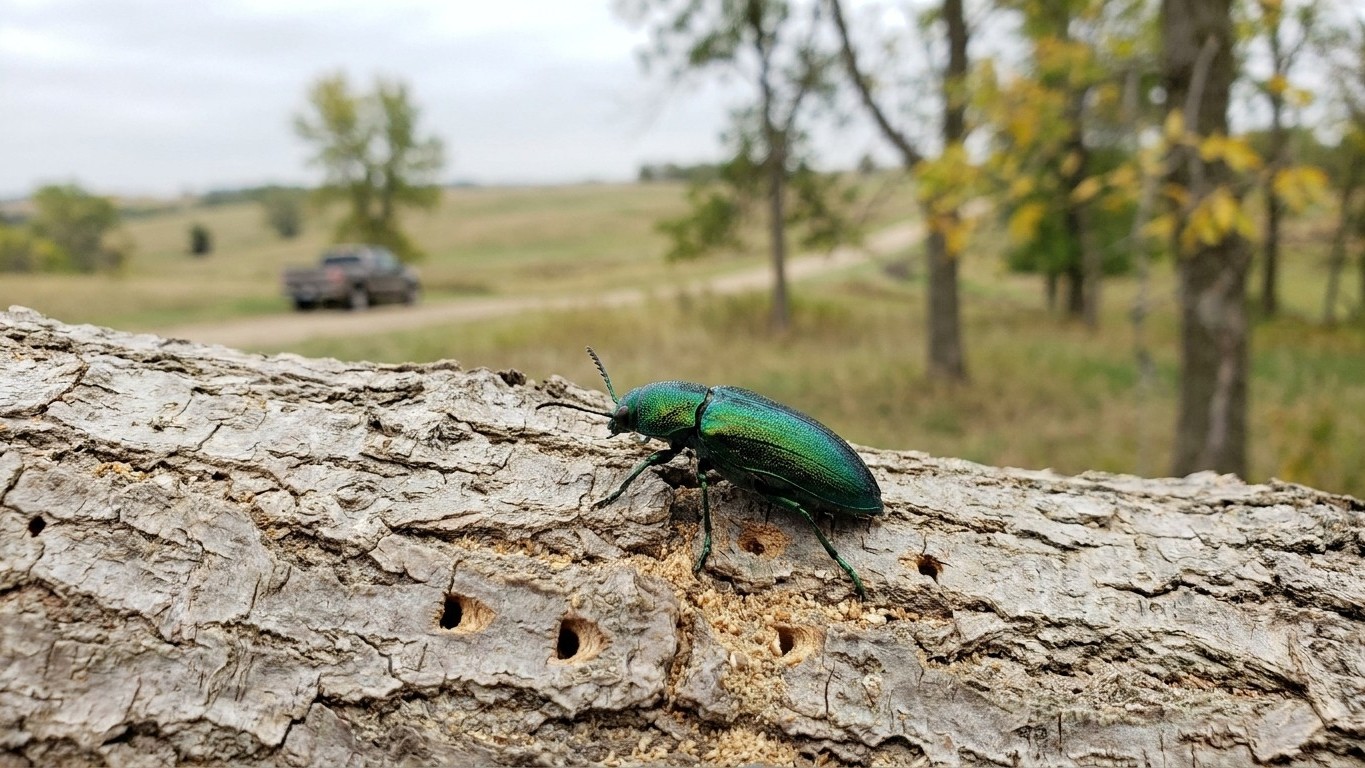

Emerald ash borer has not been confirmed as an established pest in Saskatchewan. The closest known infestation sits in Manitoba, where surveyors first verified the beetle in Winnipeg back in 2017. That’s roughly 350 miles from the Saskatchewan border, which sounds like a safe cushion until you factor in how this insect actually travels: not on its own wings, but in the back of pickup trucks hauling firewood.
Monitoring Continues, But Early Infestations Are Easy to Miss

Provincial and federal monitoring programs continue to run pheromone-baited traps across Saskatchewan’s urban centers and rural shelterbelts, and so far none have turned up a breeding population. That’s the good news. The less comforting part is that emerald ash borer larvae spend most of their life hidden under bark, so a tree can be infested for two or three years before anyone notices a problem. By the time visible dieback shows up in the canopy, the beetle has usually already spread to nearby trees.
Manitoba’s experience is the closest preview Saskatchewan has. After the 2017 Winnipeg detection, the infestation didn’t stay contained to a single neighborhood. It expanded outward over subsequent seasons, prompting the city to remove and replace thousands of boulevard ash trees. Saskatchewan’s forestry officials have been watching that trajectory closely, because the two provinces share the same ash-heavy landscape and the same highway corridors that campers, cottagers, and firewood sellers use every summer.
Why Saskatchewan’s Ash Trees Are Sitting Ducks
Ash trees are everywhere on the prairies, and there’s a specific historical reason for that. Starting in 1901, the federal government ran a shelterbelt program out of the Agroforestry Development Centre in Indian Head, Saskatchewan, distributing free tree seedlings to prairie farmers to break the wind and stop soil erosion. Green ash, tough and fast-growing, became one of the program’s signature species. Over the decades that program operated (it closed in 2013 due to federal budget cuts), it handed out hundreds of millions of trees across the prairie provinces.
Add to that the mid-20th-century push in Regina and Saskatoon to plant ash as a substitute for American elm once Dutch elm disease started wiping out boulevard elms, and you end up with a province where ash makes up a disproportionate share of both farm shelterbelts and city street trees. Saskatoon’s urban forest inventory lists ash among its most common boulevard species. Regina’s is similar. That concentration is exactly the kind of monoculture setup that let emerald ash borer tear through cities like Detroit and Toronto in the first place.
Green ash is also the dominant species in shelterbelts across the Rural Municipalities surrounding Saskatoon, Regina, Moose Jaw, and Prince Albert. If the beetle ever does establish itself, it won’t just threaten decorative boulevard trees. It threatens a working piece of prairie infrastructure that farmers have relied on for over a century to protect topsoil and livestock.
What Emerald Ash Borer Looks Like Before It’s Too Late
Adult beetles are small, metallic green, and about the size of a grain of rice. Most homeowners never spot the insect itself. What gives an infestation away is the damage it leaves behind:
- D-shaped exit holes in the bark, roughly 1/8 inch across, where new adults have chewed their way out
- Thinning or dying branches starting at the top of the canopy and working downward
- Vertical splits in the bark that expose winding, S-shaped larval tunnels underneath
- Clumps of leafy shoots sprouting from the trunk or base, a stress response called epicormic growth
- Increased woodpecker activity, since birds strip bark to get at the larvae, leaving patchy pale flecking
Any one of these signs on its own could mean something else entirely. Drought stress, other borers, or old age can cause similar symptoms. But two or three showing up together on an ash tree, especially one within a few hours’ drive of a known infestation zone, is worth reporting to a provincial forestry office or the Canadian Food Inspection Agency rather than waiting to see what happens next season.
Confirming a Suspected Infestation
Positive identification requires either catching an adult beetle or peeling back bark to examine larval galleries directly, since the exit holes alone aren’t definitive proof. Provincial agriculture and forestry departments in Saskatchewan accept photos and physical samples for identification, and getting a confirmed ID matters because it triggers a different response than a false alarm. Misidentifying a native borer as emerald ash borer wastes resources; missing a real infestation costs entire neighborhoods their tree canopy within five to ten years.
The Regulatory Wall Standing Between Manitoba and Saskatchewan
The Canadian Food Inspection Agency regulates the movement of ash material and firewood out of infested zones, and Manitoba’s Winnipeg area falls under those restrictions. That means it’s illegal to transport ash logs, branches, or untreated firewood from a regulated Manitoba zone into Saskatchewan without a permit. The rule exists specifically because natural beetle flight is slow (adults typically move only a few miles per year on their own) while human-assisted movement in a truck bed can jump the insect hundreds of miles in a single weekend.
This is the single biggest lever provinces have to slow the beetle’s spread. Every major emerald ash borer jump in North America, from Michigan to Ohio to Ontario to Manitoba, traces back to firewood or nursery stock moved by people, not to the insect flying under its own power. Saskatchewan’s best defense right now isn’t a chemical or a trap. It’s simply keeping firewood local.
Biological control also plays a role in the broader Canadian response, even if it hasn’t been deployed in Saskatchewan specifically. In heavily infested regions of Ontario and Quebec, researchers have released tiny parasitoid wasps, including species like Tetrastichus planipennisi, that lay their eggs inside emerald ash borer larvae and help suppress populations over time. It’s not a fast fix, but it’s part of the longer-term strategy for managing the pest where it’s already dug in.
What Saskatchewan Municipalities Are Doing to Prepare
Rather than wait for a confirmed detection, several Saskatchewan cities have started building EAB readiness plans modeled partly on what Manitoba learned the hard way. That preparation generally includes three pieces: inventorying how many ash trees exist on public land, setting a removal and replacement schedule that avoids planting a single replacement species (the same monoculture mistake that made the original ash boom possible), and identifying which high-value trees, like mature boulevard specimens in older neighborhoods, would justify insecticide treatment if an infestation were ever confirmed nearby.
That treatment usually means a systemic insecticide, either an azadirachtin-based product like TreeAzin or imidacloprid, injected directly into the trunk by a certified applicator. It works best as a preventive measure applied before a tree shows heavy symptoms, and it typically needs to be repeated every one to two years for as long as the beetle is active in the area. It’s not something homeowners do themselves with a hardware-store spray bottle; it requires licensed application and isn’t cheap on a per-tree basis, which is exactly why municipalities are trying to figure out now, before there’s an emergency, which trees are worth that investment.
What Homeowners and Rural Landowners Can Do Now
Don’t move firewood, especially ash firewood, out of your immediate area, and don’t bring any home from a camping trip in Manitoba or Ontario. Buy or cut firewood locally and burn it locally. That single habit does more to slow this pest’s spread than almost anything else an individual can control.
If you’re planting new trees on a shelterbelt or a boulevard, consider spreading your bets across species rather than leaning on ash the way previous generations did. Bur oak, hackberry, and various maple cultivars all handle prairie conditions reasonably well and don’t share ash’s vulnerability. Diversifying now costs a little more planning today but avoids the situation Winnipeg found itself in, where losing one species meant losing a huge share of the urban canopy all at once.
Keep an eye on mature ash trees on your own property, particularly if you’re within a couple hundred miles of the Manitoba border or near a highway corridor that sees regular cross-provincial traffic. Report anything suspicious to your municipal forestry office or Saskatchewan’s Ministry of Environment rather than assuming it’s nothing. Early detection is the only thing that has ever slowed this insect down, and in Saskatchewan’s case, the province still has the advantage of not having found it yet.