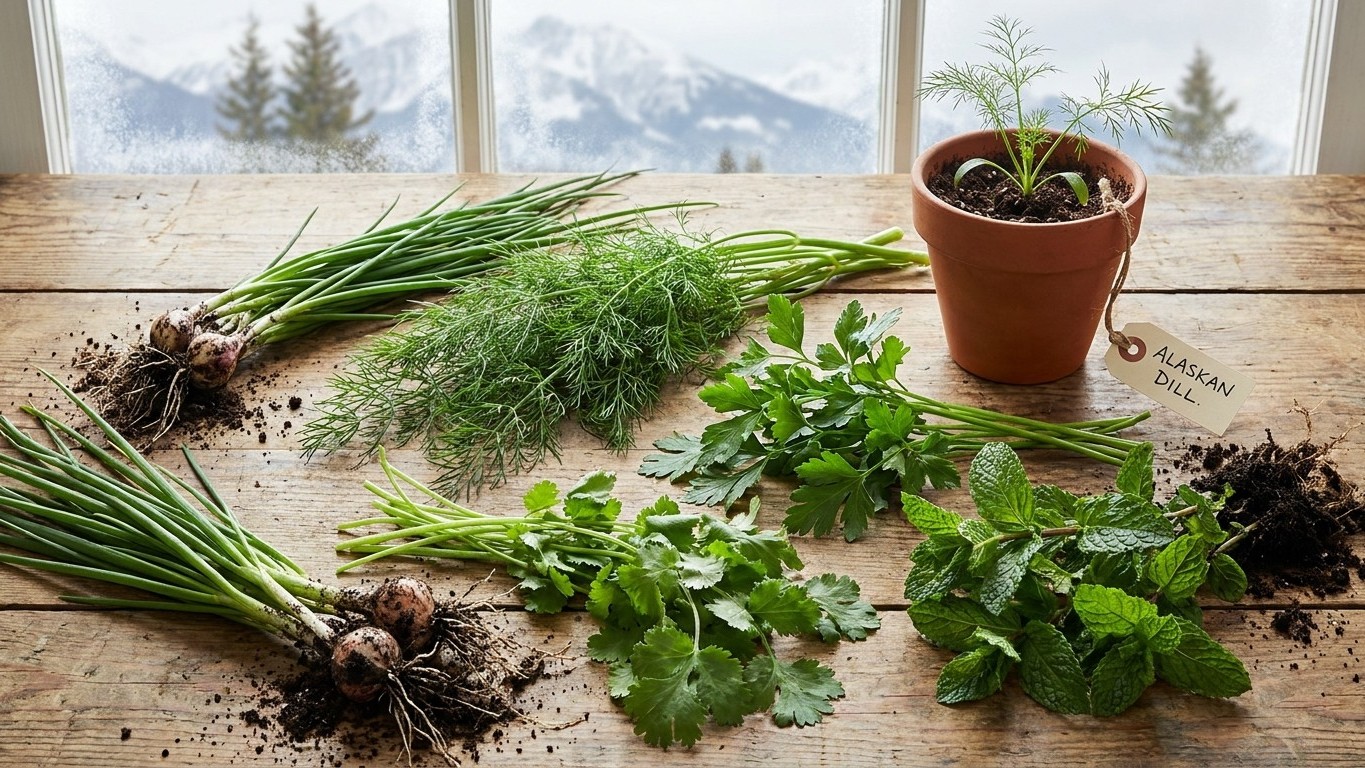

Cold-hardy herbs are the safe bet in Prince Edward Island: chives, parsley, dill, cilantro, thyme, and mint all handle the short, cool maritime season without complaint. Basil sulks, rosemary struggles to survive winter outdoors, and anything that needs a long hot stretch to mature is fighting the calendar from the start.
The short answer for Prince Edward Island
Start with the frost dates, because they set the boundaries every herb has to work inside. The average last spring frost at Charlottetown A is May 16, and the average first fall frost is October 17. That gives a mean frost-free window of roughly five months, but the word “average” is doing a lot of work here: in one year out of two, the real frost falls later than May 16 in spring, or earlier than October 17 in fall. Treat those dates as the midpoint of a range, not a promise.
That window decides which annual herbs are worth the trouble. Fast, cool-tolerant annuals like dill, cilantro, and parsley germinate in cool soil and mature well before the season closes. They’re the reliable performers here. Anything that needs sustained heat to bulk up, tropical basil being the clearest example, is racing a clock that Prince Edward Island’s climate rarely lets it win.
For perennial herbs, the number that matters most isn’t the frost date at all. It’s the coldest month’s mean daily minimum, which sits at 10.3°F at the reference station. That figure, paired with a Canadian hardiness zone of 5b, tells you which perennials can survive a Prince Edward Island winter in the ground rather than being replanted every spring like an annual. Chives, thyme, oregano, and most mints clear that bar comfortably. Sage does reasonably well in a sheltered spot. Rosemary and bay laurel do not, and no amount of mulch changes the math for a plant rated for temperatures well above 10.3°F.
So the decision by type looks like this: lean on cool-season annuals for anything you’re willing to replant, and lean on genuinely cold-hardy perennials, chives and thyme above all, for anything you want to leave in the ground year after year. Mint belongs in this second group too, though most gardeners here plant it in a container anyway to keep it from taking over a bed, which it will do in this climate as readily as anywhere else.
The Canadian hardiness zone system is not the same scale as the USDA zones used across the border. Natural Resources Canada builds its zones from seven climate variables, not one, and a single Canadian zone can span nine different USDA zones depending on region. If you’re comparing notes with a gardening friend in the US, don’t assume the zone numbers line up.
What will not work here

Basil is the herb most gardeners try first and the one that disappoints most reliably in Prince Edward Island. It wants sustained warmth, not just frost-free days, and this province’s summers run cool and often damp even in July and August. A basil plant that would be knee-high and bushy in a hot inland climate stays stunted and slow here, and the humidity that comes off the water invites downy mildew and other leaf spots long before the plant reaches a useful size. It can be grown, but expecting a heavy pesto harvest from an outdoor bed is setting yourself up for disappointment.
Rosemary is the second casualty, and the reason is written directly in the winter numbers. A mean daily minimum of 10.3°F in the coldest month is colder than most rosemary cultivars are rated to survive without heavy protection, and “most winters” isn’t good enough when a single hard cold snap kills the whole plant. Some gardeners keep rosemary in a pot and bring it indoors for winter, which works, but planting it in the ground and expecting it back next spring is a bet that loses more often than it pays off at this hardiness zone.
Bay laurel fails for the same reason, only more decisively. It’s a Mediterranean shrub with essentially no tolerance for a winter this cold, and it belongs in a container that comes indoors before the first fall frost in October, not in a permanent bed.
Lavender is a trickier case. English lavender can survive the winter cold here in a well-drained spot, but Prince Edward Island’s clay-heavy soils and damp summers are its real enemy. Lavender roots that sit in wet ground over winter rot before the cold ever gets a chance to kill the plant. If you’re growing it, raised, gritty soil matters more than the zone number does.
And close spacing on almost anything leafy, basil included, invites trouble in a climate this humid. Plants set too close to each other trap moisture between the leaves, and that moisture, combined with cool nights, is exactly what fungal disease needs to take hold. Wider spacing than a seed packet recommends for a drier climate is a reasonable adjustment here.
What changes across Prince Edward Island
Prince Edward Island isn’t one uniform garden, even though it’s Canada’s smallest province. The hardiness zone figure cited above, 5b, is drawn from the reference station at Charlottetown, and Charlottetown sits near the coast where the surrounding water moderates temperature swings in both directions. Inland districts and anywhere further from that coastal buffering can run measurably colder in winter and see frost linger later into spring than the Charlottetown normals suggest.
Zone assignments are made property by property using seven climate variables, not guessed from a provincial average, and Natural Resources Canada publishes an interactive map built for exactly this purpose. If you’re planting anything perennial, chives, thyme, or a lavender bed you’re hoping will survive the winter, check that map for your own municipality before you commit a permanent planting to the ground.
The practical shift for anyone north of Charlottetown, or further from the moderating effect of the coast, is straightforward: push your spring planting date later than May 16 rather than earlier, and don’t assume an October 17 fall frost gives you a full extra week to harvest. Both dates are averages built on a single station’s history, and the further your garden sits from that station’s particular microclimate, the less those averages describe your actual conditions.
If there’s one instruction to take from this section, it’s to resist the urge to treat “Prince Edward Island” as a single answer. The province spans real differences in exposure and elevation even across short distances, and the herbs that shrug off a Charlottetown winter aren’t guaranteed to do the same fifteen miles inland.
Where to check this for your own county
The provincial picture is built from one reference station’s climate normals. That’s useful for planning, but it isn’t a substitute for what your local agricultural extension office knows about your specific county. Prince Edward Island’s agriculture resources are maintained through the provincial government at princeedwardisland.ca/en/topic/agriculture, and that’s the right next stop before you finalize a planting plan.
What to look for there specifically: a local planting calendar that accounts for your county’s actual frost patterns rather than the Charlottetown average, and any variety trial results for herbs and vegetables that have been tested under real Prince Edward Island conditions rather than a seed catalog’s national recommendation. Provincial and county-level extension offices often track which cultivars of thyme, chives, or dill have performed well in local trial gardens, information that a general planting guide simply can’t provide because it wasn’t collected there.
The broader principle holds regardless of what you’re growing: a county-level recommendation beats a provincial one every time, because it’s built from soil and weather data specific to a smaller, more consistent area. The provincial layer is useful for understanding the general pattern of what thrives and what struggles across Prince Edward Island as a whole. It was never meant to replace the more granular guidance your local extension office can offer once you know your own municipality’s hardiness zone and frost history.
If your county-level office publishes a seasonal calendar, treat it as the more authoritative document any time it disagrees with the general dates cited here. Local data collected over years in your specific soil and microclimate will always outperform a station average, however carefully sourced that average is.
Checking this against your own garden
Every date here is an average pulled from decades of weather records at one station. Your own garden will tell you more about its actual readiness than any calendar can, if you know what to watch for.
Soil warmth by feel is the first and most useful check. Push a bare finger a couple of inches into the bed in spring. If it feels cold and damp rather than merely cool, seeds like dill and cilantro will sit and sulk rather than germinate, regardless of what the calendar says about the date. Waiting a few extra days for the soil to warm almost always beats planting into ground that still feels like winter.
The first true leaves on any seedling you’ve started, whether indoors or direct-sown, are the second signal. The first pair of leaves that emerges after germination is often not the plant’s real leaf shape; the true leaves that follow are what tell you the seedling has enough root and energy to handle transplanting or thinning. Rushing a move before those true leaves appear sets a plant back further than waiting an extra week.
For anyone growing mint, oregano, or other spreading perennials, watch for the first flush of new growth at the base of last year’s plant in spring. That flush tells you the plant survived winter in your specific spot, which is more reliable information about your own microclimate’s hardiness than any zone map, because it reflects the actual conditions of that exact patch of ground rather than a provincial average drawn from a station miles away.