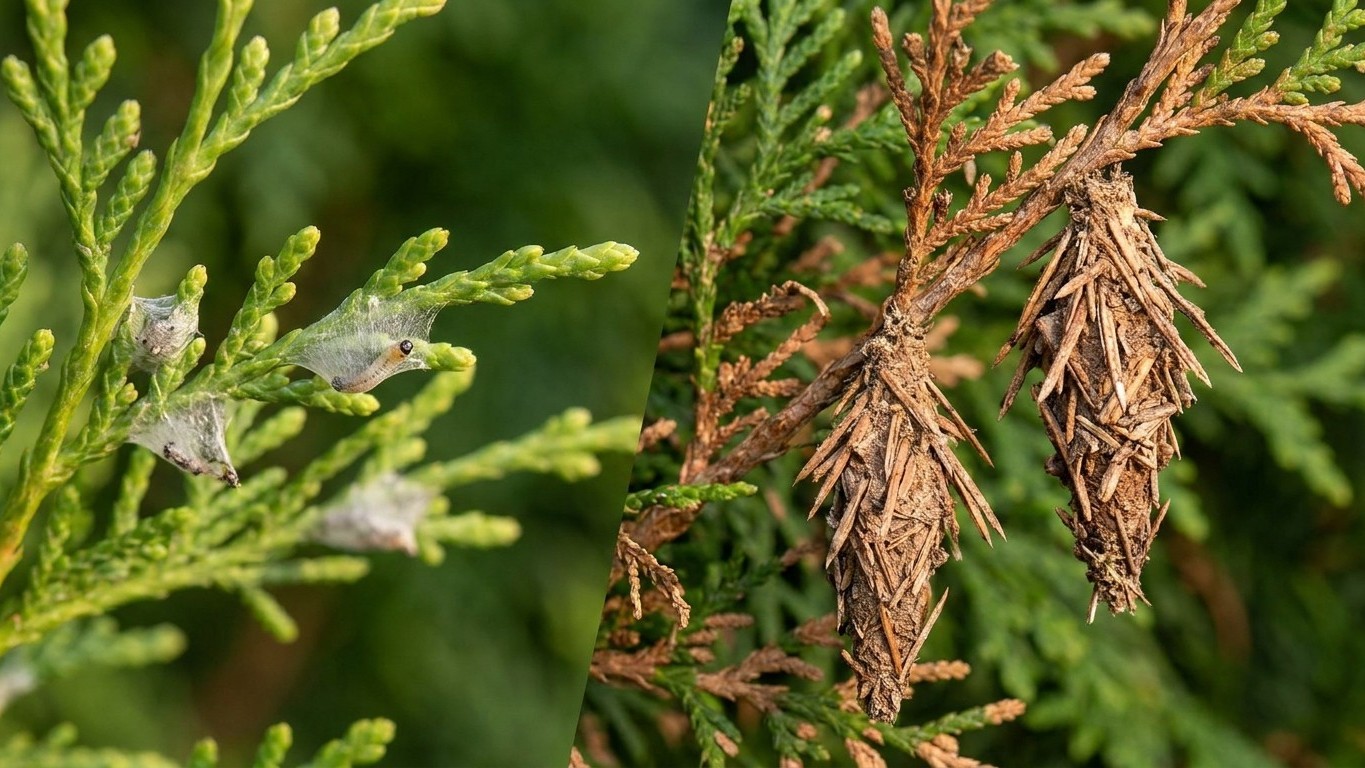

Bagworms show up in Kentucky landscapes in two distinct windows: newly hatched larvae start feeding in late May through mid-June, and the finished, spindle-shaped bags become obvious on arborvitae, junipers, and cedars by late summer and fall. Stopping them means acting in that early window with mechanical removal or an early insecticide application, because a mature bag full of eggs is nearly impossible to kill with a spray.
When Bagworms Appear in Kentucky

Kentucky sits in a transition zone between the warmer Southeast and the cooler Ohio Valley, which affects when eggs hatch each year. In most counties, overwintered eggs inside last year’s bags begin hatching around the last week of May, with activity picking up through the first two weeks of June. A cool, wet spring can push that hatch date later by a week or more, so gardeners who spray on a fixed calendar date sometimes miss the target window entirely.
Once larvae emerge, they’re barely a quarter-inch long and nearly invisible against foliage. They spin a small silk bag almost immediately, decorating it with bits of the host plant, then drag that bag around as they feed. This is the most vulnerable stage of the bagworm’s life. The bag is thin, the larva inside is small, and any treatment applied now has a real chance of working.
By July and August, the bags have grown to one to two inches long and the walls have thickened considerably. Feeding damage becomes visible as browning branch tips, especially on the interior and top of evergreens where infestations often start unnoticed. Come September, larvae stop feeding, seal themselves into bags, and pupate. Males emerge as small, dark moths that fly to find mates. Females never develop wings or legs; they stay inside the bag their entire life, mate through an opening at the bottom, then lay 500 to 1,000 eggs inside before dying. Those eggs overwinter in the bag, ready to start the cycle again the following May.
Kentucky typically gets one generation per year. That single-generation cycle is actually good news for anyone trying to manage them, because it means there’s one narrow window to interrupt reproduction rather than several overlapping generations to chase all season.
Which Plants Get Hit Hardest
Bagworms have a reputation as an evergreen pest, and arborvitae, eastern red cedar, and various juniper cultivars take the worst damage across Kentucky landscapes. These plants don’t regrow foliage the way deciduous trees do, so a heavy infestation can leave permanent brown, dead sections that never fill back in. A privacy hedge of arborvitae that’s been fed on for two or three consecutive summers can end up with bare, unsightly gaps at eye level that no amount of pruning fixes.
The insect isn’t picky, though. Bagworms have been documented feeding on more than 100 plant species, including maple, sycamore, black locust, honey locust, and various fruit trees. Deciduous hosts tend to tolerate defoliation better since they’ll push new leaves the following spring, but a young tree stripped repeatedly can still suffer stunted growth or dieback.
One pattern worth knowing: bagworm populations often start on a single tree or a handful of specimens in a yard and spread from there. Young larvae can produce a strand of silk and drift on wind currents to nearby plants, a behavior sometimes called “ballooning.” That’s why a bagworm problem that looks minor on one arborvitae in June can show up on three or four neighboring shrubs by August if nobody intervenes.
Identifying a Bagworm Problem Before It Spreads
The bags themselves are the giveaway. They resemble small pinecones or bits of debris hanging from twigs, camouflaged with plant material so effectively that homeowners often mistake them for seed pods or dead needles until they notice the bags moving. Give a suspicious bag a gentle squeeze in late summer; if it feels firm or you can see movement, it’s active.
Distinguishing bagworm damage from other common Kentucky pests matters, because treatments differ. Spider mites cause stippled, dusty-looking foliage and fine webbing, not distinct bags. Juniper scale leaves small waxy bumps on needles rather than mobile cases. Bagworm damage is more localized at first, often starting on interior branches, and the physical bags are the confirming sign no other pest leaves behind.
What Actually Stops Bagworms
Timing separates effective control from wasted effort. The three approaches below work best in a specific sequence, matched to the bagworm’s life cycle.
Hand removal in fall, winter, or early spring
Picking bags off by hand between October and April remains one of the most reliable methods, and it costs nothing but time. Each bag removed at this stage represents hundreds of eggs that never hatch. Drop collected bags into a bucket of soapy water or a sealed bag headed for the trash; don’t just toss them on the ground, since eggs can still survive and hatch there. For a hedge or foundation planting with a manageable number of bags, this single winter task can prevent most of next year’s infestation without any spray at all.
Bacillus thuringiensis (Bt) applied in June
Bt, a naturally occurring soil bacterium sold under various garden product labels, works by disrupting the digestive system of caterpillars that ingest it. It’s most effective against young larvae in their first few weeks of feeding, roughly early to mid-June in Kentucky. Once bags thicken later in summer, Bt struggles to penetrate and control drops sharply. Because Bt breaks down quickly in sunlight, a repeat application seven to ten days after the first often improves results, especially if hatching was staggered.
Conventional insecticides for larger or established infestations
For heavier infestations, or on large trees where hand removal isn’t practical, insecticides containing spinosad, permethrin, or other labeled active ingredients can knock back populations when applied to young larvae in the same early-June window. Thorough coverage matters more than product choice, since larvae hide inside bags even at this stage and a light misting won’t reach them. Spraying in August on fully grown larvae wastes product and money; by then the bag wall is too tough and the insect is nearly finished feeding anyway.
Whichever method gets used, follow-up matters. A yard that had a bagworm problem one summer is very likely to have eggs waiting in overlooked bags the following spring, so a quick inspection of evergreens each October, even after a “successful” treatment year, catches stragglers before they restart the cycle.
Why Some Kentucky Yards Keep Getting Reinfested
Persistent bagworm problems usually trace back to one of three habits: skipping the winter bag removal, spraying too late in the season, or planting the same vulnerable evergreens (arborvitae and junipers especially) close together where larvae can drift from one to the next. Mixing hedge plantings with species bagworms use less often, or simply spacing susceptible evergreens farther apart, reduces how easily an infestation on one plant becomes a yard-wide problem.
Weather plays a role too. Mild winters don’t kill overwintering eggs (they’re built to survive cold), but a wet spring can delay hatch and throw off spray timing for anyone working from a calendar instead of checking plants directly. Walking evergreens every few days starting in late May, looking for the first tiny bags rather than waiting for obvious summer damage, remains the single best way to catch the window that actually matters.