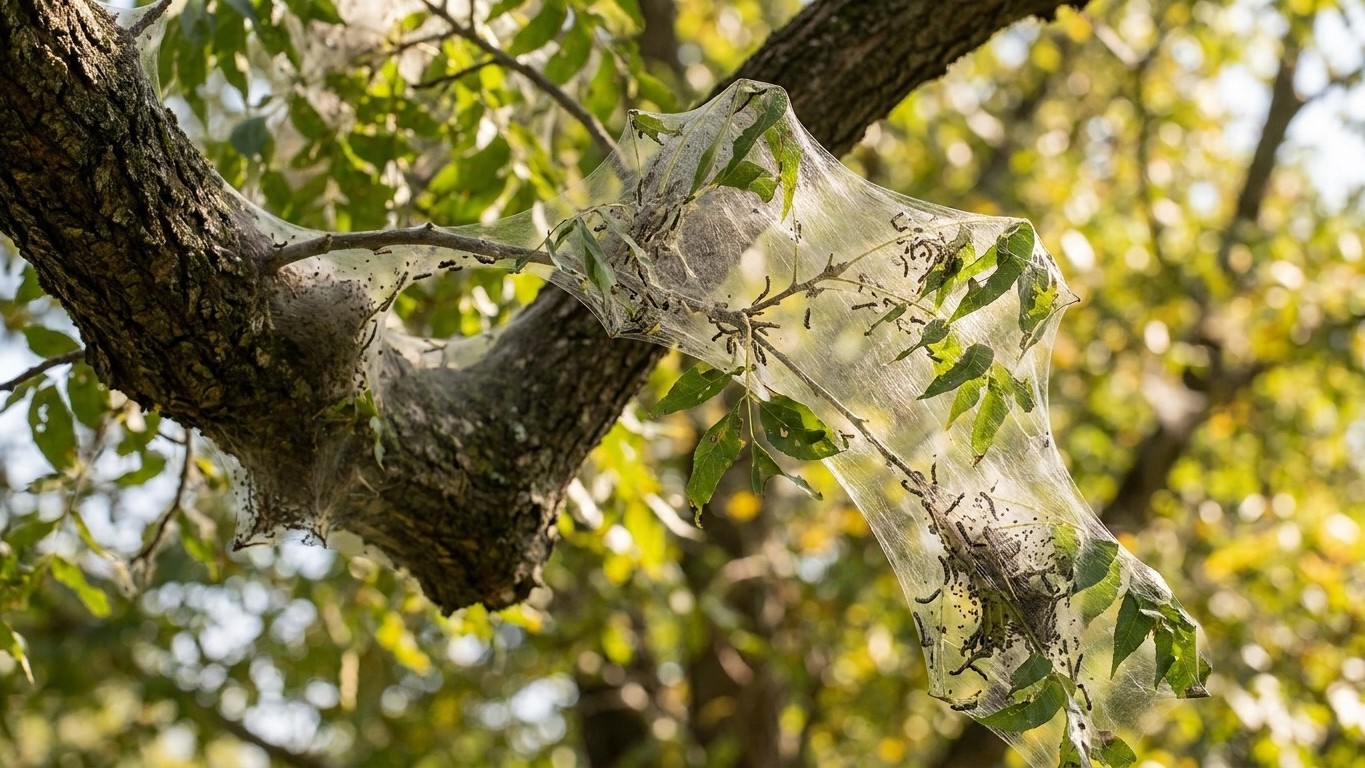

Fall webworm shows up in Kentucky twice each growing season: late May through June, then again from mid to late July. That two-wave pattern, tracked by University of Kentucky Extension Entomology, is the single most useful fact for anyone watching a backyard pecan, walnut, or wild cherry tree for the telltale silk nests this pest is known for.
When Fall webworm turns up in Kentucky

University of Kentucky Extension Entomology publishes a specific window for this insect, and it’s worth quoting exactly: fall webworm activity runs late May to June, then returns mid to late July for a second generation. That’s not a guess dressed up as a schedule. It’s two distinct emergence periods in the same season, which means a tree that looks clean in early June can still end up webbed by August.
This puts fall webworm inside a much longer pest season that stretches from late March through September in Kentucky, according to the same ENTfact series. Eastern tent caterpillar leads that parade in early April, bagworm follows in mid-May, and fall webworm’s first wave overlaps the tail end of bagworm activity before Japanese beetle season takes over in July and August. If you’re trying to keep a mental calendar of what’s chewing on what, fall webworm is the one that shows up twice.
The range given (late May to June, then mid to late July) is the data itself, not a placeholder for a single date. Weather in any given year can push either wave earlier or later, and a homeowner checking branch tips in the first week of June is looking at the front edge of a window, not a deadline. Extension entomologists give a range because the insect’s development depends on temperature accumulation, not a fixed day on the wall calendar. Treat the range as the answer, not as something to narrow down further.
Reading the calendar from your last spring frost
Kentucky gardeners already track one date religiously: the last spring frost, which NOAA’s 1991-2020 climate normals place between March 24 and April 4 for the region. That’s the number most people use to decide when it’s safe to set out tomatoes or uncover tender perennials. Fall webworm doesn’t answer to that date directly since it’s a tree and shrub pest, not something tied to vegetable transplant schedules. But the same soil-warming process that pushes the frost date around also drives when host trees leaf out, and leaf-out timing is what ultimately sets the stage for the insect’s first generation.
An early spring, meaning frost clears closer to March 24 than April 4, tends to pull the whole season forward: trees leaf out sooner, and the late May start of fall webworm’s first wave can arrive a bit ahead of schedule. A late spring does the reverse. This is why the Extension window is given as a range rather than a fixed week, and why nobody should expect the same nest to appear on the same branch on the same date two years running.
The practical takeaway for anyone managing landscape trees: don’t wait for a calendar reminder. Start checking branch tips on susceptible trees once late May arrives, and check again in mid-July for the second wave, adjusting a week or so in either direction depending on whether your spring ran warm or cool. NWS Louisville notes that the official station used for these frost normals runs later in spring and earlier in fall than surrounding rural Jefferson County, so rural properties should expect an even tighter window than the urban dates suggest.
What it attacks, and what the damage looks like
The symptom almost always arrives before the identification. What a homeowner notices first is a loose, silvery-white webbing wrapped around the leaves at the very tips of branches, usually thirty feet up on a mature tree where it’s easy to mistake for a spider web gone oversized. Inside that web, the leaves are skeletonized, meaning the green tissue has been stripped away and only a lace of veins remains. The nest itself grows over the course of a few weeks as the larvae inside it keep expanding their silk tent to enclose fresh foliage.
Host trees include pecan, walnut, mulberry, wild cherry, persimmon, and a long list of other hardwoods common in Kentucky yards and fencerows. This isn’t a picky feeder. Fall webworm will use almost any broadleaf tree available, which is part of why the nests show up in so many different settings, from orchard trees to shade trees along a driveway.
The damage is done entirely by the larval stage, the caterpillars living inside the protective web. That matters for timing any kind of response, because once the larvae have finished feeding and moved on to pupate, the visible nest is essentially an empty shell and nothing applied to it will change the outcome for that generation. The window for doing anything useful is while the web is still small and the caterpillars are actively feeding inside it, not after the nest has ballooned to cover a whole branch tip.
Because the two generations described by University of Kentucky Extension Entomology hit in late May to June and again in mid to late July, a tree can carry fresh nests twice in one summer. A homeowner who clears one wave in June shouldn’t assume the tree is done for the season.
How Kentucky sits in this pest’s range

This pest is documented in 2 territories on this site, which points to a wide distribution rather than a narrow, edge-of-range presence. For a widespread species like fall webworm, the meaningful difference between territories generally isn’t whether the insect shows up. It’s when. Local temperature patterns, leaf-out timing, and the length of the growing season shift the two generation windows earlier or later depending on where you are, even though the underlying biology, two waves of larvae building silk nests on branch tips, stays the same everywhere the insect is found.
University of Kentucky Extension Entomology is the source behind the dates used throughout this piece, and it’s the right reference for Kentucky specifically because the ENTfact calendar draws on regional monitoring rather than a single national average. That regional grounding is why the late May to June and mid to late July windows can be stated with some confidence for this state, rather than borrowed from a broader, less precise national range.
None of this supports a claim about how severe fall webworm is in Kentucky compared to other states, or whether infestations here trend worse or milder over time. The documentation only confirms presence and timing, not a ranking. Anyone looking for a severity comparison between territories will need a different kind of data than what’s published here.
What actually works against it
The cheapest and most effective response to fall webworm is mechanical, not chemical.
- Prune out the infested nest while it is still small, cutting the branch tip in the first couple of weeks after late May or after mid-July, because fall webworm larvae stay contained inside their silk tent for most of the feeding period, so a single cut removes the entire population while costing the tree minimal live canopy, and a pole pruner reaches most nests on residential trees without a ladder.
- Clear fallen leaf litter and debris around host trees in fall, which can reduce overwintering pupae in some cases, though this is a minor supporting step rather than a primary control, since fall webworm pupae can also overwinter in bark crevices and soil beyond the immediate reach of a rake.
- Watch susceptible trees, pecan, walnut, wild cherry, mulberry, persimmon, at the start of each generation window (late May and mid-July) and act on nests while they’re still small, which is the most reliable strategy a homeowner has and costs nothing but a few minutes with a pair of loppers.
Hand-removal or pruning stops working once larvae have finished feeding and dropped to the ground or bark crevices to pupate, since at that point there’s no concentrated nest left to remove and the damage for that generation is already done.
Common questions
Does fall webworm kill trees?
Established, healthy trees generally tolerate fall webworm defoliation without lasting harm, since the damage typically affects branch-tip foliage late in the season rather than the whole canopy early on. Young or already-stressed trees can be more affected by repeated defoliation across multiple years.
Is fall webworm the same as eastern tent caterpillar?
No. University of Kentucky Extension Entomology lists eastern tent caterpillar as active early April to mid-May, well before fall webworm’s late May start, and eastern tent caterpillar builds its nest in branch forks rather than at leaf-covered branch tips.
Can I treat fall webworm nests with a spray from the ground?
The silk webbing that encloses the nest is dense enough to block most sprays from reaching the larvae inside, which is part of why physical removal of the nest tends to be the more reliable approach for reachable branches.