
Winter Squash in New York goes into the ground once the soil itself has warmed, not simply once frost risk has passed. Because the state spans USDA hardiness zones 3b to 7b, that soil-warming moment can differ by a month or more between the Adirondacks and New York City. How long the season runs, how much heat and rain the vines get, and which type of squash actually finishes before fall frost all hinge on exactly where in the state you’re gardening.
When the soil is warm enough in New York

The question gardeners actually need answered isn’t “when’s the last frost” but “when is the soil warm enough to keep a squash seedling from sulking.” Those are related but not identical. At the New York City reference station (Central Park, station USW00094728), NOAA’s 1991-2020 climate normals put the last spring frost, defined as the date when the 30-70% probability band for a 32°F freeze closes, between March 23 and April 3. That’s a probability window, not a guarantee: some years the last freeze lands earlier, some later, and the normal simply describes the range where it most often falls.
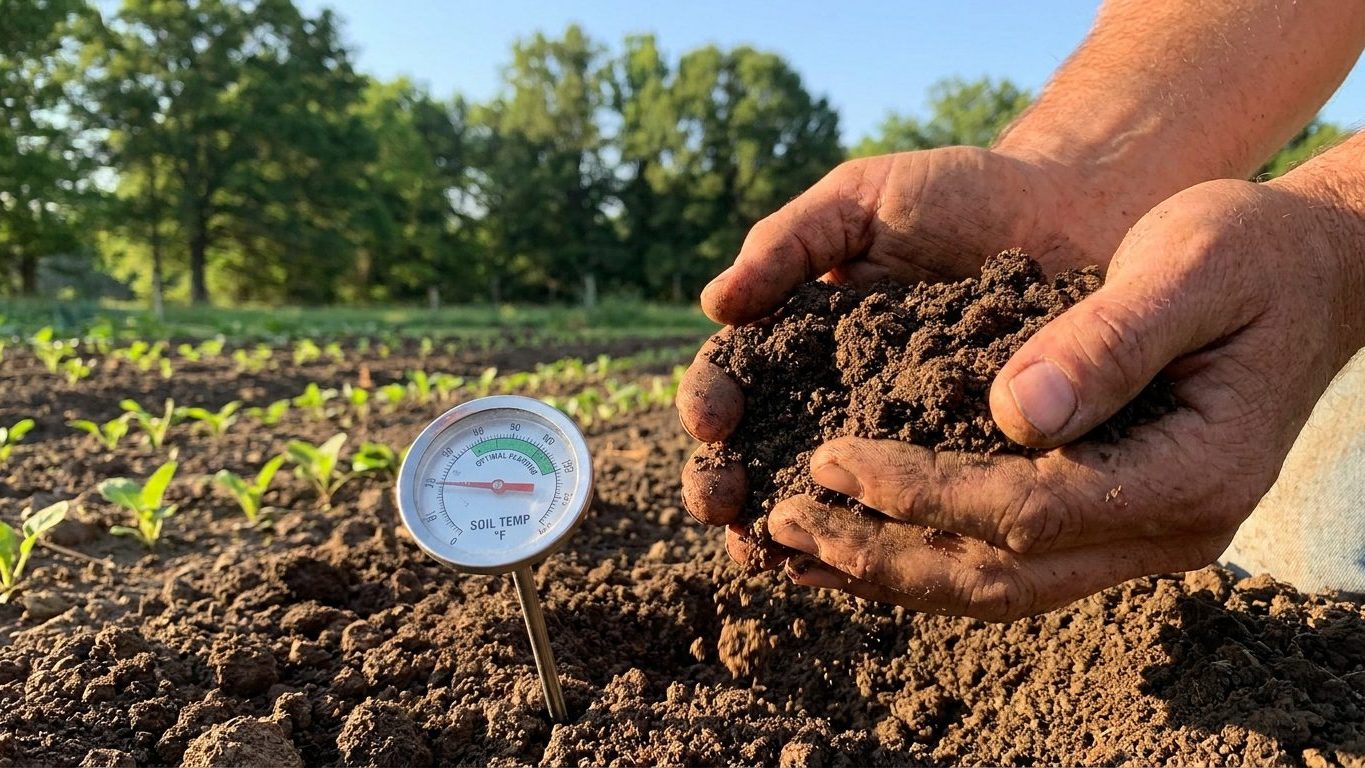
Soil temperature lags air temperature by a couple of weeks in spring, since bare or mulched ground takes longer to shed winter cold than the surrounding air does. That means the safe window for winter squash, a heat-loving crop, sits somewhat after that frost date, once nighttime lows are reliably staying above the mid-50s and the soil itself has stopped feeling cold to the touch a few inches down. Gardeners without a soil thermometer can watch for consistent daytime highs in the 70s and steady overnight warmth as a rough substitute.
One caution matters more here than almost anywhere else in the state: Central Park is a dense urban heat island. Its frost dates run measurably milder than what gardeners see upstate, in the Finger Lakes, or in the Adirondacks, where frost can linger into May and return before Halloween. Anyone gardening outside the five boroughs should treat the NYC figures as a floor, not a state-wide rule, and check locally observed frost patterns for their own county.
New York’s hardiness zones run from 3b to 7b under the USDA Plant Hardiness Zone Map (built on 1991-2020 normals), a system based on a single measure: average annual extreme minimum winter temperature. It says nothing directly about spring soil warming, but it’s a useful shorthand for how much earlier or later a given county trails or leads New York City in the calendar. For the specific varieties trialled and timed for a given county, Cornell Cooperative Extension (cals.cornell.edu/cornell-cooperative-extension) keeps regionally tested planting guidance that a statewide article like this one can’t replace.
How long the season lasts here
At the New York City reference station, the frost-free window runs from that last spring frost (March 23 to April 3) to the first fall frost, which the same NOAA normals place between November 14 and November 27. Doing the subtraction across the two probability bands gives a frost-free season of roughly 225 to 249 days, depending on which edge of each range actually plays out in a given year. That’s close to eight months, which is a genuinely long growing season by Northeast standards.
A window that size changes what’s worth attempting. Winter squash typically needs a long, uninterrupted stretch of warm weeks to set fruit and let it mature fully on the vine, and a nearly eight-month frost-free run in the city gives real breathing room. It’s long enough that a first planting failure, a slow germination, or a pest setback in early June doesn’t necessarily end the season. There’s also room to stagger plantings of different squash types so that harvest doesn’t arrive all at once, an approach covered in more detail in our guide to succession sowing winter squash.
That flexibility narrows fast outside the city. Upstate counties and the Adirondacks see both a later last frost and an earlier first frost, sometimes compressing the usable window by a month or more on each end. Where the season is shorter, the first sowing effectively becomes the only sowing, and starting seedlings indoors for transplanting, rather than direct-sowing outside, becomes worth the extra step and the root disturbance it risks. Winter squash doesn’t always transplant cleanly since its roots dislike disturbance, so that tradeoff, extra weeks of growing time against transplant shock, is a real decision rather than a formality.
The practical takeaway is that New York City’s own frost data describes a comfortably long season, but it describes New York City. Gardeners further north should treat their own county’s frost patterns, not the Central Park figures, as the number that actually decides whether a second sowing is realistic this year.
Heat and water in New York

At the same reference station, New York City averages 12.2 days a year at or above 90°F, a modest heat load compared to the interior South or the desert Southwest. That’s a count at one urban station, not a description of the whole state; heat-island effects mean the actual figure runs lower across most of upstate New York, where fewer 90-degree days pile up over a summer. For winter squash, this matters less as a stress factor and more as a reminder that this isn’t a crop fighting drought stress here the way it would in Texas or California.
Rainfall tells the more useful story. Summer rain across June, July, and August averages about 13.7 inches at the same station, broken out to roughly 4.54 inches in June, 4.6 in July, and 4.56 in August, remarkably even month to month. That’s a wet summer by national standards, and it changes the whole calculation around irrigation. Rather than needing to carry the vines through dry stretches with supplemental watering, as a grower in a hot, dry territory would, New York gardeners are more often managing the downside of ample rain: soggy leaves, standing humidity, and the fungal pressure that comes with it.
Powdery mildew and other foliar diseases thrive in exactly this kind of warm, humid, rain-fed summer, especially once a squash canopy fills in and airflow underneath the leaves drops off. That’s a bigger practical threat here than heat stress or drought. Spacing vines to let air move through, watering at the soil line rather than overhead when supplemental watering is needed, and removing visibly diseased leaves promptly all matter more in New York’s climate than any irrigation schedule would.
None of this means irrigation is irrelevant. A single summer thunderstorm can dump an inch of rain that mostly runs off a compacted or sloped garden bed rather than soaking into the root zone, and a stretch of days above 90°F increases evaporation even where the seasonal rainfall total looks generous on paper. A rain gauge on the actual plot, checked through July and August, tells a gardener more about what their squash is getting than the seasonal average ever will.
Which winter squash suit New York
New York’s combination of a long frost-free window in the city, a shorter one upstate, ample summer rain, and only moderate heat points toward a few general priorities rather than a single ideal type. In counties where the season runs close to the full 225-to-249-day range measured in New York City, most types of winter squash have enough time to mature and cure fully on the vine before frost cuts them down, since an immature squash won’t develop the hard, storable rind that defines the crop. Where the season runs shorter, as it does across much of upstate and the Adirondacks, earlier-maturing types have a real practical edge, since a fruit still filling out when the first fall frost arrives never finishes properly.
Given how often the state’s warm, rain-fed summers turn humid, disease resistance deserves to be the first criterion many New York gardeners weigh, ahead of size, shape, or storage length. A vine that shrugs off powdery mildew through a wet August has a better shot at finishing its fruit than one that loses its canopy in July. Airflow matters here nearly as much as variety selection: even a resistant type benefits from spacing that keeps leaves from staying damp for hours after a rainstorm.
This page won’t name specific varieties, and that’s a deliberate choice rather than an omission. The types trialled and recommended for zone 4 in the North Country look nothing like the ones that perform best in the milder microclimate of Long Island or the city itself, and a single statewide article can’t responsibly speak for both. Cornell Cooperative Extension (cals.cornell.edu/cornell-cooperative-extension) maintains county-level offices that track which varieties actually perform in local trials, accounting for the real frost dates, soil, and disease pressure of a specific area rather than a state-wide average. For a crop where the difference between a cured, storable squash and a soft, wasted one comes down to finishing before a specific fall frost date, that local trial data is worth more than any general recommendation this page could offer.