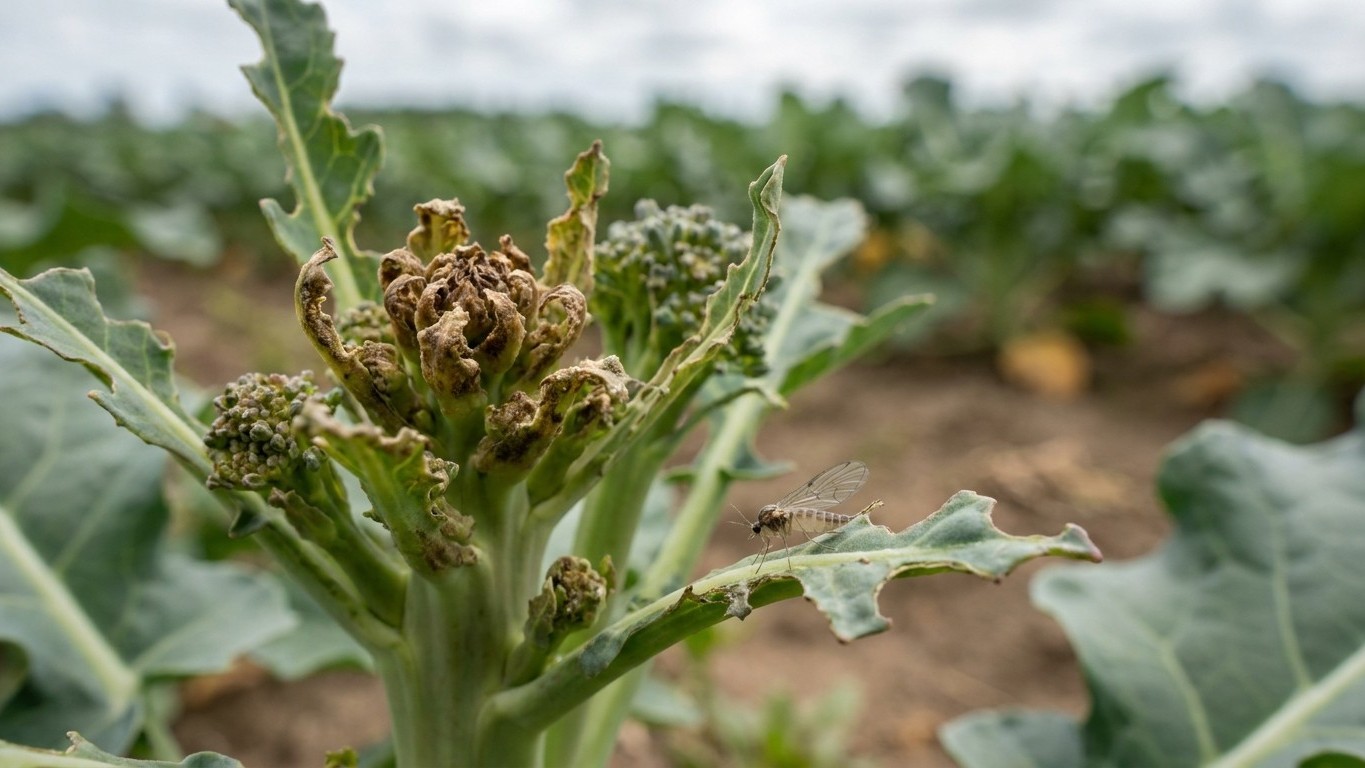

Swede midge shows up in Quebec brassica fields from late May through early October, with the heaviest pressure hitting canola, broccoli, and cabbage crops between June and August. Once larvae reach the growing point of a plant, no insecticide fixes the damage that’s already done, which is why timing and prevention matter more than any single spray.
What Swede Midge Actually Is

The insect behind the trouble is Contarinia nasturtii, a fly so small it’s easy to mistake for a gnat or simply miss entirely. Adults measure about 1.5 to 2 millimeters, roughly the size of a grain of ground pepper, and they don’t bite or sting anything. The damage comes from their offspring.
Females lay eggs in clusters on young leaf tissue near the growing tip of a plant. Larvae hatch within days and feed by secreting enzymes that break down plant cells, then sucking up the liquefied tissue. That feeding happens hidden inside leaf folds or between developing florets, which explains why growers rarely spot the culprit until the damage is obvious and the insect is long gone.
First identified in Ontario in 2000, the midge was confirmed in Quebec fields within a few years and has since become a standing concern for vegetable and canola growers across the southern part of the province, particularly in the Montérégie region where brassica production is concentrated.
How to Recognize the Damage
Symptoms mimic other problems so closely that growers often blame herbicide drift or a nutrient shortfall before they consider an insect. Look for these signs:
- Puckered, twisted, or crinkled leaves near the plant’s crown
- Multiple small growing points instead of one dominant stem (called “blind head” in broccoli and cauliflower)
- Scarred, corky tissue on stems just below the growing tip
- Swollen or fused leaf petioles on canola and mustard
- Stunted, bushy plants that never form a marketable head
Cauliflower and broccoli show the clearest losses because a distorted growing point means no usable crown forms at all. Canola tolerates some feeding without total crop failure, but yield drops when enough growing points are hit across a field.
The Seasonal Timeline in Quebec
Swede midge overwinters as larvae inside cocoons buried a few inches into the soil, usually near the base of the previous season’s host crop. When soil temperatures warm in spring, pupation begins, and the first adults typically emerge in late May, sometimes as early as the second week of the month during a mild spring.
From there, the insect runs through two to four generations before frost, depending on how warm the summer gets. Each generation takes roughly two to three weeks from egg to adult under favorable conditions, meaning a field planted in early June could face pressure from a fresh wave of adults by late June, then another in mid-July, and potentially a third by August.
This overlapping generation pattern is what makes Swede midge so hard to manage with a single intervention. Unlike pests with one clear window of vulnerability, adults, eggs, and larvae can all be present in a field at the same time by midsummer, so a treatment aimed at adults does nothing to stop larvae already feeding, and vice versa.
Population pressure tends to peak in July and taper by late September as day length shortens and temperatures cool, though late-season canola and fall brassica plantings can still take a hit if midge numbers stayed high through summer.
Where It Spreads and Why
Adult midges are weak fliers on their own, rarely moving more than a few hundred yards under still conditions. Wind is the real driver of local spread, and human activity, moving infested soil, plant material, or even equipment between fields, accounts for most long-distance jumps into new areas.
Wild brassicaceous weeds act as a reservoir that keeps populations alive even when a field sits fallow or grows a non-host crop. Wild mustard, shepherd’s purse, and other roadside weeds in the same plant family can sustain a low-level midge population right at the edge of a field, ready to move in once a susceptible crop goes in the ground.
That reservoir effect is one reason quarantine and monitoring efforts in Quebec have focused not just on crop fields but on the weedy margins, ditches, and fence lines surrounding them.
What Actually Stops It
No single tactic eliminates Swede midge from an infested area. Growers who manage it successfully combine several approaches at once, treating monitoring, rotation, and timing as parts of the same system rather than separate fixes.
Monitoring With Pheromone Traps
Pheromone-baited traps that attract male midges are the standard tool for knowing when adults are active in a given field. Checking traps twice a week from late May onward gives growers an early warning before egg-laying starts, which matters because insecticides only work against adults and newly hatched larvae, not against larvae already tucked inside a growing point.
Degree-day models built from local temperature data help predict emergence timing even letting growers anticipate the next generation before trap counts spike.
Crop Rotation and Field Sanitation
Because larvae overwinter in soil near the previous host plant, rotating brassica crops away from an infested field for at least three years, and ideally longer, starves the local population of a food source. Rotating to a non-brassica crop isn’t enough on its own if wild mustard or other host weeds are left to grow along field edges, so weed control around the rotation area matters just as much as the rotation itself.
Removing and destroying crop residue right after harvest, rather than leaving stalks and stubble in the field over winter, cuts down the number of larvae that survive to pupate the following spring. Cleaning equipment between fields, especially anything that moves soil, also limits how far an infestation travels within a farm operation.
Insecticide Timing
Because larvae hide inside leaf folds and growing points almost immediately after hatching, contact insecticides have a narrow window of usefulness, typically the first day or two after eggs hatch. Systemic products that move through plant tissue offer a longer window but still work best when applied preventively, based on trap counts and degree-day predictions, rather than after symptoms already show up.
Spraying after distorted growth appears wastes money and does nothing for the plants already affected. This is the single most common mistake growers make with Swede midge: treating it like a reactive pest problem when it requires a proactive schedule tied to monitoring data.
Resistant Varieties and Biological Control
Some broccoli and cauliflower breeding lines have shown partial tolerance to Swede midge feeding in field trials, though no commercially available variety offers full resistance yet. Researchers have also studied parasitoid wasps that attack midge larvae as a potential biological control, but none has reached the point of reliable commercial use in Quebec fields.
For now, an integrated approach built around trapping, rotation, sanitation, and precisely timed treatment remains the most dependable strategy, and it’s the one recommended by provincial agricultural extension programs working with affected growers.
A Practical Note on Home Gardens
Backyard growers with small brassica patches, a handful of broccoli or kale plants, face the same insect but with fewer tools available. Floating row covers installed at planting time and kept sealed at the soil edge physically block adults from reaching plants to lay eggs, and they’re often the most practical option for a home garden where pheromone trapping and rotation schedules aren’t feasible on such a small footprint. Checking new transplants for the telltale puckered leaves before symptoms spread across a bed catches problems early enough to remove and destroy affected plants before the next generation emerges.